The International Space Station (ISS) has returned to its standard operational capacity following the successful arrival of four new astronauts. This reinforcement comes after a prior crew departed the station earlier than planned due to health-related issues, leaving a reduced contingent to manage ongoing operations.

Context of Arrival
On Saturday, a SpaceX capsule carrying a four-person crew successfully docked with the International Space Station. The newly arrived astronauts are:

Jessica Meir (NASA)
Jack Hathaway (NASA)
Sophie Adenot (European Space Agency, France)
Andrey Fedyaev (Russia)
Their arrival marks the return of the ISS to full staffing. The previous crew was evacuated due to medical concerns, a situation that necessitated an early departure. This departure left a reduced number of astronauts aboard the station to maintain essential functions.

Crew Backgrounds
Sophie Adenot is noted as the second French woman to travel to space. This is her first mission to the ISS.
Jessica Meir and Andrey Fedyaev are experienced astronauts, with this being their second mission to the ISS.
Jack Hathaway is on his first space mission.
The new crew is expected to remain on the ISS for approximately eight to nine months, undertaking scientific research and station maintenance.
Read More: Lab Recreates Dying Stars, Shows Hydrogen Makes Life's Building Blocks

Circumstances of Prior Crew Departure
The need for the new crew's arrival stems from the unexpected early departure of several astronauts from the previous mission. Reports indicate this was due to health concerns, although specific details of the medical issues have not been widely disclosed.
The previous crew's early return resulted in a "bare-bones" or "skeleton crew" remaining on the ISS.
Astronauts Christopher Williams (NASA) and Russian cosmonauts Sergei Mikaev and Sergey Kud-Sverchkov remained to ensure station operations continued.
The early departure meant there was no handover period for the incoming crew to learn from the departing astronauts.
Launch and Journey
The four new astronauts launched from Cape Canaveral, Florida, aboard a SpaceX Dragon capsule atop a Falcon 9 rocket.
The launch occurred on Friday, February 13th, a date noted as potentially the first time a NASA mission has launched on this specific date.
The journey to the ISS lasted approximately 34 hours.
The launch had been delayed twice previously due to weather concerns.
Crew Composition and Mission Duration
The Crew-12 mission, as it is referred to, brings together astronauts from different international space agencies.
This mission aims to sustain the continuous presence of international crews on the ISS, a practice that has been ongoing for approximately 25 years.
The new crew is tasked with living and conducting research for about eight months.
Expert Perspectives
"The International Space Station returned to full strength with Saturday’s arrival of four new astronauts to replace colleagues who bailed early because of health concerns." - Associated Press
"Moving in for eight to nine months are Nasa’s Jessica Meir and Jack Hathaway, France’s Sophie Adenot, and Russia’s Andrey Fedyaev." - The Guardian
"With the launch successfully behind them, the astronauts are now settling in for the 34-hour journey ahead before they dock at the space station." - BBC News
Conclusion and Implications
The arrival of the four new astronauts has successfully restored the International Space Station to its full operational crew complement. This event is significant as it rectifies the reduced staffing levels caused by the premature departure of a previous crew due to medical reasons. The new crew, comprising astronauts from NASA, the European Space Agency, and Russia, will now undertake an extended mission of approximately eight months. This replenishment ensures the continuation of vital scientific research and station maintenance, upholding the long-standing tradition of continuous international presence in orbit. The absence of a handover period due to the emergency evacuation may present initial challenges for the incoming crew as they integrate into ongoing station activities.
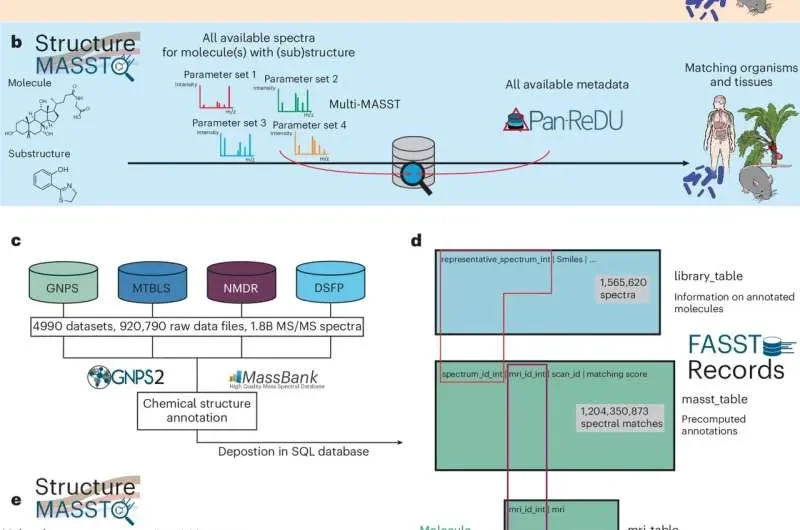
Read More: New StructureMASST tool helps find molecules in samples
Sources Used:
Associated Press: Four new astronauts arrive at the International Space Station to replace NASA's evacuated crew. Published 1 day ago. https://apnews.com/article/nasa-spacex-docking-astronauts-3bbcd406388a80468bb85d9c3e300ea2
The Guardian: Four new astronauts arrive via SpaceX rocket at International Space Station. Published 1 day ago. https://www.theguardian.com/science/2026/feb/14/international-space-station-full-crew
BBC News: Astronauts in awe at 'utterly unique, fragile' Earth as they blast off to ISS. Published 3 days ago. https://www.bbc.co.uk/news/live/c5yjrz5rlejt
Fox News: Astronauts arrive at ISS for 8-month mission after medical emergency forced early evacuation. Published 1 day ago. https://www.foxnews.com/science/astronauts-arrive-iss-8-month-mission-medical-emergency-forced-early-evacuation?msockid=0162e186db896c0923d8f684daad6db7
Spokesman: 4 astronauts arrive at ISS after prior crew's early return. Published 2 days ago. https://spokesman.com/stories/2026/feb/14/4-astronauts-arrive-at-iss-after-prior-crews-early/
CNN: SpaceX, NASA mission arrives at ISS, relieving bare-bones astronaut crew. Published 3 days ago. https://www.cnn.com/2026/02/13/science/spacex-crew-12-launch-nasa