China's semiconductor industry is navigating a complex landscape, striving for self-sufficiency in the face of international trade friction and technological hurdles. While significant progress has been made, particularly in certain equipment manufacturing segments, the nation still encounters challenges in achieving full independence, especially concerning advanced artificial intelligence (AI) chips and the sophisticated tools required for their production. This ongoing effort involves substantial investment, policy directives, and a keen awareness of global market dynamics.

Global Pressures and Domestic Response
Recent years have seen increased international scrutiny and actions targeting China's technological advancements, notably in the semiconductor sector. These efforts have included trade restrictions and export controls aimed at limiting China's access to advanced chipmaking technology.

U.S. Trade Measures: Actions such as imposing sales taxes on specific semiconductor hardware sold to China and restrictions on the shipment of advanced equipment have been observed.
Chinese Market Adjustments: In response, companies and markets within China are adapting. For instance, there have been reports of Beijing freezing purchases of certain high-end graphics processing units (GPUs) and companies reconsidering their reliance on specific foreign hardware for major AI model training.
Strategic Realignment: The broader geopolitical climate appears to be pushing China toward a more security-driven model of self-reliance, while still seeking opportunities for global integration where feasible.
Progress in Key Manufacturing Segments
Despite challenges, China has demonstrated considerable growth in specific areas of its semiconductor supply chain.

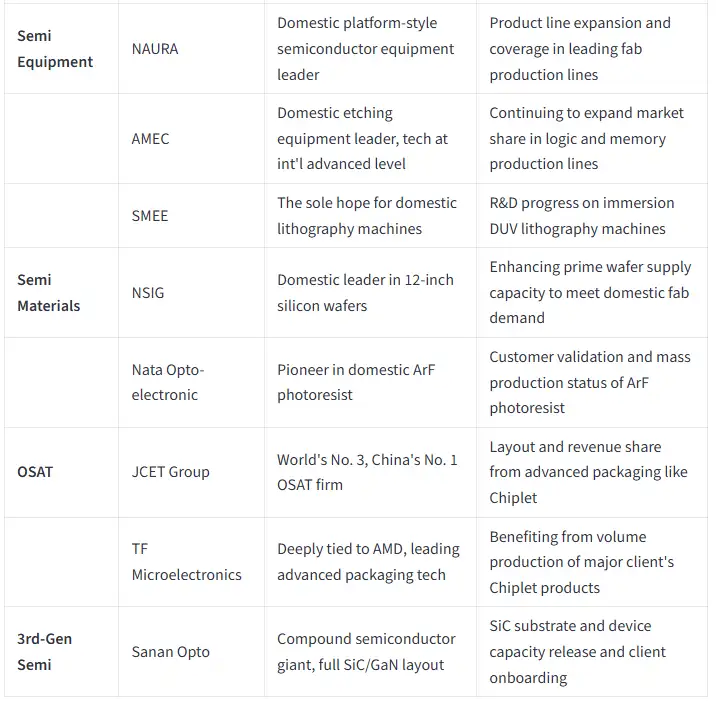
Equipment Manufacturing: China has established a notable advantage in the production of etching and deposition machines. Companies like AMEC (中微公司) are reportedly entering validation phases on world-leading 5-nanometer (nm) production lines, indicating a competitive global standing in this domain.
Supply Chain Development: The nation has made strides in building a comprehensive chip supply chain, encompassing design software, wafer manufacturing, packaging, testing, and materials.
Market Share Expansion: Reports suggest China has become a major player in global chip manufacturing capacity, potentially holding a substantial portion of the world's production. This expansion is accompanied by intense internal competition, which some suggest is leading to lower prices and improved quality.
Persistent Bottlenecks in Advanced Chip Production
The ambition for complete self-sufficiency in the semiconductor industry, particularly for cutting-edge AI chips, faces significant obstacles.
Read More: Chrome mimeHandler API lets extensions handle file types

Advanced Process Nodes: Manufacturing high-end AI chips requires access to sophisticated equipment for advanced process nodes. China's efforts in this area are reportedly years behind leading processors developed elsewhere.
Chipmaking Tools: The ability to produce these advanced chips is directly tied to the availability of specialized chipmaking tools. While China is investing heavily and attempting to develop its own capabilities, it remains behind global leaders in sophisticated machinery, such as advanced deep ultraviolet (DUV) machines, with resolutions below 10nm. Restrictions on the sale of the most advanced equipment, like EUV machines, by global suppliers have further complicated these efforts.
AI Hardware Dependence: The performance of China's AI sector appears to be contingent on hardware that is not yet fully produced domestically. This creates a dependence on foreign suppliers for the most advanced AI computing capabilities.
Economic and Strategic Considerations
The drive for semiconductor self-sufficiency is interwoven with China's broader economic strategy and its global market positioning.
Capital Investment: Government mandates and capital flow are key drivers in China's industrial development, including the chip sector.
Global Market Integration vs. Self-Reliance: The industry faces a strategic tension between pursuing global integration and pivoting towards security-driven self-reliance. This balance is influenced by international relations and technological access.
Economic Factors: Local government support for ambitious self-reliance goals can be impacted by national economic conditions, such as slowdowns, making sustained investment a complex undertaking.
Market Expansion: Facing restrictions from one bloc, China has reportedly sought to broaden its market reach in other regions.
Expert Observations
Insights from industry observers highlight the multifaceted nature of China's chip industry development.
"Chinese people work hard — and work smart." - An unnamed source, as reported by NPR.
"Overall, the friction with the United States over technology is a good thing for China's chip industry." - An unnamed source, as reported by NPR.
"The hardware that can be made in China is years behind the processors developed on U.S. soil." - Tom's Hardware analysis.
"China’s chip manufacturing capabilities are unmatched globally." - The China Academy analysis.
"Despite no official announcement from the Chinese government or state media, the reality is that China has become the world’s largest chip manufacturer, holding half of the global chip production capacity." - The China Academy analysis.
Conclusion
China's pursuit of semiconductor self-sufficiency is a dynamic and ongoing process marked by both significant achievements and substantial challenges. While the nation has fortified its position in critical segments of the manufacturing supply chain, particularly in certain types of equipment, it continues to confront limitations in producing the most advanced chips, especially those crucial for AI development. International trade restrictions and access to sophisticated manufacturing tools remain key variables influencing the pace and ultimate success of this ambitious endeavor. The industry's trajectory will likely continue to be shaped by the interplay between domestic innovation, strategic investment, global economic conditions, and evolving geopolitical relationships.
Read More: China Ethnic Unity Law starts July 1 2026 for all citizens
Sources Used:
chinabizinsider.com: China's Chip Battle: Path to Self-Sufficiency (Published: Aug 18, 2025)🔗 https://chinabizinsider.com/chinas-chip-breakthrough-battle-an-in-depth-look-at-the-semiconductor-industrys-push-for-self-sufficiency-in-2025/
npr.org: In the shadow of U.S. export controls, China rallies its own chip industry (Published: Dec 19, 2025)🔗 https://www.npr.org/2025/12/19/nx-s1-5637428/china-chip-industry-trade-restrictions
tomshardware.com: Fragmented ecosystems and limited supply: Why China cannot break free from Nvidia hardware for AI (Published: Aug 18, 2025)🔗 https://www.tomshardware.com/tech-industry/artificial-intelligence/fragmented-ecosystems-and-limited-supply-why-china-cannot-break-free-from-nvidia-hardware-for-ai
mronline.org: How China built its chip empire (Published: Dec 5, 2025)🔗 https://mronline.org/2025/12/09/164032/
thechinaacademy.org: China's Chip Boom: How It Became the World's Largest Semiconductor Manufacturer (Published: Dec 12, 2024)🔗 https://thechinaacademy.org/the-chip-war-is-nearing-its-end-as-china-chips-in/
cnbc.com: China's ambitions for semiconductor self-sufficiency thwarted by lack of chipmaking tools (Published: Sep 27, 2024)🔗 https://www.cnbc.com/2024/09/27/chinas-ambitions-for-chip-self-sufficiency-thwarted-by-lack-of-tools-.html
economicsobservatory.com: What’s happening in China’s semiconductor industry? (Published: May 28, 2025)🔗 https://www.economicsobservatory.com/whats-happening-in-chinas-semiconductor-industry
federalreserve.gov: Developments in Chinese Chipmaking (Published: Jan 17, 2025)🔗 https://www.federalreserve.gov/econres/notes/feds-notes/developments-in-chinese-chipmaking-20250117.html