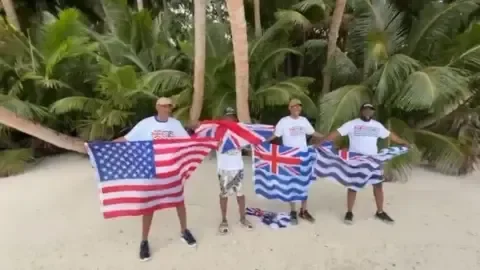
A group of Chagossian individuals has landed on an atoll in the Chagos Archipelago, aiming to establish a permanent settlement. This action comes as the United Kingdom and Mauritius finalize an agreement to transfer sovereignty of the islands, a move that has raised concerns among displaced islanders who fear it jeopardizes their right to return home. The resettlement attempt appears intended to influence the ongoing political and territorial arrangements concerning the archipelago.
The Chagos Archipelago, a strategically important territory in the Indian Ocean, has been a point of contention for decades. Historically inhabited by the Chagossian people, the islands were the site of forced removals in the mid-20th century to make way for a joint U.S.-UK military base on Diego Garcia, the largest island. Following years of legal and political battles, the UK agreed to transfer sovereignty to Mauritius, while retaining a lease on the Diego Garcia base. However, this deal has been met with strong opposition from many Chagossians, who see it as a failure to address their historical grievances and their aspirations to return to their homeland.
Read More: Taiwan Holds Nantou County Drills to Prepare for State Collapse
The core issue revolves around the future governance of the Chagos Islands and the rights of the Chagossian people.
Concerns have been raised by international bodies regarding the potential perpetuation of historical rights violations.
The current resettlement action directly challenges the recently agreed-upon transfer of sovereignty.
Evidence of Resettlement Efforts and Official Response
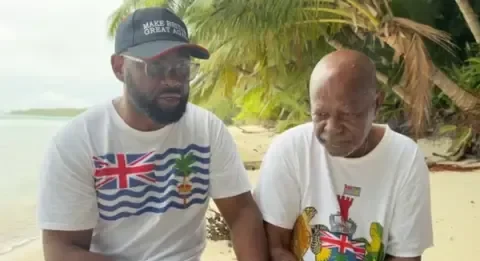
On Monday, February 17th, 2026, four individuals, identifying as Chagos islanders, arrived on the remote Ile du Coin atoll. They have stated their intention to create a lasting settlement.
Misley Mandarin, a leader of this group, reported that they are currently living in tents.
He also indicated expectations of further arrivals, with approximately ten more individuals anticipated the following week and a larger number in the coming year.
Mandarin's father, Michel Mandarin, who was forcibly removed from the islands at the age of 14, is reportedly among the group.
In response to these landings, authorities have taken action.

A British patrol vessel encountered the individuals on the atoll.
Officials reportedly encountered difficulties reaching the shore and used a borrowed dinghy to serve the group with eviction papers.
These papers warned of potential fines or imprisonment if the islanders do not depart.
Chagossian Perspectives on the UK-Mauritius Deal
The agreement to transfer sovereignty of the Chagos Islands from the UK to Mauritius has generated a spectrum of reactions among the Chagossian diaspora. While some may accept the new arrangements, a significant segment expresses deep dissatisfaction.
Bernadette Dugasse, who was removed from her birthplace as a child and only returned as an elder, articulated a strong rejection of affiliation with Mauritius. Her experience highlights the profound emotional and ancestral ties Chagossians have to their homeland, even facing restrictions on collecting natural items like seashells.
Many Chagossians view the deal as a betrayal of their long-standing struggle for repatriation.
They hold onto the hope that the UK might retain sovereignty, preserving a pathway for their eventual return.
International Scrutiny and Calls for Suspension
The UK-Mauritius agreement has attracted the attention of international bodies concerned with human rights and the treatment of displaced populations.

The United Nations Committee on the Elimination of Racial Discrimination has formally urged both Britain and Mauritius to halt the ratification of the agreement.
Their concern stems from the risk that the deal could continue historical injustices against the Chagossian people.
Similarly, UN experts have called on UK Prime Minister Sir Keir Starmer to suspend the deal.
These experts have criticized the perceived lack of meaningful consultation with the Chagossian people prior to the agreement's finalization.
They have advocated for a new agreement that unequivocally guarantees the rights of Chagossians to return to all islands within the archipelago, including Diego Garcia.
Political figures, such as Conservative shadow foreign secretary Dame Priti Patel, have also publicly urged the government to reconsider and halt the deal.
Underlying Tensions and Historical Context
The current events are rooted in a complex history of territorial claims and the displacement of an indigenous population.
The Chagos Archipelago was declared a British Indian Ocean Territory in 1965.
Shortly thereafter, the inhabitants were forcibly removed to establish a U.S. military base on Diego Garcia.
The legality of the UK's separation of the islands from Mauritius before granting Mauritius independence has been a subject of international dispute.
The International Court of Justice issued an advisory opinion in 2019, stating that the UK's detachment of the archipelago was unlawful.
The recent agreement allows the UK to maintain control over the Diego Garcia military base through a 99-year lease under the new sovereignty arrangement.
Analysis of Competing Interests
The situation presents a clear conflict between governmental diplomatic agreements and the asserted rights and aspirations of a displaced population.
Read More: Man Dies After Setting Fire Outside UN in Protest
British and Mauritian Government Position
The UK government argues that the deal with Mauritius represents a fair resolution to a long-standing dispute.
Provisions within the agreement that prevent development on the rest of the archipelago without UK consent are framed as a measure to preclude foreign military installations.
The Mauritian government, through the agreement, regains sovereignty over territory it considers historically its own.
Chagossian Islanders' Demands
The resettlement attempt signifies a direct challenge to the authority of the UK and Mauritius over the islands.
Chagossian groups are seeking the unfettered right to return to their ancestral lands, including Diego Garcia.
Their actions aim to disrupt the implementation of the deal and draw renewed international attention to their cause.
Conclusion and Implications
The landing of Chagossian islanders on Ile du Coin and their stated intention to form a permanent settlement underscore the deep divisions and unresolved issues surrounding the Chagos Archipelago.
The actions represent a direct defiance of an official removal order and highlight the determination of some Chagossians to assert their claim to their homeland.
The situation complicates the diplomatic efforts between the UK and Mauritius, potentially triggering further international pressure.
The response of the British and Mauritian authorities to this ongoing resettlement attempt will be critical in shaping the immediate future of the archipelago.
The unresolved question of the Chagossians' right to return remains a central point of contention, with international bodies expressing grave concerns.
Sources
BBC News: "Chagossians trying to resettle on islands defy removal order" (Published: 17 hours ago). https://www.bbc.com/news/articles/ce8w2jknnk0o
US News: "Four Islanders Land on Remote Chagos Atoll, Hope to Block UK–Mauritius Deal" (Published: 1 day ago, referencing Feb 17, 2026). https://usnews.com/news/world/articles/2026-02-17/four-islanders-land-on-remote-chagos-atoll-hope-to-block-uk-mauritius-deal
AP News: "Displaced Chagos islanders fear they will never go home after a UK-Mauritius deal" (Seen on Bing). https://apnews.com/article/chagos-britain-mauritius-chagossians-97e1acb6d1accbb0fb65d08357595e08
LBC: "UN calls on Starmer to suspend Chagos Islands deal over concerns that expelled Chagossians won’t be able to return" (Published: Jun 10, 2025). https://www.lbc.co.uk/article/un-starmer-suspend-chagos-deal-rpX9N2/