London, UK – April 24, 2026 – Global stock markets are teetering on the edge of a significant downturn, with the Bank of England's deputy governor identifying a dangerous disconnect between elevated asset prices and the multitude of risks confronting the world economy. Simultaneously, former US President Donald Trump has issued a direct threat to the United Kingdom, vowing to impose substantial tariffs if the UK government does not abandon its digital services tax (DST), a levy perceived by Washington as unfairly targeting American tech giants.
The core of the financial unease lies in what Bank of England Deputy Governor Sarah Breeden described as an environment where "asset prices are at all-time highs" despite "a lot of risk out there." This sentiment was echoed by other central bank officials who pointed to a disconnect between market valuations and the underlying economic realities. The potential fallout from such an overcorrection could extend beyond mere financial losses, impacting consumer confidence and potentially leading to reduced corporate investment and hiring. Breeden emphasized that her role is not to predict the timing or magnitude of market shifts but to ensure the financial system's resilience.
Read More: Solaris Energy SEI Stock Price Forecast Reaches $91.98 by July 2027

Trump Escalates Trade Tensions Over Digital Tax
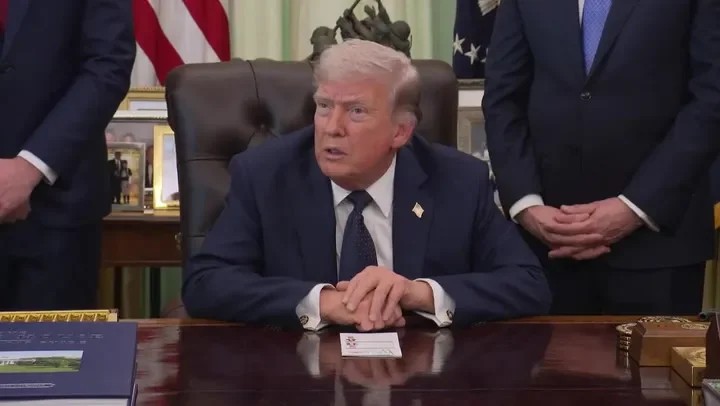
The specter of retaliatory tariffs from the United States hangs over the UK as Donald Trump has reiterated his demand for the abandonment of the Digital Services Tax. Trump has explicitly stated he will "put a big tariff on the UK" if Prime Minister Keir Starmer does not scrap the tax, which he views as a targeted imposition on "our great American companies" like Apple, Google, and Meta. This stance underscores a recurring tension in UK-US trade relations, with the DST being a point of contention for months. The tax, a 2% levy on the revenues of large digital platforms operating in the UK, generates approximately £800 million annually.
The dispute has particular resonance ahead of an upcoming state visit by the US President to the UK, during which the Starmer government had hoped to foster a broader technology partnership. However, public opinion in the UK appears to broadly support the enforcement of the DST, limiting the government's maneuverability. This dynamic suggests a continued willingness from the US to leverage tariff threats in trade disputes, complicating bilateral negotiations and introducing uncertainty into prospective digital trade agreements.
Read More: Australia-US Trade Dispute: New Tariffs Cause Friction
Background to the Digital Services Tax Dispute
The UK's Digital Services Tax, introduced as a temporary measure during ongoing international discussions on global tax reform, applies to companies with UK revenues exceeding £25 million or global revenues above £500 million. While the UK government cites data indicating that a significant portion of liable companies are not US-headquartered, US officials maintain the tax disproportionately impacts American tech firms.
This is not the first instance of such a confrontation. Trump previously initiated an investigation into digital services taxes across several countries in February 2025. The DST was a point of discussion during trade deal negotiations between the UK and US in May 2025, with both sides agreeing to pursue a separate digital trade accord. The current friction also arrives against a backdrop of strained UK-US relations, particularly following Sir Keir Starmer's decision to rule out British involvement in a recent conflict in the Middle East. Some reports also indicate a prior Supreme Court ruling in February 2025 that had struck down Trump's broader tariff agenda, adding another layer of complexity to the current trade posture.
Read More: Rocket Companies brand update in April 2026 changes logos and names