Recent developments have brought to light previously misplaced fossils of ancient amphibians, offering fresh insights into the lives of creatures that roamed the Earth as the Age of Dinosaurs began. These discoveries are reshaping our understanding of how early land animals adapted to marine environments and how widely they were distributed across the globe.
Forgotten Finds Resurface, Revealing Ancient Lives
Fossils of a prehistoric amphibian, now known as Erythrobatrachus, were first found in Australia decades ago. Expeditions in the 1960s and 1970s unearthed these ancient remains. However, for roughly 50 years, the original fossils went missing, only to be rediscovered recently. This rediscovery allows scientists to re-examine these creatures, which are being sent back to Australia. Meanwhile, other ancient amphibian fossils from the same era are already available for the public to view at the Swedish Museum of Natural History. The renewed study of these fossils, collected over 60 years ago, is providing new understanding of how land-dwelling animals first began to adapt to life in the sea during the early Age of Dinosaurs.
Read More: New 43-Foot Mosasaur Found in Ancient Oceans
'Sea-Salamanders' and Their Global Journey
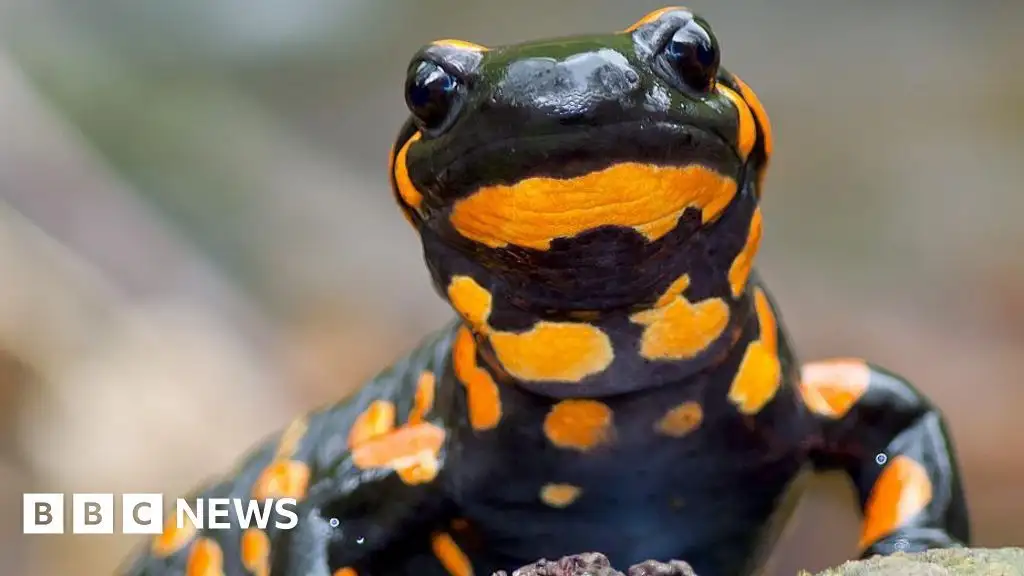
The reappearance of the Erythrobatrachus fossils has led to a significant conclusion: what was once thought to be one species is now understood to be two. This finding adds depth to our knowledge of these strange amphibians, called temnospondyls. These creatures, which lived during the Age of Dinosaurs, are described as looking like a mix between a salamander and a crocodile. They were prominent predators, feeding on fish and other small animals. Other well-known temnospondyls include Eryops and Koolasuchus.
One of the rediscovered Erythrobatrachus fossils is distinct enough to keep the original name, while the other represents a new species. This suggests a wider presence and variety of these "sea-salamanders" than previously understood.
Read More: Hunter Region Gets $12 Billion Train Factory
A 'Sand Creeper' Emerges from a Wall
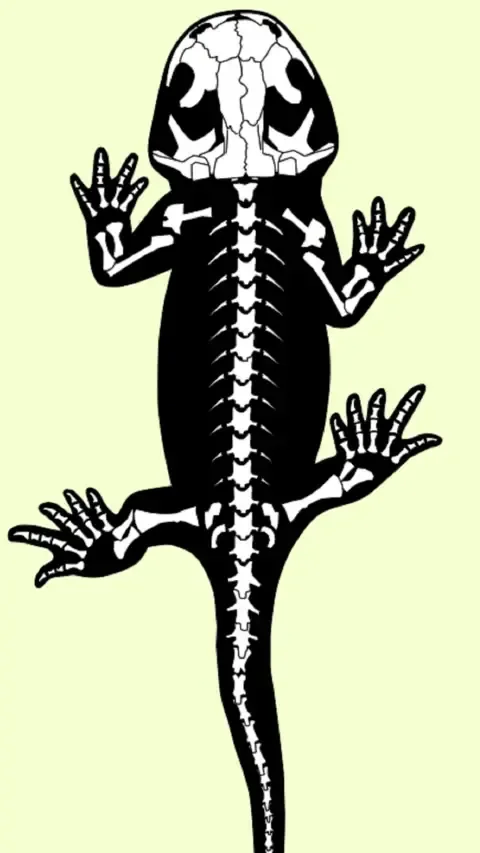
In a separate, yet equally remarkable find, the fossil of an ancient amphibian named Arenaerpeton supinatus has been identified. This creature, meaning 'supine sand creeper', was discovered by a retired chicken farmer in New South Wales. The fossil was found embedded within what appeared to be a normal wall.
Remarkably, the fossil is nearly complete, showing the entire skeleton and even the outlines of the creature's skin. Its discovery has added important details to the fossil record of Australia during a period often lacking clear information.
Physical Description: Arenaerpeton is estimated to have been about 1.2 meters (around 4 feet) long from head to tail. It possessed formidable teeth, including a pair of tusk-like ones on the roof of its mouth.
Ecological Role: It likely hunted ancient fish, such as Cleithrolepis. Evidence regarding other animals it shared its environment with is limited.
Classification: Arenaerpeton belongs to a group called chigutisaurids, a branch of the diverse temnospondyls. This places it among early amphibian-like tetrapods that thrived before and during the age of dinosaurs.
Global Distribution and Evolutionary Paths
The study of Erythrobatrachus and Arenaerpeton highlights the global spread of temnospondyls. These amphibians occupied diverse niches across different continents as the Age of Dinosaurs dawned.
Erythrobatrachus: The rediscovery of these fossils suggests that by the start of the Age of Dinosaurs, temnospondyls were already adapting to marine life and spreading globally. This period was critical for the evolution of land animals.
Arenaerpeton: Its placement within the chigutisaurid family, and its existence in Australia, helps fill gaps in the geographical and temporal understanding of these amphibians. Researchers note that while Arenaerpeton shares some similarities with other temnospondyls found in the same areas, its specific lineage followed its own evolutionary path long before modern salamanders existed.
Expert Perspectives on the Significance
Paleontologists involved in these discoveries emphasize their importance for understanding ancient life.

"Fossils recovered from this region over 60 years ago, and almost forgotten in museum collections, have now shed new light on the earliest global radiations of land-living animals adapting to life in the sea." – Scimex Article 1
Dr. Matthew McCurry, a Senior Lecturer at UNSW and Curator of Palaeontology at the Australian Museum, stated that the Arenaerpeton supinatus fossil is a significant find for Australian paleontology. He noted that the evolution of increased size in some temnospondyls might have aided their survival through mass extinction events.
Read More: New Giant Dinosaur Nagatitan Found in Thailand Forests
Lachlan Hart, a paleontologist who has worked on Arenaerpeton, mentioned that while this creature was large compared to its close relatives at the time, its survival might have been aided by adaptations like burrowing.
Conclusion: A Window into an Ancient World
The rediscovery and ongoing study of fossils like Erythrobatrachus and Arenaerpeton supinatus are crucial. They are helping scientists to:
Map Global Distribution: Understand how ancient amphibians like temnospondyls spread across continents.
Trace Evolutionary Adaptations: Detail how early land animals began to adapt to life in aquatic and marine environments.
Fill Fossil Record Gaps: Provide concrete evidence from periods and locations where such data has been scarce.
The Erythrobatrachus fossils are currently being repatriated to Australia. The Arenaerpeton supinatus fossil, after being identified, is expected to go on display at the Australian Museum. These efforts continue to bring to light the complex history of life on Earth, just as the age of dinosaurs was dawning.
Read More: Australia Under-16 Social Media Ban Delayed for 8 Weeks by Senate
Sources:
Scimex: https://www.scimex.org/newsfeed/rediscovery-of-ancient-australian-sea-salamanders-from-the-beginning-of-the-age-of-dinosaurs - Article focuses on the rediscovery of Erythrobatrachus fossils and their significance for understanding early marine adaptations.
The Conversation: https://theconversation.com/250-million-year-old-amphibian-fossils-from-australia-reveal-global-spread-of-sea-salamanders - Details the two species identified within the Erythrobatrachus fossils and discusses the global spread of temnospondyls.
UNSW Newsroom: https://www.unsw.edu.au/newsroom/news/2023/08/scientists-name-new-species-of-giant-amphibian-found-in-retainin - Announces the naming of Arenaerpeton supinatus, highlighting its preservation and size.
Earth.com: https://www.earth.com/news/arenaerpeton-fossil-chinese-giant-salamander-found-inside-normal-wall-of-home/ - Discusses Arenaerpeton's classification within chigutisaurids and its role in filling geographical and temporal gaps.
SMH (The Sydney Morning Herald): https://www.smh.com.au/national/nsw/scientists-finally-identify-chicken-farmer-s-240-million-year-old-fossil-20230807-p5duik.html - Covers the identification of the fossil found by a chicken farmer and its journey to the Australian Museum.