Agnikul Cosmos, a private Indian space firm, has conducted a significant test involving the simultaneous firing of three of its semi-cryogenic rocket engines. This event represents a notable advancement in the company's development of propulsion systems for its upcoming orbital launch vehicle, Agnibaan. The successful test demonstrates progress towards Agnikul's goal of providing rapid and cost-effective access to space for small satellites, a capability crucial for the expanding global space economy.

Background and Timeline of Agnikul's Engine Development
Agnikul Cosmos has been systematically developing and testing its rocket engines, with a particular focus on 3D-printed, semi-cryogenic technology. Key milestones in this progression include:

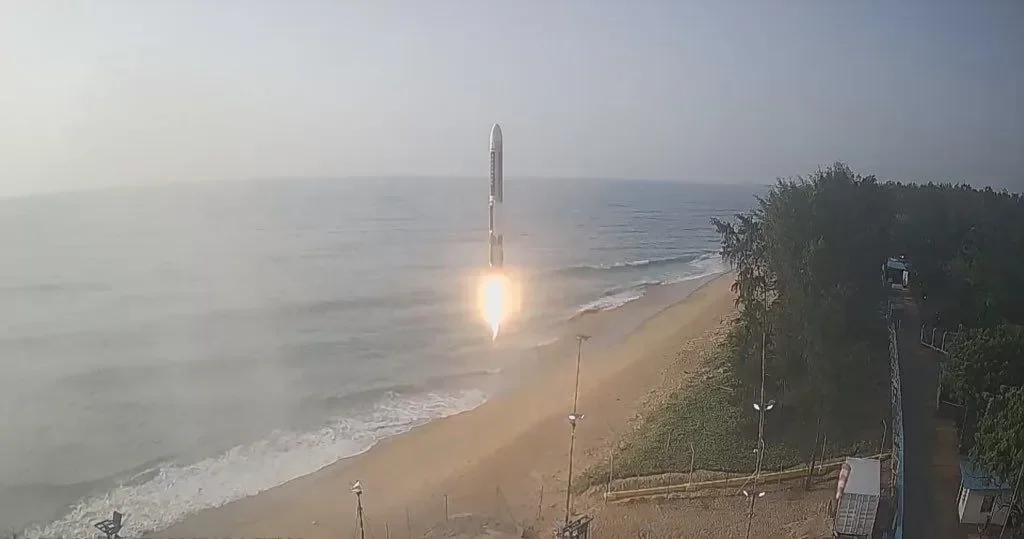
May 2024: Agnikul conducted the first sub-orbital test flight of its Agnibaan rocket, utilizing 3D-printed engines. This mission, Agnibaan SOrTeD-01, was launched from the company's private launchpad at Sriharikota. Reports describe this as a controlled vertical ascent. (Article 4, 5, 8, 9, 11, 12, 17)
August 2024: Agnikul opened its facility dedicated to manufacturing 3D-printed rocket engines, with plans to produce multiple engines per week. The company produces two main engine types: Agnilet and Agnite. The Agnite engine, for example, is developed as a single piece through 3D printing. (Article 13)
May 23, 2025: The company successfully test-fired a single semi-cryogenic engine powered by an electric motor, a crucial step toward firing multiple engines together. This engine uses liquid oxygen and refined kerosene as propellants. (Article 6, 7)
October 23, 2025: Agnikul successfully tested a dual-engine cluster. This test showcased the ability to precisely adjust thrust between engines using in-house developed software, contributing to smoother performance and enhanced reliability in multi-engine setups. The engines were described as being fully 3D-printed as a single piece, using proprietary Agnilet technology. (Article 2, 3, 8)
Late October 2025: Reports indicated a simultaneous test of three semi-cryogenic engines. This latest test further refines the engine control and thrust management capabilities. (Article 1)
December 19 & 22, 2025: Agnikul successfully fired dual indigenous 3D-printed rocket engines. Videos demonstrated these electric motor-driven, pump-fed, single-piece engines achieving thermal steady state and maintaining uniform performance for 49 seconds. This validates engine reliability for flight. (Article 10, 15)
September 10, 2025: Agnikul's Inconel engine, claimed to be the world's largest single-piece 3D-printed engine, was highlighted. This engine is described as longer, more complex, and massive than earlier upper-stage engines, extending Agnikul's prior accomplishments. The company also holds a US patent for its single-piece engine design and manufacturing. (Article 14)
Technological Advancements in Agnikul's Engines
Agnikul's engine development is characterized by several key technological innovations:
3D Printing and Single-Piece Design: A core element of Agnikul's approach is the use of additive manufacturing (3D printing) to create engines as single, integrated components. This method, exemplified by the Agnilet and Agnite engines, eliminates the need for multiple assembled parts, reducing potential leak points, simplifying manufacturing, and shortening production times. (Article 3, 13, 14)
Semi-Cryogenic Propulsion: The engines utilize a semi-cryogenic system, combining a cryogenic oxidizer (liquid oxygen) with a non-cryogenic fuel (refined kerosene). This offers advantages in terms of propellant storage and handling compared to fully cryogenic systems, while still providing high performance. (Article 7, 11)
Electric Motor-Driven Pumps: Unlike traditional engines that rely on gas generators or turbopumps, Agnikul's engines use an electric motor to power the pumps circulating propellants. This system, along with in-house developed control software and motor drives, allows for precise thrust management. (Article 6, 7, 10, 15)
Software-Based Thrust Control: The ability to precisely control thrust balance between multiple engines through software is a critical advancement. This feature enhances the stability and reliability of the rocket, particularly in multi-engine configurations, and was demonstrated during the dual-engine test. (Article 1, 2)
Rapid Reusability: The simplified engine design, with fewer moving parts and no hot gas pipes or turbomachinery, is intended to facilitate rapid reusability of the launch vehicle's components. Agnikul is reportedly modifying its Agnibaan vehicle for a reusable booster. (Article 8)
Role of Agnikul in India's Space Sector
Agnikul Cosmos operates from India's first private launchpad and mission control center at Sriharikota. The company's progress is seen as a significant contribution to the growth of India's private space sector.
Read More: Mars Rover Concept Uses Curved Wheels to 'Swim' on Sand
Indigenous Capability: Agnikul's development of fully homegrown technology for advanced propulsion systems strengthens India's self-reliance in space launch capabilities. (Article 10, 15)
Enabling Small Satellite Launches: The company's focus on rapid, cost-effective launches is aimed at catering to the growing demand for small satellite deployment. (Article 3)
Industry Collaboration: Agnikul's work is supported by organizations like the Indian Space Research Organisation (ISRO) and the Indian National Space Promotion and Authorization Centre (IN-SPACe). ISRO has congratulated Agnikul on its milestones, recognizing the significance for the Indian space ecosystem and encouraging innovation. (Article 5, 12, 15)
Expert Commentary and Analysis
Pawan Goenka, Chairman of IN-SPACe, described the successful launch of the Agnibaan as "a historic moment for India's space sector" and a significant milestone for private players contributing to the nation's space growth. (Article 4)
ISRO Chairman S. Somanath has stated that Agnikul's achievements motivate ISRO to support space startups for innovation and Atmanirbharata (self-reliance), aiming to foster a vibrant space ecosystem in India. (Article 12)
Findings and Future Implications
The simultaneous test of three semi-cryogenic engines by Agnikul Cosmos marks a critical step towards the operational readiness of its Agnibaan orbital launch vehicle. The company's consistent progress in developing 3D-printed, semi-cryogenic engines with advanced control systems underscores its potential to become a key player in the small satellite launch market. This advancement not only highlights Agnikul's technological capabilities but also reinforces India's expanding presence and ambition in the global private space industry. The focus on single-piece engine design, electric motor integration, and software-based thrust management positions Agnikul at the forefront of innovative propulsion technologies.
Sources Used:
Agnikul Cosmos conducts India’s first semi-cryogenic rocket engine: https://raksha-anirveda.com/agnikul-cosmos-successfully-test-fires-semi-cryogenic-rocket-engines/
Agnikul successfully tests dual 3D-printed rocket engines for upcoming launch: https://www.newsbytesapp.com/news/science/agnikul-test-fires-india-s-first-semi-cryogenic-rocket-engines/story
Agnikul test fires 3D-printed rocket engine, preps for launch: https://www.indiatoday.in/science/story/agnikul-3d-printed-rocket-india-weaponry-indigenous-launch-2807100-2025-10-23
India launches nation's 1st 3D-printed rocket engine: https://www.space.com/india-agnikul-3d-printed-rocket-engine
Space startup Agnikul Cosmos flies world’s first 3D-printed rocket engine in fifth attempt: https://indianexpress.com/article/technology/science/agnikul-carries-out-successful-sub-orbital-launch-of-agnibaan-rocket-9360673/
Agnikul Cosmos successfully test fires engine to power Agnibaan rocket: https://www.indiatoday.in/science/story/agnikul-cosmos-successfully-test-fires-engine-to-power-agnibaan-rocket-2729543-2025-05-23
India tests first semi-cryogenic rocket engine powered by electric motor: https://www.newsbytesapp.com/news/science/agnikul-cosmos-successfully-fires-its-electric-motor-driven-semi-cryogenic-engine/story
Agnikul test-fires pair of semicryogenic engines: https://www.news9live.com/science/agnikul-test-fires-pair-of-semicryogenic-engines-2899212
India’s Agnikul Cosmos flies additively manufactured rocket engine: https://www.metal-am.com/indias-agnikul-cosmos-flies-additively-manufactured-rocket-engine/
Watch: India's Agnikul Cosmos fires indigenous 3D-printed rocket engine: https://www.indiatoday.in/science/story/watch-indias-agnikul-cosmos-fires-indigenous-3d-printed-rocket-engine-2838643-2025-12-19
IIT Madras based Startup Agnikul Cosmos Launched World’s First Rocket with single piece 3D-Printed Engine: https://visionias.in/current-affairs/news-today/2024-05-31/science-and-technology/iit-madras-based-startup-agnikul-cosmos-launched-worlds-first-rocket-with-single-piece-3d-printed-engine
India’s IIT Madras startup Agnikul Cosmos launches world’s 1st rocket with fully 3D: https://www.newsonair.gov.in/indias-iit-madras-startup-agnikul-cosmos-makes-history-with-the-worlds-first-3d-printed-engine-rocket-launch/
First Facility to Make 3D Printed Rocket Engines Opened by Agnikul Cosmos: https://raksha-anirveda.com/first-facility-to-make-3d-printed-rocket-engines-opened-by-agnikul-cosmos/
Application of the Month: World’s First Single-Piece 3D Printed Inconel Rocket Engine: https://www.3dnatives.com/en/application-of-the-month-worlds-first-single-piece-3d-printed-inconel-rocket-engine/
Agnikul successfully fires dual 3D printed rocket engines: https://www.voxelmatters.com/agnikul-successfully-fires-dual-3d-printed-rocket-engines/