The promise of Secure Digital Ultra Capacity (SDUC) memory cards reaching up to 128 terabytes (TB) has been on the horizon for years, with the standard first outlined in 2018. While the SD Association states these multi-terabyte cards are already in use in certain sectors, consumers seeking these massive storage solutions in everyday retail channels face significant scarcity. This creates a gap between the stated capabilities of the SDUC standard and its current tangible availability for the general public.

Timeline of SDUC Development and Announcements
The journey toward high-capacity SD cards began with the definition of the SDUC standard, which expands the maximum storage limit significantly beyond previous specifications.
June 2018: The SD Association (SDA) announces the SD 7.0 specification, introducing SD Express for faster speeds and SDUC for expanded capacity up to 128TB. The theoretical maximum transfer rate for SD Express is 985 megabytes per second (MB/s).
April 2020: The SDA's SD Express standard, initially offered on SDUC, SDXC, and SDHC cards, is discussed as a potential way to achieve 128TB capacity and 985MB/s transfer rates.
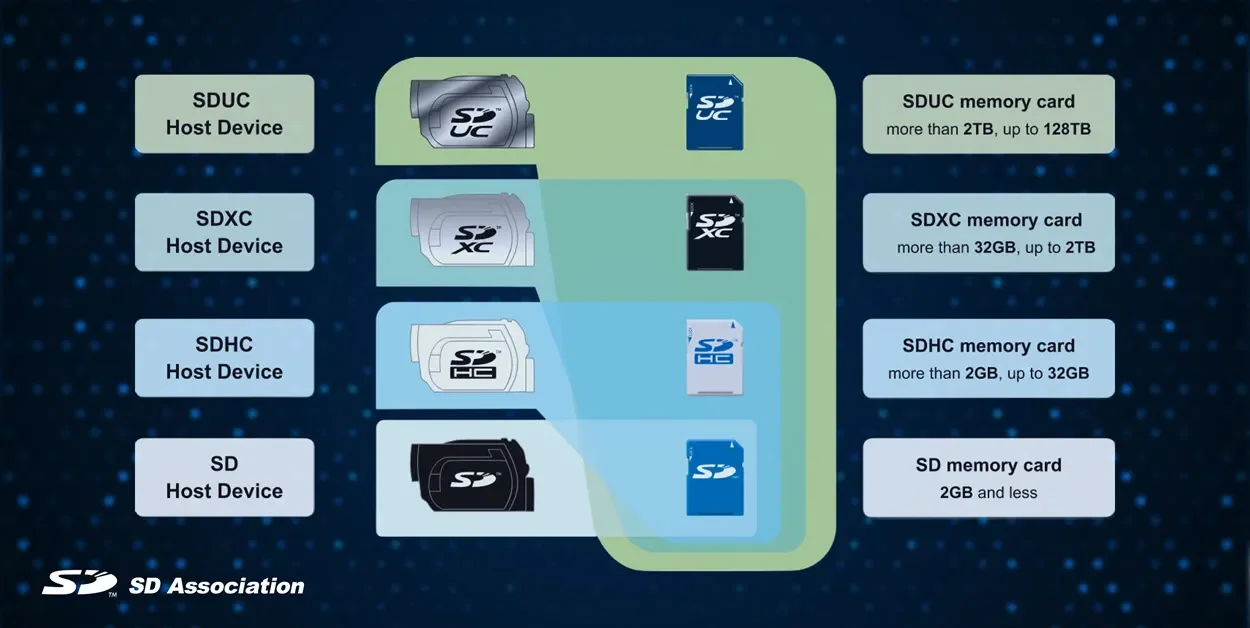
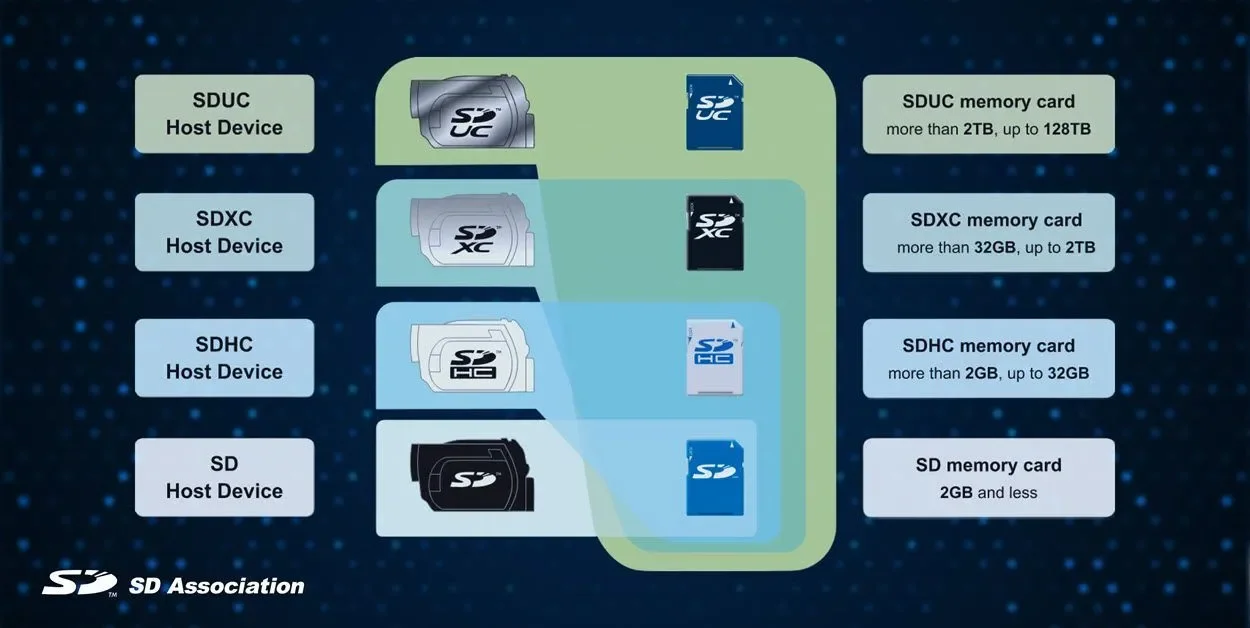
October 2023: The SDA officially outlines the capacity tiers: SD up to 2GB, SDHC up to 32GB, SDXC up to 2TB, and SDUC from over 2TB up to 128TB, all using the exFAT file system for capacities over 2TB.
April 2024: Western Digital showcases a 4TB SDUC SD card prototype.
September 2025: The SDA highlights the SDUC standard and its ability to overcome the 2TB limit of SDXC.
November 2024: A Linux kernel update (6.11) adds support for SDUC and UHS-II SD cards, noting that an 8TB SDUC card was announced following earlier 4TB SDUC card sightings.
The SDUC Standard: Technical Framework and Goals
The SDUC standard represents a significant expansion of the SD card's capabilities, primarily focused on increasing storage capacity and enhancing data transfer speeds.
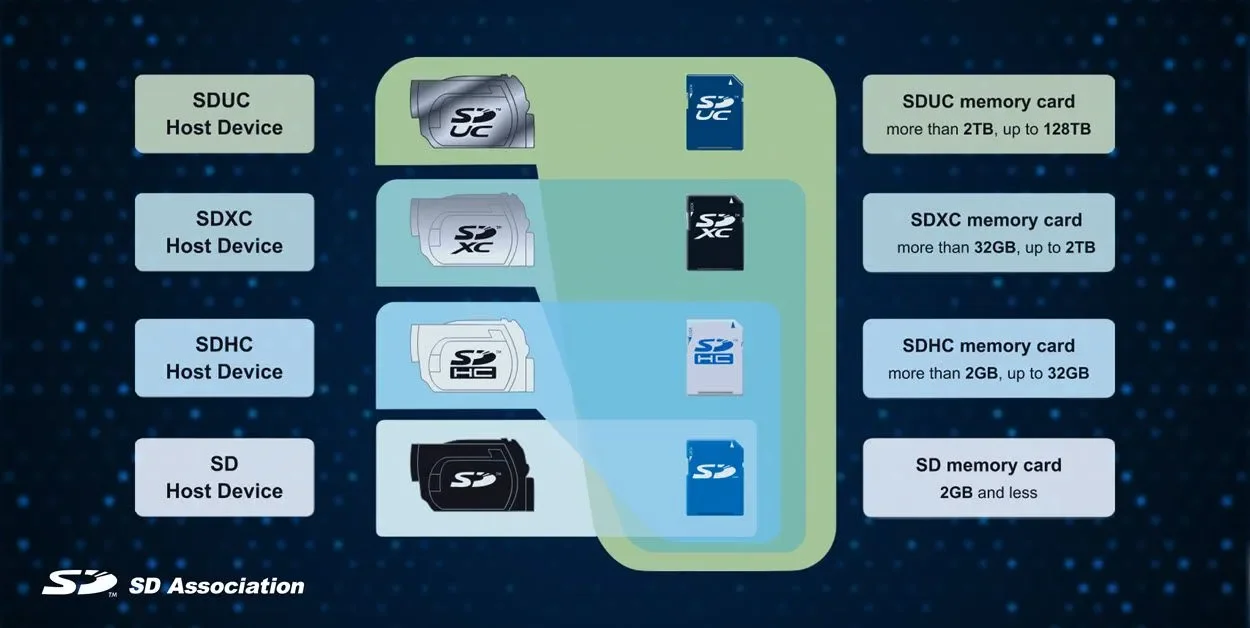
Capacity Expansion: SDUC moves the theoretical maximum storage capacity from 2TB (SDXC) to 128TB. This is achieved by extending the addressing capabilities within the standard.
File System: SDUC cards utilize the exFAT file system, which is also used by SDXC cards, allowing for larger file sizes and volumes.
SD Express Integration: The SDUC standard is closely linked with SD Express, which incorporates PCI Express (PCIe) and NVMe interfaces. This aims to bring SSD-like speeds to SD cards, with transfer rates potentially reaching 985 MB/s.
Backward Compatibility: Innovations in the SD 7.0 specification, including SDUC and SD Express, are designed to maintain backward compatibility with existing SD host devices. However, new drivers may be required for hosts to fully support SDUC, particularly for the extended address bits and command sequences.
Reported Availability vs. Consumer Access
While the SD Association states that multi-terabyte SDUC cards are "already shipping," pinpointing their widespread availability for the average consumer proves difficult.
Read More: Chrome mimeHandler API lets extensions handle file types

Official Statements: The SD Association asserts that multi-terabyte SDUC cards are shipping across various sectors.
Showcased Prototypes: Companies like SanDisk (Western Digital) have demonstrated 4TB SDUC cards and, more recently, an 8TB SDUC card has been announced.
Market Reality: Despite these announcements, these high-capacity cards remain largely absent from common retail listings. Even 2TB SD cards are relatively rare, suggesting a substantial gap between the SDUC specification and mass-market products.
Targeted Use Cases: The need for such large capacities is often linked to demanding applications like storing 8K video files, massive photo libraries, or professional video production. This implies that initial shipments might be directed towards specialized professional markets rather than general consumer electronics.
Technological Hurdles and Cost Considerations
The transition from theoretical capacity to commercially viable products involves overcoming significant technical and economic challenges.
Manufacturing Complexity: Producing memory chips with such high densities is complex. The "engineering wall" may relate to the difficulties in creating reliable and affordable NAND flash memory at the 128TB scale within the physical constraints of an SD card.
Cost-Prohibitive Nature: The cost of manufacturing SD cards with massive storage capacities is acknowledged as a barrier. Reports suggest that a 128TB Express card would likely be extremely expensive, potentially costing more than a vehicle.
Compatibility and Drivers: For devices to utilize SDUC cards, their drivers must be updated to handle the new command sequences. Without proper driver support, SDUC cards may not initialize or function correctly.
Expert Insights and Observations
Analysis of the SDUC situation highlights the phased rollout of new technology and the economics of storage.
"The SD Association says multi-terabyte SDUC cards are already shipping, with the format starting at 2TB and scaling up to a theoretical 128TB. The SD Association insists that multi-terabyte SDUC cards are shipping already, although it doesn’t spell out where those products are actually appearing."
This quote from TechRadar points to a discrepancy between official pronouncements and observable market presence.
"Given how slow the progress has been toward 2TB cards, there’s no telling how long it’ll take before manufacturers hit the higher figures that SDUC allows…"
This observation from The Verge in 2018 underscores the gradual pace of technological adoption and manufacturing advancements in achieving high-density storage.
Conclusion and Forward Outlook
The SDUC standard outlines a compelling future for removable storage, with a theoretical capacity of up to 128TB and speeds comparable to SSDs via SD Express. While the SD Association confirms that multi-terabyte SDUC cards are in circulation within certain sectors, these appear to be specialized or early-release products. The delay in widespread consumer availability suggests that significant manufacturing, cost, and potentially compatibility hurdles persist.
Read More: New GNStor System Uses GPUs for Faster Storage
Key Findings:
The SDUC standard, supporting up to 128TB, was announced in 2018.
Prototypes and announcements of 4TB and 8TB SDUC cards have occurred.
The SD Association states these cards are "shipping," but specific market locations are unspecified.
Consumer availability of high-capacity (even 2TB) SD cards remains limited.
Manufacturing costs and complexity are likely reasons for delayed mass adoption.
SD Express aims to provide significantly faster data transfer rates alongside higher capacities.
Implications: Consumers and professional users requiring massive portable storage will likely continue to rely on external SSDs or specialized storage solutions until the economics and manufacturing processes for 128TB SD cards mature and become broadly accessible. Further advancements in NAND flash technology and cost reduction in manufacturing are critical for the widespread realization of the SDUC standard's full potential.
Sources Used:
TechRadar: "Multi-terabyte SD cards are “shipping,” just not to you" (Published: ~1 week ago)🔗 https://www.techradar.com/pro/sduc-cards-in-multi-terabyte-capacities-are-already-shipping-but-where-are-these-removable-memory-cards-with-4tb-or-8tb-capacities-that-sandisk-launched-almost-two-years-ago
SD Association: "How to Prepare for the Future of Memory Technology with SDUC" (Published: October 31, 2024)🔗 https://www.sdcard.org/press/thoughtleadership/how-to-prepare-for-the-future-of-memory-technology-with-sduc/
The Verge: "SD cards could soon hold 128TB of storage" (Published: June 28, 2018)🔗 https://www.theverge.com/2018/6/28/17514660/sd-card-128tb-storage
SD Association: "Growing Demand, Growing Capacity: An introduction to the new SD Ultra Capacity function" (Published: September 8, 2025)🔗 https://www.sdcard.org/press/thoughtleadership/growing-demand-growing-capacity-an-introduction-to-the-new-sd-ultra-capacity-function/
Tom's Hardware: "Western Digital preps 4TB SD cards for 2025 — SDUC cards big enough to tackle 8K video" (Published: April 13, 2024)🔗 https://www.tomshardware.com/pc-components/microsd-cards/western-digital-preps-4tb-sd-cards-for-2025-sduc-cards-big-enough-to-tackle-8k-video
PetaPixel: "SDUC Express Memory Cards to Allow 128TB Storage and 985MB/s Speed" (Published: June 28, 2018)🔗 https://petapixel.com/2018/06/27/sduc-express-memory-cards-to-allow-128tb-storage-and-985-mb-s-speed/
Optocrypto: "SDUC: New SD card standard can have up to 128TB of storage capacity" (Published: December 23, 2023)🔗 https://optocrypto.com/sduc-new-sd-card-standard-can-have-up-to-128tb-of-storage-capacity/
Wetpixel: "SD Association announces 128TB SD cards" (Publication Date not explicitly stated, context implies 2018)🔗 https://wetpixel.com/articles/sd-association-announces-128tb-sd-cards
Inkl: "‘SDUC cards in multi-terabyte capacities are already shipping’: but where are these removable memory cards with 4TB or 8TB capacities that Sandisk launched almost two years ago?" (Published: ~1 week ago)🔗 https://www.inkl.com/news/sduc-cards-in-multi-terabyte-capacities-are-already-shipping-but-where-are-these-removable-memory-cards-with-4tb-or-8tb-capacities-that-sandisk-launched-almost-two-years-ago
Tom's Hardware: "Linux update adds support for 128 terabyte SD cards— SDUC and UHS-II SD cards are now supported" (Published: November 24, 2024)🔗 https://www.tomshardware.com/software/linux/linux-update-adds-support-for-128-terabyte-sd-cards-sduc-and-uhs-ii-sd-cards-are-now-supported
SD Association: "Capacity (SD/SDHC/SDXC/SDUC)" (Published: October 19, 2023)🔗 https://www.sdcard.org/developers/sd-standard-overview/capacity-sd-sdhc-sdxc-sduc/
MyMemory Blog: "SD Express Cards To Support Up To 128TB And 985MB/s" (Published: April 27, 2020)🔗 https://www.mymemory.co.uk/blog/sd-express-cards-to-support-up-to-128tb-and-985mb-s/
CNET: "New SD card UC, Express specifications tout 128TB max at up to almost 1GB per second" (Published: June 27, 2018)🔗 https://www.cnet.com/tech/mobile/new-sd-card-uc-express-specs-tout-128tb-max-up-to-almost-1gb-per-sec/