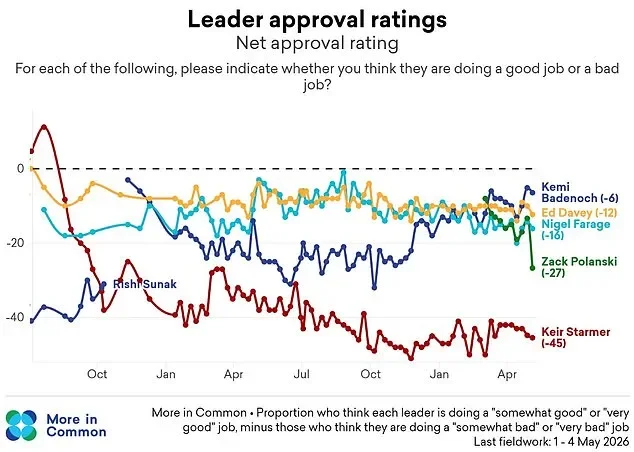
Green Party leader Zack Polanski, who is Jewish, is embroiled in a significant political storm, facing widespread criticism from across the political spectrum, including within his own party, concerning his rhetoric and actions related to the Israel-Palestine conflict. The controversy has intensified following a stabbing incident in Golders Green, north London, with Polanski facing accusations of conflating criticism of Israel with antisemitism, a move he has resisted. His personal ratings have seen a substantial drop of 14 points in the past week, reaching a net score of minus 27.

The core of the dispute centers on Polanski's public statements and social media activity, particularly his response to the Golders Green attack and his stance on pro-Palestine demonstrations. He retweeted a post critical of police actions during the arrest of a suspect in the stabbing, which he later described as being due to being "traumatised" by the footage. This drew sharp rebukes from political opponents, including Labour's Sir Keir Starmer, who deemed his comments "disgraceful" and "not fit to lead." Polanski has also faced scrutiny for his remarks on chants like "globalise the intifada," stating he would discourage their use but arguing against banning marches outright, citing freedom of speech concerns.
Read More: Bihar Cabinet Expansion May 7: Nishant Kumar Likely to Join

Internal Party Strife and External Pressure
The Green Party is grappling with internal dissent and external accusations of antisemitism. Several Green candidates have been flagged for alleged antisemitic posts, leading to arrests and demands for disciplinary action from figures like former Green leader Caroline Lucas. Lucas stated that "immediate action" was required against local election candidates who had made "unacceptable" statements. Polanski himself issued a "half-hearted apology" regarding the antisemitism issue, which has been met with skepticism.

Polanski's Position and Shifting Identity
Polanski, who has openly discussed his Jewish identity and pride in being the first gay, Jewish deputy leader in British history, has positioned himself as a defender against the conflation of anti-Israel sentiment with antisemitism. He has argued that criticism of Israel is increasingly and unfairly branded as antisemitic. However, his critics contend that he has not adequately addressed antisemitism within the party. Some sources suggest Polanski sees his stance as strengthening his support among certain segments of the Jewish community and pro-Palestine activists. His views on Israel have evolved, shifting from "liberal Zionist" to "non-Zionist" and then to an explicitly "anti-Zionist" position, reportedly signaling support for a motion defining the Green Party as anti-Zionist.
Read More: Arsenal Beats Bayern Munich in London, Ends Unbeaten Streak

Broader Political Context and Media Scrutiny
The controversy surrounding Polanski has drawn significant media attention, with some outlets accused of "smearing" him and the Green Party. Reports indicate a surge in articles critical of Polanski's stance on Israel and accusing the party of antisemitism, particularly in the lead-up to local elections. Politicians like Kemi Badenoch have labelled Polanski as being "in over his head" and "not serious." The Guardian notes that media coverage has, on average, published two articles a week attacking Polanski for his views, escalating to one per day recently.
Read More: Sarkozy Leaves Jail, Faces New Trial for Libyan Funding Case
Accusations of "Sectarian Tactics"
In a separate but related controversy, the Green Party faced accusations of employing "sectarian" campaign tactics in a by-election, including issuing leaflets in Urdu urging voters to "punish Labour for Gaza" and featuring a candidate on an "extremist" Muslim media channel. A Green spokesperson defended the inclusivity of the Urdu leaflets, stating that not all voters speak English as their first language.
Background: A Political Journey
Zack Polanski's political trajectory has seen him rise within the Green Party, eventually becoming its leader. His public pronouncements on the Israel-Palestine issue, coupled with his identity as a Jewish leader, have placed him at the center of a complex and highly charged debate within British politics. The recent controversies have highlighted deep divisions and the fraught nature of discussions surrounding the conflict and its impact on domestic political discourse.
Read More: London deploys 100 police officers to stop antisemitic hate crimes