The WNBA's arena entertainers, often relegated to the periphery of sports discourse, are slowly but surely carving out their own niche, defying simple categorization. While some teams boast a dedicated character, others appear to be in a perpetual state of mascot flux, leaving fans to ponder the efficacy and sheer vibes of these costumed figures. Recent observations suggest a trend towards mascots who are less about traditional athletic prowess and more about personality, fashion, and a certain je ne sais quoi.
Ellie the Elephant, the New York Liberty's iconic figure, has emerged as a standout, reportedly garnering unanimous praise from players as the league's best mascot. Her ability to dance, strut, and captivate an audience, as described by fans and media alike, positions her as more than just a furry costume; she’s a recognized presence in the league’s entertainment landscape. This elevated status, especially when compared to mascots whose descriptions verge on the bizarre – one source even dubbing a character "a Fraggle on HGH" – highlights a divergent spectrum of mascot creation and reception.
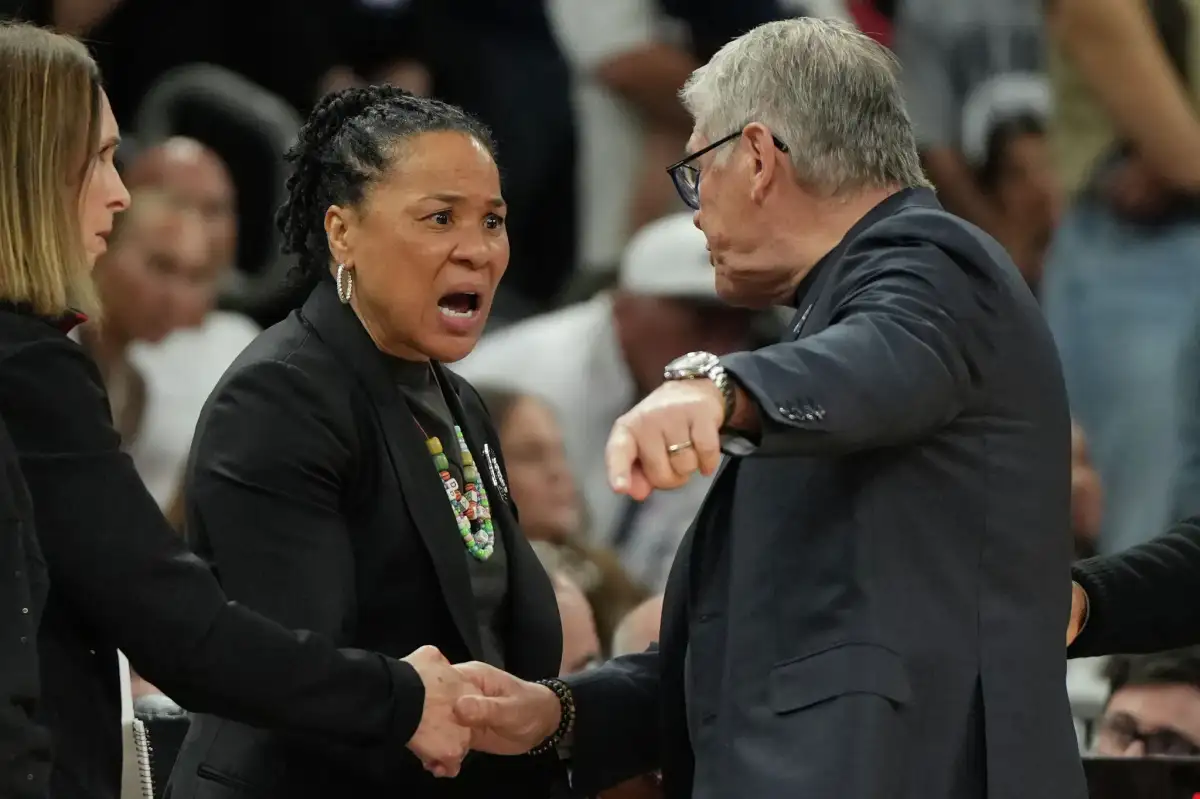
Read More: Geno Auriemma says 'dumb' after fight with Dawn Staley
Beyond the Sideline: Mascots as Cultural Signifiers
The discussion around WNBA mascots extends beyond mere entertainment value, touching on themes of identity and cultural resonance. Notably, some mascots are being interpreted through a lens of LGBTQ+ association.
Sapphic Undertones: Figures like Lightning of the Dallas Wings, depicted with dancers, and Doppler of the Seattle Storm, shown "caressing a clam," are being noted for their perceived "lesbian coding." Ellie the Elephant, with her fashionable demeanor and dance prowess, also features in this conversation, aligning with the sport's already established connection to the queer community. The presence of numerous queer women in the league lends itself to these broader interpretations of on-court and arena characters.
Unconventional Personalities: The spectrum of WNBA mascots ranges from the seemingly sophisticated to the overtly eccentric. Freddy Fever of the Indiana Fever is described in starkly unglamorous terms, conjured from "a cocaine binge inside a microwave," and employing peculiar modes of transport like a scooter or "something that looks dangerously close to a toilet on wheels." This contrasts sharply with the celebrated, almost diva-like aura attributed to some mascots.
A Shifting Landscape: From Absence to Ambition
The WNBA's mascot scene is not static. While some franchises have well-established characters, others appear to be navigating a mascot-less period or are in the process of evolving their on-court presence.
Team-Specific Identities: Examples of specific mascots include Blaze (Connecticut Sun), Freddy Fever (Indiana Fever), Doppler (Seattle Storm), Ellie the Elephant (New York Liberty), and Lightning (Dallas Wings). Other recognized characters include Skye the Lioness, Maddie Major, Scorch, The Fox, Pax, Star, Sky Guy, Volt Fox, Buckets, and Sparky.
The "Vibe" Factor: The subjective assessment of mascots, particularly through criteria like "vibes," suggests a move beyond purely athletic or comedic archetypes. A recent ranking based on these less tangible qualities placed a yet-to-be-named mascot for Toronto Tempo (despite the team being currently mascot-less) at a high position, lauded for "wholesome panda energy," a "diva" persona, and an awareness of being "the moment."
The Mascot Hall of Fame also acknowledges various WNBA characters, listing them by name and species, such as Ellie the Elephant and Skye the Lioness, underscoring a growing formal recognition of these figures within the broader landscape of costumed entertainment. The "complete guide" approach indicates an increasing effort to catalog and celebrate these characters as the league's popularity and brand outreach expand.