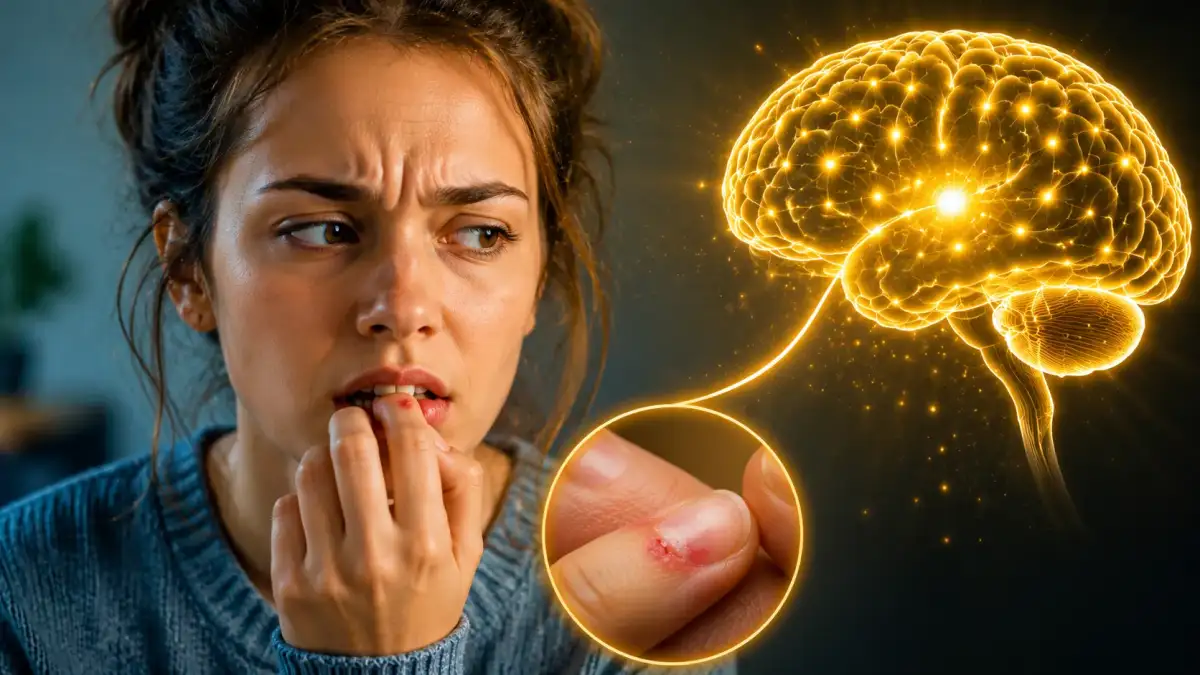
Clinical evidence suggests that the compulsion to bite periungual skin, medically termed Dermatophagia, functions less as a deficit of willpower and more as a hijacked neurobiological feedback loop. Researchers observe that the behavior often bypasses conscious deliberation, triggered by internal states like boredom or stress, but sustained by the brain's internal reward circuitry.
| Aspect | Observation |
|---|---|
| Primary Driver | Neurobiological reward system |
| Common Triggers | Stress, boredom, emotional tension |
| Diagnostic Classification | Body-focused repetitive behavior (BFRB) |
| Functional Intent | Coping strategy for emotional regulation |
The act is rarely an isolated choice; it operates as a repetitive sensory engagement.
Practitioners of this habit often report a reduction in tension when the biting occurs, confirming that the brain assigns a fleeting value to the physical damage.
Recovery trajectories are inherently irregular, requiring consistent somatic re-training rather than simple abstinence.
"Treating damaged skin with quality products is a signal to your brain that your body is valuable." — Clinical observation on sensory re-patterning.
Mechanisms of Habitual Biting
The compulsion serves as an irregular Coping Mechanism for individuals navigating emotional intensity. While popular discourse frequently frames the act as a failure of discipline, current analysis indicates the brain treats the skin-biting action as a high-frequency input to mitigate anxiety.
The physical act itself functions as a loop:
Trigger Phase: External or internal environment shifts (e.g., waiting, restlessness).
Action Phase: The repetitive gnawing of tissue around the nail bed.
Reinforcement: The brain registers the tactile feedback as a temporary regulatory signal.
Investigative Perspective
Modern behavioral science is moving away from moralizing the habit as a "lack of control." Instead, the focus shifts to why the human brain designates Dermatophagia as a viable tool for emotional calibration.
Read More: Families' Silence on Suicide Risks Lives, Experts Warn
The process of ceasing the behavior requires addressing the "ask" of the brain—the underlying need for stimulation or soothing—rather than merely obscuring the hands. By prioritizing sensory awareness and restorative skin care, individuals are encouraged to provide the brain with alternative signals that the body is "valuable," effectively decoupling the nervous system from the cycle of self-damage.