Uttar Pradesh Chief Minister Yogi Adityanath has asserted that the state is experiencing a "renaissance," citing significant development and a transformation from a "Bimaru" state to an economic powerhouse under the Bharatiya Janata Party (BJP) government. These claims are made against a backdrop of recent electoral challenges where the BJP faced setbacks in the state, a situation that also reflected on Adityanath's standing.
Government's Development Narrative
The state government, marking eight years of BJP rule in Uttar Pradesh, has highlighted its development agenda. Chief Minister Yogi Adityanath stated that the administration's policies have led to more development in the last eight years than in the preceding 70 years.
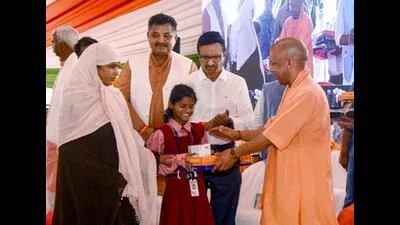
"One district, one mafia" to "one district, one medical college": This shift in policy is presented as a key achievement, aimed at transforming lives across the state.
Emergency Services and Safety: Improvements in emergency service response times and the creation of a "safe and conducive environment" for citizens are also emphasized.
Welfare Schemes: The government points to beneficiaries under schemes like Ujjwala Yojana (over 2.94 lakh people), Ayushman Bharat coverage (11.4 lakh people), and pension schemes as evidence of its commitment to public welfare.
Economic Transformation: Adityanath has described Uttar Pradesh's evolution from a "Bimaru" state to an "economic power," releasing a booklet and documentary detailing the administration's focus on "service, security, and good governance."
Direct Benefit Transfer (DBT): The disbursement of Rs 88,746 crore through DBT for paddy procurement is cited as a concrete economic achievement.
The core message from the Chief Minister's office is that the current administration has fundamentally reshaped Uttar Pradesh, moving it from a state of perceived decline to one of significant economic and social progress.
Read More: India IVF Costs And Social Barriers Limit Access In April 2026
Contrasting Electoral Performance
Despite the government's positive narrative, recent election results in Uttar Pradesh present a different picture, indicating a degree of public dissatisfaction or a shift in political alignment.

Lok Sabha Election Results: The BJP and its allies secured 36 seats, while the Samajwadi Party (SP)-Congress alliance won 43 seats in the state. This outcome is described as a "setback" not only for the BJP but also for Yogi Adityanath.
State's Performance Relative to Neighbors: The BJP's performance in Uttar Pradesh stood in contrast to its strong showings in neighboring states like Uttarakhand, Madhya Pradesh, Chhattisgarh, Himachal Pradesh, Delhi, and Bihar. This disparity made the electoral outcome in UP particularly challenging for the party.
SP as Leading Party: The Samajwadi Party emerged as the leading party in terms of the seat tally within Uttar Pradesh.
Review of Performance: It is understood that these electoral results are subjects for review by the party to understand the factors contributing to the performance.
While the government promotes an image of strong progress, the electoral outcomes suggest a complex public sentiment that does not fully align with the "renaissance" narrative.
Faith, Governance, and Identity
Chief Minister Adityanath's rhetoric often intertwines governance with cultural and religious identity, a theme that has drawn both support and criticism.
"Soul of India's Faith": Adityanath has stated that Uttar Pradesh is the "epicenter of India’s faith," suggesting that a "renaissance of faith" began in the state.
National Song and Opposition: He has taken a strong stance against those who oppose the National Song, "Vande Mataram," suggesting they have no right to reside in India. This sentiment appears directed at the opposition, particularly the Samajwadi Party.
Closure of Illegal Slaughterhouses: Adityanath's administration has undertaken actions such as the closure of illegal slaughterhouses, which aligns with a Hindutva-oriented governance approach.
Kanwar Yatra: The practice of showering flower petals on pilgrims during the Kanwar Yatra, initiated by Adityanath, is presented as an act of respect and support for religious traditions.
Hindu Yuva Vahini: Adityanath's past dissolution of the Hindu Yuva Vahini indicates a focus on consolidating organizational control and projecting a particular image of leadership.
"It would be no exaggeration to call it the soul of India’s faith." - Yogi Adityanath
The Chief Minister's statements indicate a strong emphasis on religious and nationalistic themes as integral components of his governance and vision for Uttar Pradesh.
Expert Analysis and Perspectives
Political analysts and commentators offer varied interpretations of the developments in Uttar Pradesh.
"Double Engine" Development Model: The BJP government has promoted a "double engine" development model, attributing growth and improved public service delivery to this approach.
Shift from "Anarchy": Adityanath has characterized the state's situation eight years prior as a period of "chaos and lawlessness," contrasting it with the present, which he describes as a period of agricultural leadership and order.
Setback Analysis: Reports suggest that the BJP's electoral performance in Uttar Pradesh surprised many, including those who believed Yogi Adityanath's assertive style had widespread appeal.
"Our govt replaced the previous administration’s policy of “one district, one mafia” with “one district, one medical college”, bringing significant transformation in lives of people across UP." - Yogi Adityanath
The narrative of transformation under Adityanath is robustly presented by the government, yet the electoral outcomes necessitate further investigation into the public's perception of this transformation.
Read More: Ram Temple Trust Audit Shows Money Irregularities
Conclusion and Implications
Chief Minister Yogi Adityanath presents Uttar Pradesh as a state undergoing a profound positive transformation under BJP rule, characterized by economic growth, improved governance, and a resurgence of cultural identity. The government highlights numerous development projects and welfare initiatives as evidence of this progress.
However, the recent Lok Sabha election results in Uttar Pradesh, where the BJP and its allies did not secure a majority of seats, present a significant counterpoint. This electoral setback raises questions about the extent to which the government's narrative of success resonates across all segments of the electorate. The disparity in performance compared to neighboring states further underscores the unique challenges and perceptions within Uttar Pradesh.
The government's emphasis on religious and nationalistic themes as integral to its governance strategy, while appealing to a specific voter base, also remains a point of discussion and analysis. The interplay between this ideological emphasis, the claimed development achievements, and the electoral verdict forms the complex picture of Uttar Pradesh's current political landscape. Future political strategies and governance approaches will likely be shaped by the need to address these multifaceted dynamics.
Read More: Tamil Cinema Loses K. Bhagyaraj and Bharathiraja, Ending An Era
Sources
The Hindu: U.P. is witnessing a model of renaissance under BJP regime, says Adityanath
Hindustan Times: UP saw more development in 8 years than in 70 years before that: Yogi
ABP Live: UP No Longer 'Bimaru': CM Yogi Adityanath Says State Has Become 'Economic Power' Under BJP
The Indian Express: The ‘return’ of Yogi of old: How UP CM is readjusting gears amid rifts in state BJP
India TV: Yogi govt completes 8 years in office, CM highlights 'double engine' development model
The New Indian Express: UP results a setback not just for the BJP, but for Yogi Adityanath too