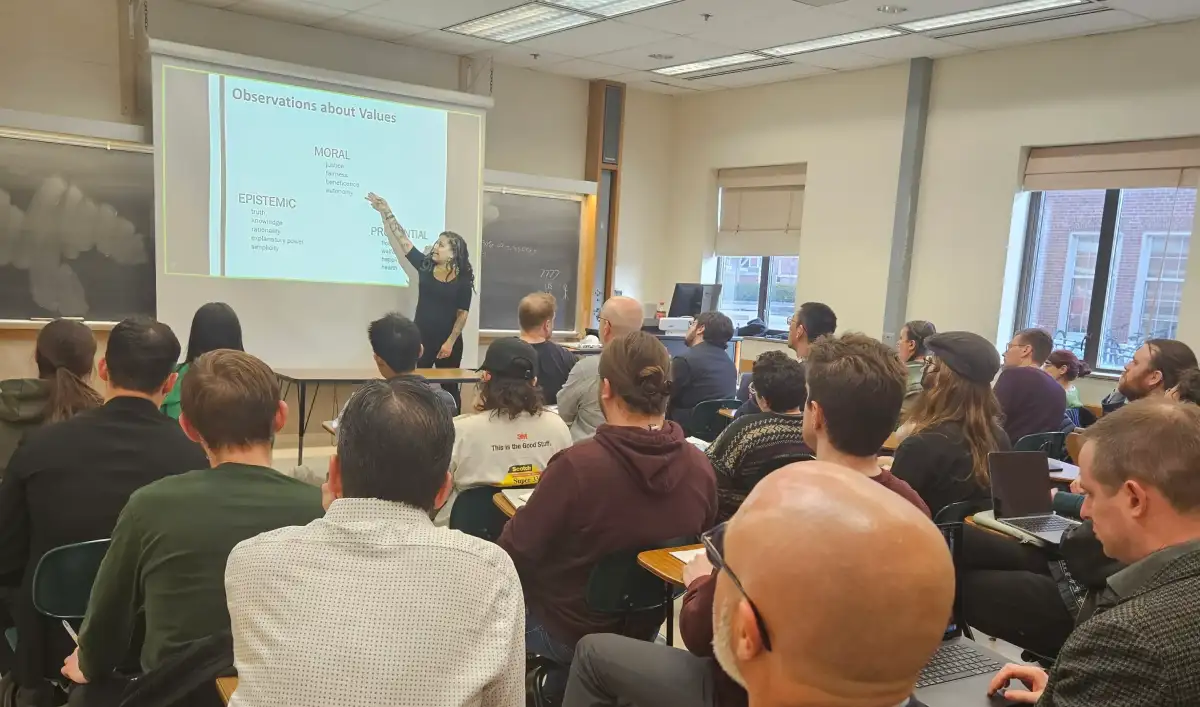
Across American universities, philosophy departments have brought their spring colloquia series to a close. Notable institutions recently concluded their programs, with discussions touching on various facets of contemporary thought, including gender distinctions and inferential logic. These gatherings, often spanning months, offer platforms for scholars to present work before broader academic scrutiny.
Stanford University hosted a colloquium as recently as Friday, May 1, 2026, held in Building 370, room 370, from 3:30 PM to 5:30 PM. This event followed previous sessions on April 24, 2026, and April 10, 2026, all occurring at the same time slot. Meanwhile, at Columbia University, the 2025-26 series finished its scheduled talks. Its final presentation for the stated term occurred on Thursday, April 23, 2026, with Rachel Fraser of the Massachusetts Institute of Technology presenting from 4:10 PM to 6:00 PM in Philosophy Hall 716.
Academic Gatherings Recap
Earlier in the spring season, Columbia's schedule featured other academics:
Read More: Corpus Christi History Educator Robert Parks Dies After 30 Years
Mala Chatterjee from Columbia Law School on February 19, 2026.
Patricia Marechal from the University of California, San Diego, on October 16, 2025.
Daniel Hausman of the University of Wisconsin-Madison, initiating the series on September 25, 2025.
These events consistently occupied Philosophy Hall 716 from 4:10 PM to 6:00 PM, concluding with a light reception, as is customary.
Further across the continent, Purdue University's Department of Philosophy likewise held a colloquium series for 2025-2026. Their scheduled presentations included:
Gonzalo Rodriguez-Pereyra on September 10, 2025.
Hrishikesh Joshi from the University of Arizona, who presented on February 6, 2026.
Alisabeth Ayars of Washington University, presenting on March 13, 2026.
An unconfirmed speaker identified only as "Leonard W." on April 10, 2026.
These Purdue events were generally set for 3:30 PM.
Other institutions maintained their regular schedules. Florida State University listed Joshua Knobe (Yale University) on March 6, 2026, and Mark Schroeder (University of Southern California) on March 13, 2026, both at Dodd Hall Auditorium from 3:30 PM to 5:00 PM. The University of Rochester saw Ben Bradley of Syracuse University on February 27, 2026, Jennifer Blumenthal-Barby from Baylor College of Medicine on March 6, 2026, and Luara Ferracioli of the University of Sydney on April 3, 2026, all presenting at 3:00 PM in Dewey 2110-E.
Ongoing Discourse
Topics under consideration by scholars throughout these various colloquia sometimes include complex analytical distinctions. One such area, without a specified recent date for presentation, but nonetheless a part of ongoing academic conversations, involves the normative properties of ' gendering ' and ' misgendering '. Arguments presented in one academic summary suggested a framework distinguishing ' Bad Gendering ', 'Misgendering', and ' Defective Gendering '. Further, it claimed ' reverse inference ' in scientific method has been overly criticized, while ' forward inference ' remains less scrutinized despite inherent difficulties. These points reflect current preoccupations within certain academic philosophy circles, often presented and debated within the structure of a colloquium.
Read More: USI Staff Food Fund Starts May 16, 2026, Ends May 7, 2027
Context of Colloquia
Philosophy colloquia generally serve as a persistent feature of academic life, offering forums for presenting fresh inquiry and engaging with critical perspectives. Departments at institutions such as William & Mary maintain these series, inviting thinkers from various global and national locales. These structured discussions typically feature a formal talk, followed by an interrogation session, concluding with informal interaction, which collectively sustains the scholarly interchange fundamental to the discipline's operation.