

WHISPERS OF POISONED SEEDS
Declassified government documents and historical records from Cold War biological weapons programs have become the fodder for alarming allegations. A biochemist, Dr. Robert Malone, has put forth claims suggesting that the Central Intelligence Agency (CIA) may have conducted secret experiments involving biological agents, potentially linked to major disease outbreaks.
Malone’s assertions center on activities allegedly undertaken in the 1960s. He points to reports of over 282,000 radioactive ticks purportedly released in Virginia. Further, open-air tick research at Plum Island, a federal laboratory situated near the area where Lyme disease was first identified, is also highlighted.
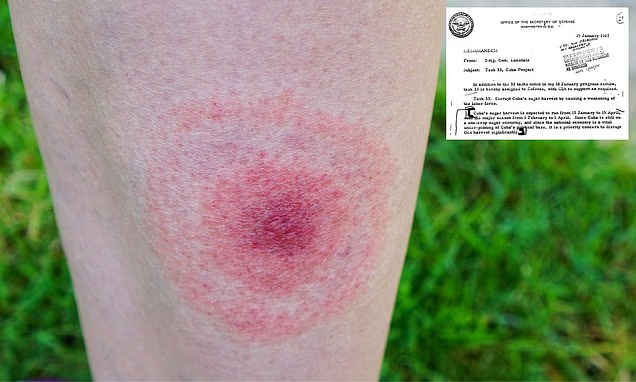
The core of the claim is that modern outbreaks, particularly Lyme disease, could be an unintended consequence or direct result of these alleged CIA bioweapon experiments. This framing implies a deliberate manipulation of biological agents, with the ensuing health crises being a buried secret for decades.
UNRAVELING THE THREADS OF SUSPICION
While the accusations gain traction, voices of caution emerge from within the scientific community. Experts, such as Phillip Baker, Executive Director of the American Lyme Disease Foundation (ALDF), express reservations. Baker has publicly stated that the claims are based on "false and misleading information," asserting that the individual presenting them is "terribly misinformed."
Read More: DHS $220 Million Ad Contract Under Fire For Kristi Noem Ties
Counterarguments point to recent research indicating the presence of the Lyme disease bacterium, Borrelia burgdorferi, in America even before recorded European arrival, dating back thousands of years. This challenges the notion of a solely modern, human-induced introduction of the pathogen.
Despite these reservations, the reverberations of these allegations have prompted action. A bill was quietly passed in the U.S. House of Representatives last week. It mandates the Inspector General of the Department of Defense (DoD) to review whether the Pentagon experimented with ticks and other blood-sucking insects as biological weapons. This review is slated to cover the period between 1950 and 1975.
The questions surrounding these experiments, should they have occurred, are numerous. They reportedly include attempting to understand how bioweapons specialists might have engineered ticks with pathogens designed to cause severe illness, disability, or even death, targeted at potential adversaries. The scope of such a review suggests a deep-seated unease about past governmental actions and their potential long-term health implications for the populace.
A HISTORY OF THE UNSEEN
Plum Island, the site of some alleged research, has long been a facility associated with investigations into infectious diseases and biological warfare defense. Its proximity to the geographic origins of the Lyme disease outbreak in the United States has made it a focal point for speculation. The narrative, however, is complex, involving not just scientific inquiry but also the shadowy world of Cold War-era defense strategies. The declassification of documents, a process intended to foster transparency, has instead opened a Pandora's Box of anxieties about the potential for covert governmental actions to have unforeseen and widespread consequences.
Read More: Gut Bacteria Clostridium butyricum May Help Fight Inflammation and Infections