

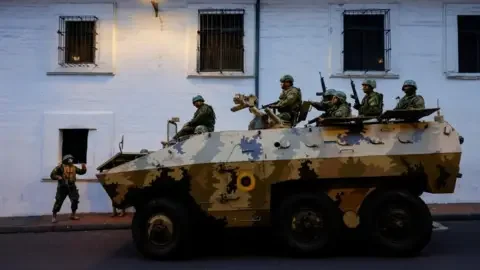
Ecuador has requested U.S. military assistance in targeting suspected narco-terrorist networks, leading to "lethal kinetic operations" carried out by joint U.S. and Ecuadorean forces. According to statements from U.S. Southern Command (SOUTHCOM), the U.S. Department of Defense conducted a targeted action to dismantle a supply complex associated with these groups. Pentagon spokesperson Sean Parnell emphasized that the operation is part of a broader effort to unite partners across the Western Hemisphere in disrupting organizations that foster violence and corruption. This coordinated action, specifically at Ecuador's request, aims to dismantle narco-terrorist networks and sends a message that they will not find refuge in the hemisphere.

Recent operations, including a confirmed strike on March 6th, involve "lethal kinetic operations" against designated terrorist organizations operating within Ecuador. SOUTHCOM Commander General Francis Donovan directed the joint force to support Ecuadorean forces in these actions. This marks a shift from traditional police operations and drug seizures to direct military intervention, enabled by detailed intelligence and coordination with Ecuadorian authorities. The U.S. military's involvement signifies an expanded role in combating organized crime in the region, leveraging capabilities such as intelligence, surveillance, reconnaissance (ISR), and air mobility.
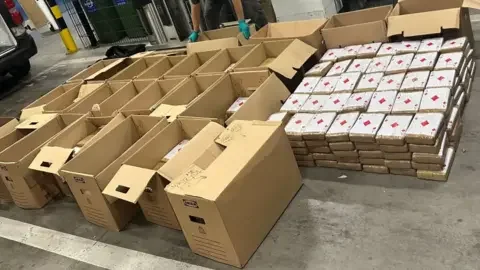
Operation's Context and Rationale
The intervention comes as Ecuador grapples with a significant surge in violence linked to drug trafficking and illegal mining. President Daniel Noboa's administration has framed these joint actions as part of a new phase in combating organized crime. Ecuador's strategic location, situated between Colombia and Peru—major cocaine producers—renders it a crucial transit point for illicit drug trade, making it a prime target for drug-trafficking gangs. The U.S. views these operations as integral to cutting off drug supply channels to North America and dismantling cartel logistics hubs.

Initial announcements regarding these joint operations, which began around March 3rd, were sparse on specific details regarding scope and location. However, U.S. Southern Command has characterized these efforts as a powerful demonstration of commitment from partners in Latin America and the Caribbean to combat narco-terrorism. The operations are described as confronting groups that have long inflicted terror, violence, and corruption.

Background and Operational Framework
The U.S. military's role, as outlined by SOUTHCOM, involves advisory support, intelligence sharing, operational planning assistance, and logistics, while Ecuadorian special operations units conduct raids on narco facilities. Crucially, U.S. personnel operate under a Status of Forces Agreement (SOFA), precluding independent command over Ecuadorean forces or autonomous combat operations without explicit Ecuadorean authorization.
This expansion of U.S. military engagement in Ecuador follows broader strategic objectives by the White House to increase its military posture in the hemisphere. Reports suggest that the campaign aims to disrupt trafficking routes, secure ports, and dismantle narco-terror infrastructure. The U.S. military's participation is seen as enabling rapid destruction of criminal logistics hubs directly at their bases, a departure from previous methods. Despite the intensity of the operations, both nations have stated adherence to agreements concerning sovereignty and regional stability.