

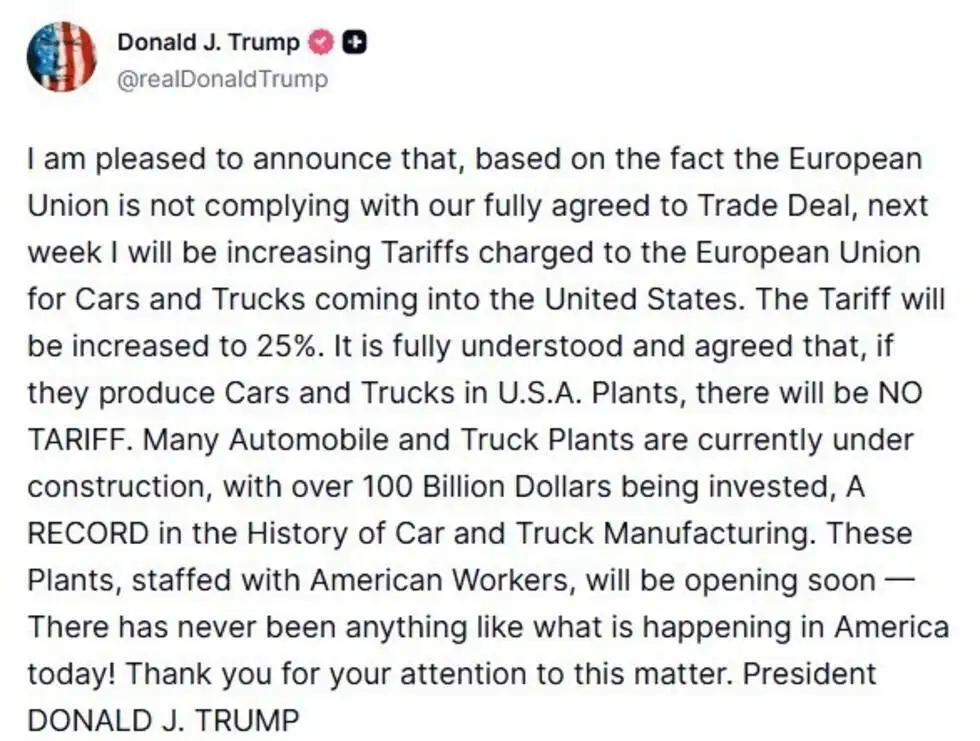
President Donald Trump has again threatened to impose a 25% tariff on automobiles and auto parts imported from the European Union, escalating transatlantic trade tensions and causing European markets to slide. The move, announced via Trump's social media platform, targets the EU for perceived non-compliance with a trade agreement reached in July of the previous year. This announcement sent shockwaves through European financial markets, with the pan-European STOXX 600 index experiencing its largest one-day drop in about a month, closing down 1%. Major European bourses in Frankfurt, Paris, and Milan also registered declines.
The direct impact was felt most acutely in the automotive sector. The automobiles index saw a 1.1% decrease, with car parts supplier Continental falling 4.4%. Other major automakers like Porsche and Volkswagen each declined by 0.9%. Conversely, Thyssenkrupp, a German industrial giant, saw a gain of 2.1% on the same day. Utilities also slid 1.2%, and the food and beverage sector lost 0.6%.
Read More: FIFA World Cup 2026 Revenue Reaches $15 Billion With New Ticket Prices
The European Commission has stated it is "keeping its options open" in response to the tariff threat, emphasizing its commitment to the Turnberry Agreement, named after Trump's golf course in Scotland. The bloc maintains it is implementing the deal according to standard legislative practice and has kept the U.S. administration informed.
Underlying Discord and Delayed Deal
The renewed tariff threat comes despite a trade deal agreed upon last summer, which capped U.S. tariffs on EU autos and parts at 15%. Trump alleges the EU is dragging its feet on finalizing this agreement. The European Parliament has been progressing slowly on the deal, with completion of its work expected next month.

A key German Member of the European Parliament, Lange, suggested the move is "politically against Germany," implying a targeted strategy. This comes amid broader cooling of EU-U.S. relations, further strained by European countries' refusal to participate in military operations related to the conflict with Iran. Trump's stance on tariffs has also faced scrutiny following a Supreme Court ruling in February that struck down significant portions of his tariff agenda.
Read More: Australia-US Trade Dispute: New Tariffs Cause Friction
Context of Trade Tensions
This latest development reignites a broader trade dispute between the U.S. and the EU. The U.S. president has a history of strained relations with European allies, including past threats regarding Greenland and criticism of NATO members' contributions. The upcoming U.S. midterm elections also add a layer of political pressure, with rising inflation creating a challenging environment for Trump.
The EU-US trade agreement, known as the Turnberry Agreement, was established after previous trade tensions and Trump's push for a nationalist trade agenda. However, implementation has faced challenges, with reports indicating that the European Parliament had suspended approval in January, partly due to U.S. pressure concerning Greenland and the aftermath of the Supreme Court's tariff ruling. Divergent views among EU member states, with France backing a tougher stance and Germany resisting certain provisions, further complicate the situation.
Read More: Hunter Region Gets $12 Billion Train Factory
' Trump Tariffs ', ' European Markets ', ' Trade Deal '


