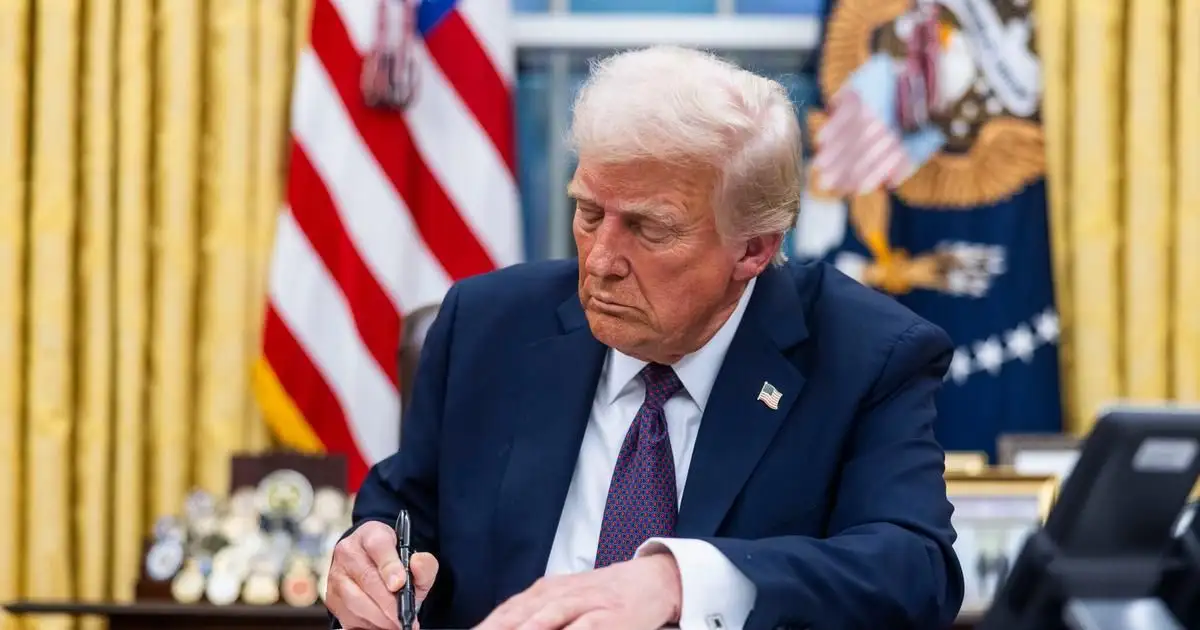
WASHINGTON D.C. – In a swift and sweeping executive action, Donald Trump has initiated a significant pivot in federal policy, targeting what he terms "woke" ideology. The directives, signed within hours of his inauguration in January 2025, mandate a strict adherence to biological definitions of sex, declaring that only 'man and woman' will be officially recognized by the government. This move has led to the immediate dismantling of Diversity, Equity, and Inclusion (DEI) programs across federal agencies and institutions receiving federal funding.

The executive orders specifically abolish DEI programs and redefine foundational terms like "sex," "woman," "girl," "man," and "boy," emphasizing biological reality over gender identity. This policy shift extends to institutions such as museums, with actions planned to scrutinize funding for programs deemed "anti-American" or divisive.

Governmental Overhaul and Scientific Disruption
Federal agencies are now under direct orders to cease any activities contradicting these new mandates. Scientists relying on federal grants are instructed to cease initiatives that clash with Trump's executive decrees. This has resulted in a chilling effect, with fears of job loss prompting some government employees to move climate change research "underground" to avoid acknowledging global warming. Environmental data tracked by organizations shows a significant deletion of climate change information from over 200 government websites since Trump's return to office.
Read More: Opposition Parties Support 'Cockroach' Youth Movement, Congress Silent

Corporate and Academic Repercussions
The impact of Trump's anti-"woke" stance is also being felt in the private sector and academia. Several major corporations, including McDonald's, Meta, Walmart, Ford, John Deere, and Harley-Davidson, have announced the elimination or significant alteration of their DEI programs, reportedly in response to pressure from conservative groups. Universities are also facing a backlash, with some institutions resisting the administration's directives.
Shifting Public Opinion and Societal Division
Public opinion on the "woke" issue appears sharply divided. An ABC News/Washington Post/Ipsos poll released in late April 2025 indicated the country is almost evenly split on the matter, suggesting a deepening societal polarization. The political discourse surrounding "wokeism" has become a central theme, with critics on both sides of the political spectrum weighing in on its divisive nature.
Background: The "Anti-Woke" Movement
The term "woke," originally associated with heightened awareness of social injustices, has become a focal point for conservative critique. Critics, including figures within the Trump administration and conservative movements, argue that "woke" ideology has permeated cultural institutions and academic research, leading to what they describe as an overemphasis on identity politics at the expense of broader societal values. This has fueled a counter-movement advocating for a return to what is perceived as common sense and traditional values.
Read More: FBI Agents Look for New Jobs After Catholic Memo Controversy
In the wake of events such as the October 2023 open letter from Harvard student organizations regarding the Israeli-Palestinian conflict, which was characterized by some as reflecting "woke" sensibilities, and the subsequent resignation of Harvard President Claudine Gay amidst plagiarism accusations and criticism of the university's response, the debate over "wokeism" has intensified. This has led to attacks on diversity policies and affirmative action initiatives, impacting institutions like Harvard and influencing federal policy.