


United States and Israeli forces destroyed multiple oil depots and refineries across Tehran and Karaj late Saturday. The aerial bombardment has severed the primary energy arteries of the Iranian state, leading to immediate reports of environmental collapse in the capital. Iranian Sports Minister Ahmad Donyamali confirmed the country will not participate in the FIFA World Cup, citing the death of Supreme Leader Ayatollah Ali Khamenei in the strikes.
"Our players do not have security," Donyamali stated, marking a total cessation of international cultural participation as the administrative head of the state is confirmed dead.
The primary objective appears to be the total erasure of Iran’s logistics and economic movement. While the Israel Defense Forces (IDF) claim the depots served military infrastructure, local reports describe a different landscape:
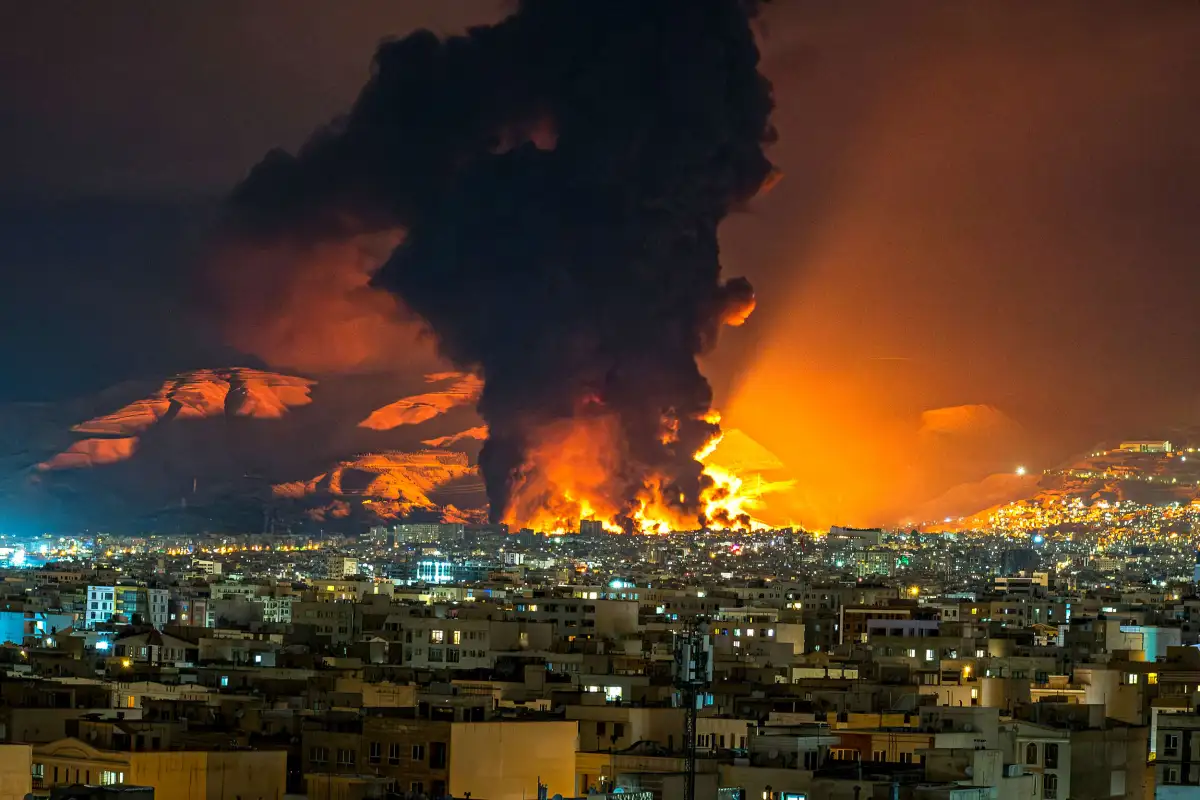
Tehran is currently under a blanket of viscous, black smoke that has begun to precipitate as oil-saturated rain.
The Iranian Red Crescent has labeled this rainfall "extremely dangerous" for the population.
At least 1,300 civilians are reported dead since this phase of the conflict began on February 28.
Footage from the ground shows residential neighborhoods near the depots consumed by ' fireballs ' and "streets on fire."
Regional Grinding and Response
The friction has leaked across all borders. Iran’s Revolutionary Guard claims to have attacked two ships near the Strait of Hormuz for ignoring warnings. Meanwhile, the conflict has expanded into a wider Gulf campaign:
Read More: Trump Says India Buying Russian Oil Helps Global Oil Prices
| Location | Incident Type | Reported Impact |
|---|---|---|
| Dubai | Aerial Explosions | Drones crashed; 8 days of food security questioned. |
| Bahrain | Missile Strikes | State oil company Bapco declared force majeure. |
| Iraq | Missile Strike | US Embassy helicopter pad hit in Baghdad. |
| Kuwait | Drone Incursion | Target: Kuwait Airport; operations continue under alert. |
| Jordan | Air Raid Sirens | Potential aerial threats moving through regional airspace. |
The United States has confirmed the deaths of six US troops during this escalation. In a separate development, an Indian sailor was killed after a "suicide boat" struck the US-linked tanker Safesea.
The Petroleum Ledger
Despite the International Energy Agency (IEA) releasing a historic volume of petroleum reserves, ' oil prices ' remain stubbornly high. The market refuses to stabilize as the Strait of Hormuz—the world’s most critical oil transit point—becomes a site of active maritime combat.
Over 130 countries have backed a UN motion demanding Iran halt its regional strikes and cease interference with maritime navigation.
US President Donald Trump has explicitly ruled out allowing Kurdish forces to join the ongoing war against Iran.
In a display of institutional optimism, FIFA President Gianni Infantino suggested on social media that the World Cup is needed to "bring people together," even as one participating nation’s leadership is eliminated and its capital city rains petrol.
Background and Calculated Ruin
The conflict entered its 12th day with a shift from military-only targets to "lifeline" infrastructure. This tactic, described by some analysts as an attempt to "break the resilience" of the Iranian public, mimics older theories of strategic bombing. The aim is to paralyze the daily movement of a nation by removing its fuel.
Read More: Lebanon Displacement Crisis: 700,000 Uprooted by Israeli Attacks
The current situation traces back to February 28, with the US and Israel launching a coordinated campaign against Iranian military capabilities, leadership, and its nuclear program. The death of the Supreme Leader represents the most significant shift in the regional hierarchy in decades, leaving a power vacuum beneath a sky of ' black clouds '.