The majestic Taj Mahal, a globally recognized symbol of eternal love and architectural marvel, is once again at the center of a fiery debate. A new Bollywood film, "The Taj Story," has thrust a long-simmering conspiracy theory – that the Taj Mahal was originally a Hindu temple – back into the spotlight. This isn't just a cinematic puff of smoke; it's a deeply divisive issue that touches upon India's complex history, national identity, and the potent weaponization of narrative in the digital age. As the film hits screens, we must ask: is this a work of artistic license, or a calculated move to rewrite history and fracture the very soul of India?
The story of the Taj Mahal has always been a tale of romance, Mughal emperor Shah Jahan's undying love for his wife Mumtaz Mahal. Yet, beneath the veneer of this iconic love story lies a contentious undercurrent. For decades, fringe theories have whispered that this 17th-century mausoleum is not what it seems, but rather a desecrated Hindu temple, allegedly named "Tejo Mahalaya." While widely dismissed by mainstream historians, this narrative has found fertile ground among certain nationalist groups. Now, "The Taj Story," with its provocative poster and storyline, seems poised to fan these flames, turning a cinematic release into a historical and political flashpoint. But what drives this resurgence, and what are the real stakes for India's cultural fabric?
Read More: India Creators Fight Back Against Book Censorship and Event Disruptions
Echoes of the Past: A History of Taj Controversy
The Taj Mahal, a UNESCO World Heritage site, has always been a potent symbol, but its historical narrative has been subject to challenges, particularly from those seeking to assert a Hindu-centric view of India's past.
The "Tejo Mahalaya" Theory's Origins: The most prominent voice behind the "Tejo Mahalaya" theory is P.N. Oak, a right-wing author who, as far back as the 1980s, propagated the idea that the Taj Mahal was built over a pre-existing Hindu temple. His book, "Taj Mahal: The True Story," argued this point, though historians have largely debunked his claims as lacking credible evidence.
Legal Challenges: This theory has not remained confined to academic debates or fringe publications. In 2022, Rajneesh Singh, an Ayodhya-based BJP spokesperson, filed a Public Interest Litigation (PIL) in the Allahabad High Court. His plea sought the opening of 22 locked rooms within the Taj Mahal, claiming they contained "Hindu idols and inscriptions" that would verify the temple theory.
| Court | Date of Dismissal | Reason for Dismissal |
|———-|——————————|———————————|
| Allahabad High Court (Lucknow Bench) | Not specified (post-2022 PIL) | Dismissed the plea, stating PILs are "not meant for historical research." |
The "Cultural Fusion" Narrative: Conversely, the Taj Mahal is widely recognized by historians as a masterpiece of Mughal architecture, representing a period of significant cultural fusion in India. Its documented construction under Shah Jahan for Mumtaz Mahal is considered one of the best-documented episodes of Mughal history.
The persistent reappearance of these claims, despite judicial dismissals and scholarly consensus, raises critical questions: Is this about uncovering hidden truths, or is it a deliberate attempt to overwrite established historical narratives? Why do these theories continue to gain traction, even reaching the halls of justice?

"The Taj Story": A Cinematic Spark or a Propaganda Blaze?
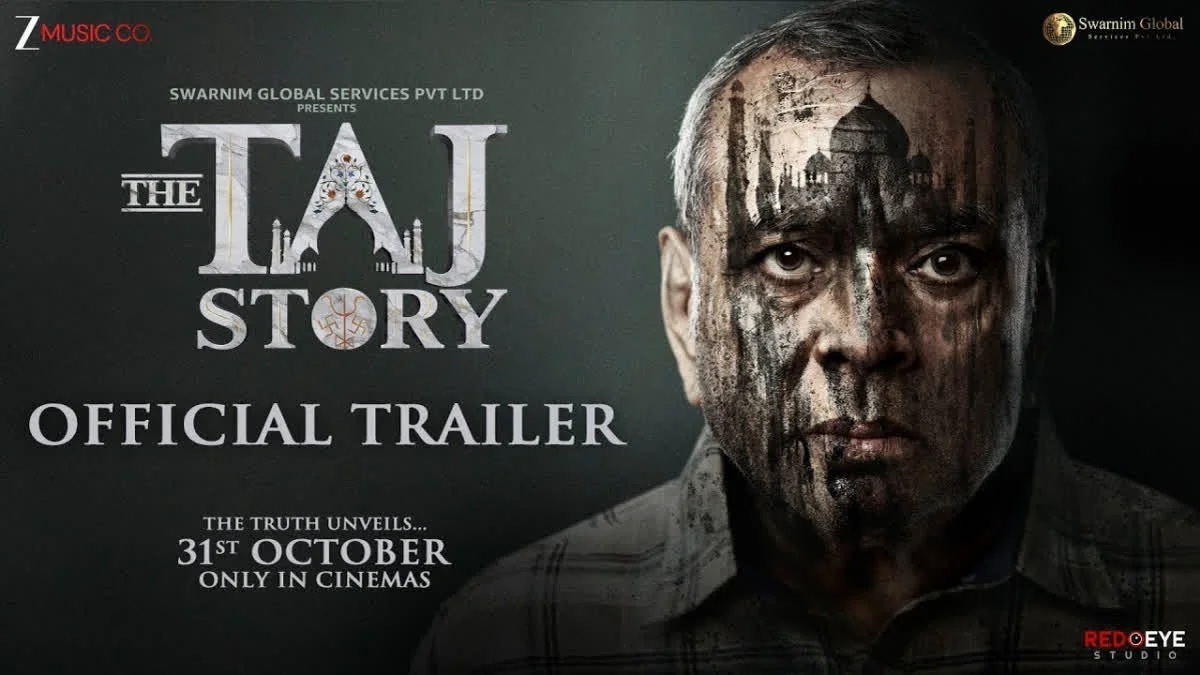
"The Taj Story," produced by Paresh Rawal, has ignited a firestorm not just with its title, but with its audacious imagery and the very premise it seems to embrace. The film's poster, featuring a statue of Lord Shiva emerging from the Taj Mahal's iconic dome, immediately sent shockwaves through audiences and critics alike.
Read More: Narungga 'Guuranda' play in Chennai shares South Australia stories with India
The Poster's Provocation: The visual of a Hindu deity superimposed on a structure intrinsically linked to Mughal history is a powerful, albeit controversial, statement. It directly taps into the "Tejo Mahalaya" narrative, acting as a visual manifesto for the temple theory.
Filmmakers' Clarifications: In the face of widespread backlash, the filmmakers and Paresh Rawal have issued statements attempting to distance the film from making explicit religious claims. They assert that "The Taj Story" focuses on "historical facts" and "doesn't deal with any religious issue."
The core defense is that the film is based on "historical facts," a statement that itself is contested, as the "Tejo Mahalaya" theory is widely dismissed by historians.
Scholarly Concerns: Experts like Dr. Rasheed Ali, a media scholar, express grave concerns. He notes the "emotional reach" of cinema makes it a potent tool for propaganda, and fears "The Taj Story risks the latter." This suggests a suspicion that the film, regardless of official disclaimers, is designed to sway public opinion rather than present objective history.
The filmmakers' defensive posture begs the question: if the film is purely about "historical facts," why the need for such a provocative poster? And if it truly doesn't "deal with any religious issue," why has it so effectively reignited a deeply religious and historical controversy? Is the disclaimer a genuine attempt at clarity, or a strategic move to navigate regulatory hurdles while still achieving its intended impact?

The Politics of Memory: Rewriting India's Past?
The controversy surrounding "The Taj Story" is not an isolated incident but appears to be part of a broader ideological trend in India. Many observers and analysts see it as reflecting a push towards a more Hindu-centric national identity, where historical narratives are being reinterpreted to align with this vision.
Rewriting History as a Political Project: Critics argue that the attempt to rebrand the Taj Mahal as a Hindu monument is part of a larger "ideological project to claim ownership over India's past." For some within the Hindutva movement, the existence of iconic, beautiful structures built by Muslim rulers is seen as "intolerable to their notion of national identity."
Educational Shifts: This trend is not limited to cinema. Reports indicate that institutions like the National Council of Educational Research and Training (NCERT) have revised key history textbooks to present a different interpretation of India's medieval period. This suggests a top-down influence on how history is taught and understood.
Erasure of Muslim Heritage: The concern is that when the established Mughal origins of sites like the Taj Mahal are contested, it leads to the "erasing of India's Muslim past." This framing of Islamic architecture as "foreign" rather than "integral to its heritage" signals a deliberate attempt to alter historical perception and, by extension, national identity.
The controversy over "The Taj Story" highlights a disturbing trend of manipulating historical narratives to align with a specific political ideology, potentially undermining India's pluralistic heritage.
Global Implications: This reinterpretation of history doesn't just resonate domestically; it also has international repercussions. As one expert noted, while it may "rally supporters locally," it "damages the brand of India" on the global stage, where the Taj Mahal is cherished as a universal symbol of love and architectural achievement.
If history is indeed being rewritten, who is benefiting from this altered narrative, and at what cost to India's diverse cultural tapestry? Is the film a symptom of this larger trend, or a catalyst for its acceleration? What are the long-term consequences of divorcing iconic monuments from their established historical context?
Read More: India Child Health Warning 2024: Poor Diets Cause Adult Diseases in 2 in 3 Kids

Beyond the Screen: Pseudo-History and its Perils
The debate around "The Taj Story" ventures into the murky territory of pseudo-history, where unsubstantiated claims are presented as facts, often with significant societal and political ramifications. The film's willingness to engage with the "Tejo Mahalaya" theory, even if disclaimed, raises alarm bells about the normalization of such narratives.
The Blurring of Lines: "The Taj Story" is accused of blurring the lines between historical fact and fabricated myth. When a film chooses to revisit a contested piece of history, it enters a "fragile intellectual space where creativity collides with responsibility."
Weaponizing Memory: The contest over the Taj Mahal's origins is not merely about bricks and mortar; it's about "memory." By challenging its Mughal origins, the film, intentionally or not, contests the memory of India's syncretic past and the contributions of its Muslim rulers.
P.N. Oak's Wider Claims: The foundation of the "Tejo Mahalaya" theory lies in the broader, often outlandish, claims of P.N. Oak, who also posited that global sites like the Kaaba in Mecca were originally Hindu temples. Such theories, though lacking scholarly support, demonstrate a pattern of historical revisionism aimed at asserting Hindu primacy across various cultural landmarks.
| P.N. Oak's Controversial Claims | Dismissed by Historians |
|————————————————-|————————————-|
| Taj Mahal was originally "Tejo Mahalaya" (Hindu temple). | Lacks credible evidence; construction meticulously documented. |
| Kaaba in Mecca was a Shiva temple. | No historical basis. |
| The Black Stone in Kaaba is a Shiva lingam. | Pure speculation; rooted in mythology, not history. |
The Danger of Normalization: When films like "The Taj Story" gain mainstream attention, they risk legitimizing fringe theories and pseudo-historical narratives. This can have a corrosive effect on critical thinking and informed public discourse, making it harder to distinguish between documented history and politically motivated fabrications.
What does it say about a society when films that traffic in unsubstantiated theories can gain significant traction and provoke national debates? Are audiences being adequately equipped to critically engage with such content, or are they being subtly led down a path of revisionist history? What responsibility do filmmakers and the media have in preventing the spread of pseudo-history, especially when it carries potent political undertones?
The Verdict on "The Taj Story": More Than Just a Movie?
"The Taj Story" has successfully achieved what many films strive for: it has sparked a massive debate. However, the nature of this debate—centered on historical revisionism and national identity—suggests that its impact may extend far beyond the box office. While the filmmakers may claim artistic freedom or adherence to "historical facts," the context in which this film emerges, coupled with its provocative imagery, paints a concerning picture.
Read More: Why people call some movies 'perfect' online
The resurgence of the "Tejo Mahalaya" theory, amplified by "The Taj Story," is not merely a historical footnote; it’s a manifestation of deeper societal fissures and ideological battles over India's past and future. The legal challenges, the re-evaluation of school curricula, and now a Bollywood film, all point to a concerted effort to reshape how India views its heritage.
Ultimately, the film serves as a stark reminder that history is not static; it is constantly interpreted, debated, and sometimes, manipulated. The Taj Mahal, a monument that has stood for centuries as a testament to love and architectural genius, is now a battleground for competing narratives. The question remains: will India embrace its rich, complex, and diverse history, or will it succumb to the allure of myths manufactured for political expediency? The answer to this will determine not just the legacy of a monument, but the soul of a nation.
Read More: India LPG Shortage: Cold Stoves as State Gas Supply Delays Hit Homes
Sources:
CNN: India’s symbol of love mirrors its divides in a new Bollywood film. (December 6, 2025). https://www.cnn.com/2025/12/06/india/the-taj-story-india-film-controversy-intl-hnk-dst
UCA News: Indian film claiming Taj Mahal originally a Hindu temple causes stir. (October 20, 2025). https://ucanews.com/news/indian-film-claiming-taj-mahal-originally-a-hindu-temple-causes-stir/110673
ETV Bharat: The Taj Story Controversy Explained: How Paresh Rawal's Film Has Stirred A Historical Storm. (October 29, 2025). https://www.etvbharat.com/en/entertainment/the-taj-story-controversy-explained-how-paresh-rawals-film-has-stirred-a-historical-storm-enn25102901015
India Today: Paresh Rawal's Taj Story poster sparks backlash, makers clarify. (September 30, 2025). https://www.indiatoday.in/movies/bollywood/story/paresh-rawal-the-taj-story-no-shiv-temple-claim-taj-mahal-controversy-2795672-2025-09-30
TRT World: The ‘Taj Story’ and the Hindu right-wing’s politics of erasing India’s Muslim past. (October 30, 2025). https://www.trtworld.com/article/d640c13e3ea0
Tabla!: A Film’s Narrative Stirs Controversy Around Taj Mahal, Culture, Tabla. (December 12, 2025). https://www.tabla.com.sg/culture/film/films-narrative-stirs-controversy-around-taj-mahal
Mint: The Taj Story controversy: PN Oak's ‘Tejo Mahalaya' theory, Supreme Court ruling, PIL and more | Explained. (October 30, 2025). https://www.livemint.com/entertainment/the-taj-story-controversy-pn-oak-s-tejo-mahalaya-theory-supreme-court-ruling-pil-and-more-explained-11761819423398.html
eNewsRoom: The Taj Story: Unmasking the Rising Danger of Pseudo-History Today. (November 25, 2025). https://enewsroom.in/propaganda-film-the-taj-story-movie-review-pseudo-history/
Nikkei Asia: Indian film rekindles debate over Taj Mahal's history. (November 9, 2025). https://asia.nikkei.com/politics/indian-film-rekindles-debate-over-taj-mahal-s-history