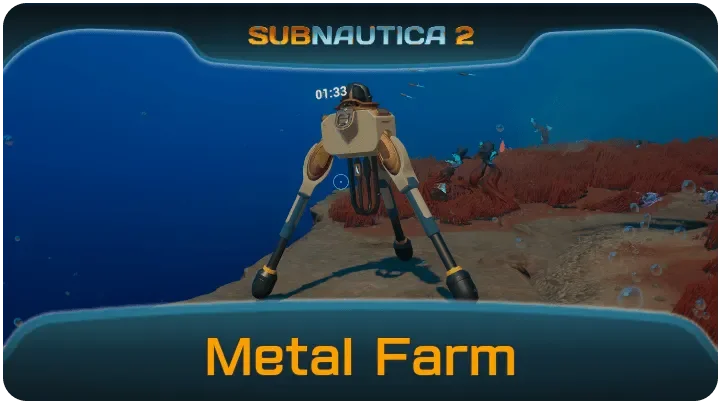
A new base module, dubbed the "Metal Farm," is now available in Subnautica 2, allowing players to passively generate mineral resources. This development fundamentally alters the resource acquisition loop, transforming underwater habitats into ongoing production sites. The structure, when submerged and connected to a power source, accumulates minerals from its surroundings over time.

The Metal Farm consumes 20 units of power per cycle to operate. Its blueprint is located within the Karakorum Metal Farm zone, described as a large basin containing a glowing green pool. Players must scan the remains of these farms to unlock the ability to craft the module. Once constructed via the Habitat Builder, the farm requires a valid ore sample to initiate its resource-gathering process. The time it takes for a mineral to accumulate is reportedly dependent on the specific mineral itself.
Read More: Forza Horizon 6: Fastest Cars Have Low Acceleration

The implications for endgame progression, particularly for crafting complex items like Mangalloy Ingots which require significant amounts of resources such as Troilite, are substantial. Reports suggest the Metal Farm can duplicate rare metals, offering a more sustainable approach than constant environmental scavenging. Players can apparently build multiple Metal Farms, provided they can meet the power demands, further amplifying passive resource generation.

Acquisition and Construction
Unlocking the Metal Farm blueprint involves venturing into a "dangerous biome" located at least 2,100 meters east of the Lifepod. Players are advised to search for these farm remains, often found situated on "yellow metal fields." Once the blueprint is secured and the necessary materials gathered, the Metal Farm is crafted using the player's Habitat Builder. Placement requires a stable, underwater surface near the player's base.
Operational Mechanics
The Metal Farm acts as a 'cultivation structure', naturally gathering minerals. This process involves the farm accumulating minerals from the immediate environment. After a mineral has been accumulated, the farm "resets for another cycle." To kickstart this cycle, players must interact with the finished farm and insert an ore sample from their inventory. This establishes the type of mineral the farm will attempt to replicate.
Read More: Rocksteady Helps Lego Batman Game Combat
Context and Significance
Subnautica 2's Metal Farm introduces a shift from purely extractive gameplay towards a more sustainable, production-oriented model for rare materials. This comes at a time when certain endgame materials, like Troilite, are becoming scarce due to their extensive use in high-tier crafting. The ability to passively generate these resources could alleviate the pressure of constant exploration for basic necessities, allowing players to focus on more complex base building and exploration objectives.