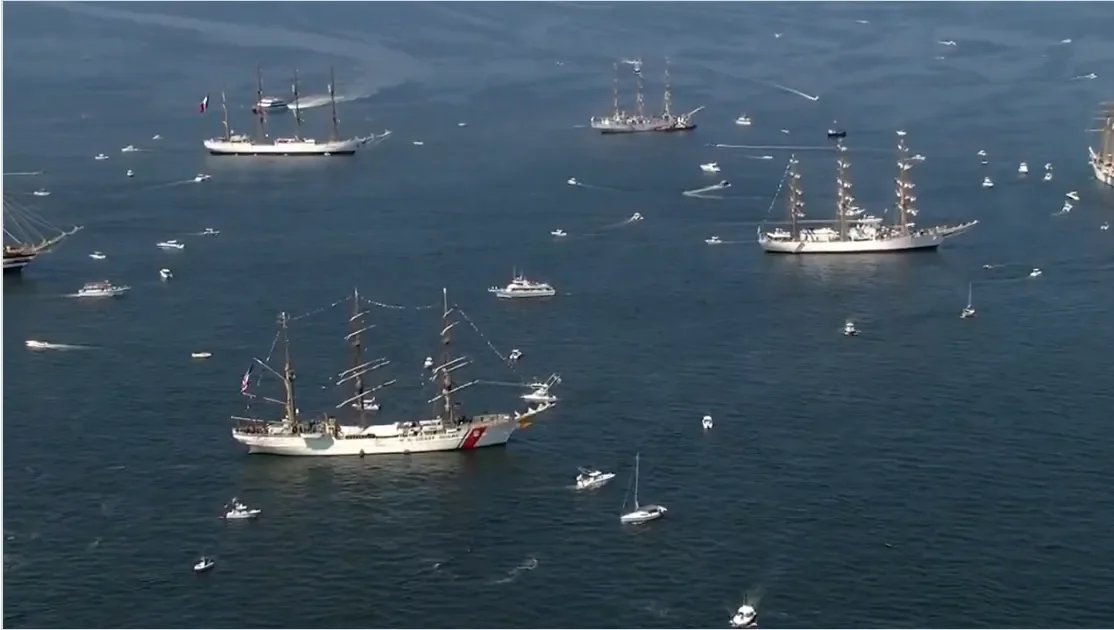
As of today, July 7, 2026, the Sail4th 250 celebration is concluding its final phase of public ship tours across the New York and New Jersey harbor region. The event, which functioned as the centerpiece for the nation’s semiquincentennial, gathered vessels and naval contingents from 46 nations to mark the anniversary of American independence.
The event represents the largest maritime and aerial assembly in American history, utilizing the Hudson River as a corridor for both historical tall ships and modern naval projection.
Operational Scope and Timeline
The festivities were structured around a multi-day itinerary designed to blend public observation with international naval diplomacy:
| Event Component | Key Features |
|---|---|
| Parades of Sail | Transit of Class A and B historic tall ships from Sandy Hook through New York Harbor. |
| Naval Review | Deployment of over 50 U.S. and allied naval vessels anchored along the Hudson River. |
| Aerial Review | Formation flyovers led by the U.S. Navy’s Blue Angels, involving 100+ international aircraft. |
| Public Engagement | Vessel tours scheduled July 5–7 following the primary July 4th parades. |
International Participation: Roughly 20 nations—including Italy, Spain, India, Peru, Poland, and Sweden—contributed vessels to the fleet.
Logistical Complications: A flash storm on July 4th resulted in significant structural damage to the Premier Access area on Governors Island, though primary events continued as planned.
Economic Context: The event serves as the high-water mark for the Sail 250 consortium, a five-city initiative that also includes New Orleans, Norfolk, Baltimore, and Boston.
Investigative Reflection: Diplomacy and Tradition
The reliance on Tall Ships as a mechanism for international commemoration serves a dual purpose: it anchors the current administration’s celebration in the visual lexicon of the Revolutionary War while facilitating informal, high-level interaction between global militaries.
Read More: Great American State Fair on National Mall faces low turnout July 2026
During a period of notable friction in International Relations, these vessels operate as floating embassies. The cadet-exchange culture—documented through the trading of commemorative coins and memorabilia—suggests an effort to maintain a veneer of cooperation beneath the displays of naval hardware. By hosting these foreign militaries in waters directly adjacent to key Revolutionary War sites, the organizers have effectively tethered contemporary geopolitical alignment to the foundational myths of the United States.
The integration of 46 nations into a single naval and aerial display represents a calculated shift in how the state broadcasts its historical legitimacy, moving away from purely domestic displays toward an explicitly internationalized, heavily militarized aesthetic.

:max_bytes(150000):strip_icc():focal(799x0:801x2)/nyc-sky-taylor-swift-travis-kelce-wedding-070326-2dc0d912004b400eac2c8c8b5adeff2a.jpg)
:max_bytes(150000):strip_icc()/GettyImages-186597754-5299e3e5f6b34731bde30b83ba436316.jpg)