Beijing, China - A Chinese-made humanoid robot, identified as Honor's Lightning, has reportedly shattered the human half-marathon world record during a race held in Beijing this past Sunday. The robot's recorded time of 50 minutes and 26 seconds for the 21-kilometer distance significantly outpaced the previous human record of 57 minutes and 20 seconds, set by Uganda's Jacob Kiplimo in March. This development, while framed as a technological leap, occurred alongside a backdrop of less-than-perfect robot performances, with several units experiencing mishaps during the event.
The accelerated progress in humanoid robotics, particularly in athletic demonstrations like this half-marathon, positions China as a key player in the global technological race, even as the practical, widespread application of such machines remains a subject of ongoing discussion.
Dozens of humanoid robots participated in the event, running on a parallel course to approximately 12,000 human competitors. Organizers aimed to mitigate collisions by separating the two groups. While the lead robot demonstrated exceptional speed and autonomous navigation, a notable portion of the competing machines still relied on remote control. This contrasts with last year's inaugural robot half-marathon, where the fastest robot finished in over two hours and forty minutes.
Read More: Google Pixel 10a: Same Chip as Pixel 9a, Adds Satellite SOS
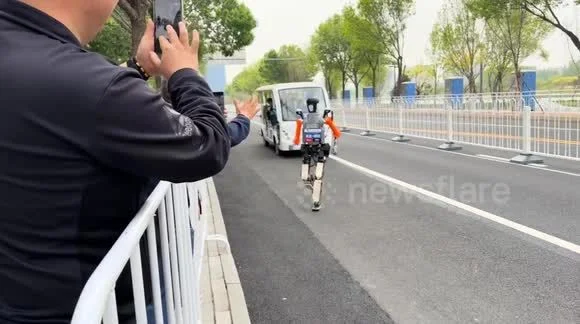
The event was not without its mechanical troubles. Reports indicate that some robots struggled with navigation and obstacles. One autonomous robot, also identified as Lightning, crashed into a railing mid-race. Another unit reportedly fell at the start line during a rehearsal, and some robots were observed stumbling at the beginning of the official race.
"The surprise on the faces of some of the human runners summed up how fast humanoid robots have developed since the first half marathon last year."
This year's race saw significant improvements in robot performance compared to its predecessor. Notably, nearly half of the robots were capable of autonomous navigation, a marked increase from the previous year when most required remote operation. The teams from Honor, a company linked to Huawei, reportedly secured the top three positions with their self-navigating robots.
While the performance of Honor's Lightning has been highlighted as a major achievement, some observers note that excelling in a half-marathon tests specific capabilities like locomotion and energy management. This type of event, they argue, does not fully represent the broader functionalities and task adaptability that define practical robotics, drawing comparisons to robots like BMW's Figure 02 used for industrial tasks.
Read More: Yankees Giancarlo Stanton Calf Injury May Lead to Injured List
The Beijing half-marathon, held in the city's industrial technology hub, has become a platform for showcasing advancements in robotics. Organizers have reportedly introduced new rules to standardize procedures and tighten limits on human intervention in robot operation.