Municipal boundaries and their redrawing have become a focal point for political discourse, with the Bharatiya Janata Party (BJP) actively pushing for changes in various regions, often sparking immediate opposition and accusations of politically motivated maneuvers.
West Bengal: A Rare Point of Agreement?
In the vicinity of Siliguri, a curious alignment has emerged regarding the creation of new civic bodies. Both the BJP and the Trinamool Congress (TMC) have voiced support for separate municipalities in the Matigara–Naxalbari Assembly constituency. The outgoing BJP MLA, Anandamay Barman, has pledged to establish two distinct civic bodies – one for parts of Bagdogra and another for the Matigara–Shivmandir area – should his party form the government in Bengal. This echoes a demand previously raised by TMC candidate Shankar Malakar, who indicated that Chief Minister Mamata Banerjee has already approved the proposal for a separate civic body in the Matigara–Shivmandir region.
Read More: Taiwan Holds Nantou County Drills to Prepare for State Collapse
Odisha: Accusations of 'Copy-Paste' Governance
The Biju Janata Dal (BJD) has sharply criticized the BJP government in Odisha following the recent announcement of 16 new Notified Area Councils (NACs) and seven municipalities. The BJD has characterized this move as a "copy-paste" governance model, suggesting the BJP is repackaging existing plans for political gain rather than introducing genuine initiatives. This criticism emerged after Chief Minister Mohan Charan Majhi presented the urbanisation drive as a significant advancement. The BJD maintains that these declarations lack originality and are merely a rehash of prior development schemes, aimed at garnering political mileage. The state government, however, maintains that it is responding to public demand, with Housing and Urban Development Minister confirming steps to establish these new NACs, with some local representatives advocating for the upgrade of existing areas to municipalities.
Rajasthan: Reversal of New Districts
Conversely, in Rajasthan, the Bhajan Lal government has taken a different tack, scrapping the recent creation of nine new districts and three divisions. The specific justifications for this reversal have not been detailed in the provided material.
Read More: High Court Questions Waqf Board Structure Without Non-Muslim Members
Telangana: Allegations of Conspiracy in GHMC Expansion
The BJP in Telangana has leveled accusations of a "larger conspiracy" behind the merger of several municipalities, corporations, and gram panchayats into the Greater Hyderabad Municipal Corporation (GHMC). While not opposing Hyderabad's expansion in principle, the BJP has condemned the manner in which the Congress government reportedly executed the merger of 20 municipalities, seven corporations, and key gram panchayats without public consultation. The party has also pointed to alleged undue favors extended to the AIMIM and a significant tax hike in newly integrated areas that reportedly still lack basic infrastructure.
Delhi: Renaming Localities
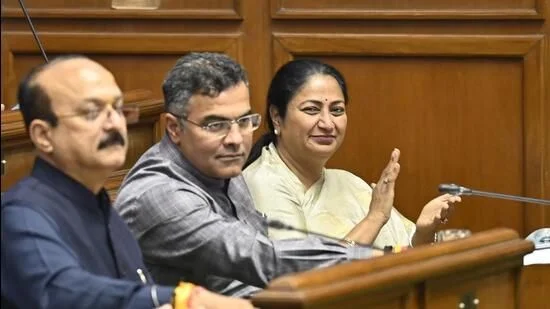
In Delhi, BJP MLAs have put forward proposals to rename three localities: Najafgarh to Nahargarh, Mohammadpur to Madhavpuram, and Mustafabad to Shiv Vihar. These demands are reportedly rooted in historical grievances. However, an official from the Delhi Assembly indicated that the assembly lacks the authority to alter the names of assembly constituencies.
Read More: FBI Analysts Review Georgia 2020 Election Data in Fulton County
Background Dynamics
The proliferation of new administrative divisions and municipal bodies, or the restructuring of existing ones, appears to be a recurring theme across various states. These actions are frequently met with political contention, with opposition parties often questioning the motives and originality of the proposals.
In Odisha, the push for new NACs and municipalities by the BJP government has been met with strong resistance from the ruling BJD, which alleges a lack of fresh ideas.
The BJP's stance in Telangana, opposing the GHMC expansion's methodology, highlights concerns about public input and potential economic implications.
The stark reversal in Rajasthan, with the government undoing recent administrative creations, presents a counter-narrative to the expansionist trend seen elsewhere.
Meanwhile, the West Bengal situation offers a rare instance where both major parties seem to converge on the need for new civic structures, albeit with different political framings.
The renaming proposals in Delhi, though seemingly localized, point to the broader undercurrent of historical narratives influencing present-day administrative decisions.