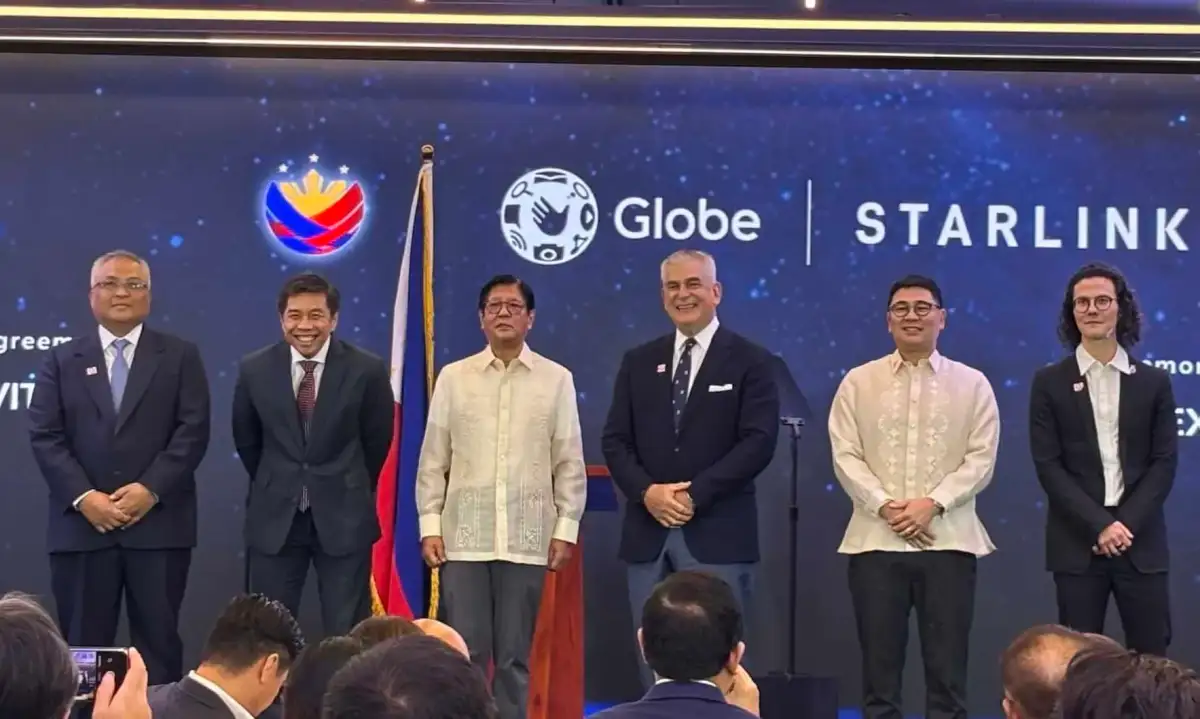
The Philippines has officially become the first nation in Southeast Asia to implement direct-to-cell (DTC) satellite technology, effectively repurposing low-Earth orbit (LEO) satellites as floating cellular base stations. Through a partnership between Globe Telecom and SpaceX’s Starlink, standard LTE mobile devices can now achieve connectivity without proprietary hardware, satellite-specific handsets, or modified SIM cards.
Pilot testing, recently concluded in regions including Rizal, Batangas, and Bataan, confirms that users can maintain a signal link simply by maintaining a clear line of sight to the sky.

Key Technical and Operational Realities
Seamless Integration: The system functions by utilizing the Starlink constellation—currently numbering over 650 satellites—to transmit signals directly to existing mobile frequency bands.
Infrastructure Bypass: In archipelagic topographies where physical tower construction is economically unfeasible, the service offers an alternative to terrestrial build-outs.
Strategic Reach: Initial coverage maps suggest utility for maritime operations, extending at least 12 nautical miles from the coast, in addition to remote, underserved inland communities.
Status: While technical feasibility is proven, commercial pricing models and definitive public rollout dates remain under internal review by Globe Telecom.
"This partnership will usher the Philippines into a new era of connectivity… and will be critical in times of disasters when communication can mean the difference between life and death." — Henry Aguda, Secretary of the Department of Information and Communications Technology (DICT).
A Shifting Regulatory Landscape
The deployment arrives alongside recent legislative adjustments in the Philippines that allow for full foreign ownership in key telecommunications sectors. This shift, supported by the administration of President Marcos Jr., frames the adoption of satellite-to-mobile technology as a matter of "national resilience."
| Feature | Standard Satellite (Dish-based) | Direct-to-Cell (DTC) |
|---|---|---|
| Hardware | External Receiver/Dish | Unmodified Smartphone |
| Deployment | Static (Home/Vehicle) | Mobile/Handheld |
| Application | High-bandwidth Internet | Voice, Text, Basic Data |
| Infrastructure | Ground-based terminal | LEO Space-based station |
Contextualizing the Signal
The industry narrative currently positions this development as an evolution of the traditional mobile network rather than a replacement. The primary technical obstacle has never been the satellite link itself, but rather the business case for closing the final "percent of coverage" in geographically isolated areas. By integrating these satellite assets as a roaming partner—conceptually similar to how a phone switches to a foreign carrier when traveling—the project aims to mitigate the volatility of physical infrastructure during extreme weather events.
Read More: Chrome mimeHandler API lets extensions handle file types
While proponents emphasize disaster preparedness and digital inclusion, the project remains in the testing phase. Regulatory authorities are balancing the immediate benefits of disaster-resilient communications against the long-term dependency on a singular private provider’s proprietary constellation.
Keywords: Satellite Connectivity, Direct-to-Cell, Digital Infrastructure, Telecommunications Policy