
UPDATE: CORONAL HOLE UNDERSTANDING ADVANCES
Khagendra Katuwal, an astronomy student at NMSU, has published work on solar coronal holes that potentially refines how we forecast space weather. The research, detailed in The Astrophysical Journal, focuses on the magnetic conditions within these solar features and their link to high-speed solar wind streams.
JUST IN: IMPLICATIONS FOR FORECASTING
Katuwal's paper, "Unipolarity of the Solar Magnetic Field in Equatorial Coronal Holes," introduces a set of parameters to define "unbalanced" regions on the sun. These are areas from which particles escape more readily, leading to faster, denser solar wind. This work uses data from the Inouye Solar Telescope, described as the world's most powerful solar observatory, to examine these small solar features.
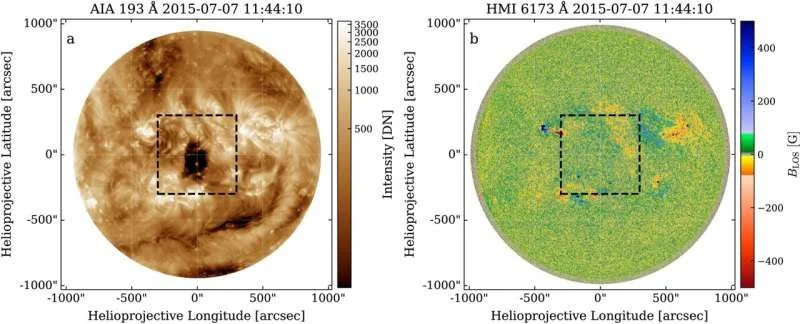
The direct impact of this research on actual forecasting capabilities remains understated. While Katuwal states his findings "help us better understand the magnetic conditions that produce high-speed solar wind streams from coronal holes," the practical steps towards integrating this into predictive models are not yet detailed.
LATEST: BACKGROUND NOISE
Further research is planned using data from the Daniel K. Inouye Solar Telescope. The precise nature of these future investigations and their timeline are not specified.
The summaries for articles from Newswise and Phys.org were too brief to extract substantive information. The NMSU newsroom article, published approximately two weeks ago, is the primary source for this report. The other two articles were published much more recently, one a day ago and another 17 hours prior, but provide no additional material for analysis.