Recent online exchanges between California Governor Gavin Newsom and Texas Senator Ted Cruz highlight a pattern of pointed political sparring, often involving accusations of hypocrisy and claims of victimhood. These public disagreements, frequently conducted on social media platforms, have drawn commentary from various news outlets, underscoring their broader significance in the ongoing political discourse.

The interplay between Newsom and Cruz is not a new phenomenon. Their past exchanges have touched upon issues ranging from Texas Democrats' departure from their state to avoid a redistricting vote, to California's energy infrastructure and redistricting threats. The recent flare-up, involving an apparent jab by Cruz about dyslexia and Newsom's response, appears to be the latest instance in this ongoing dynamic.
A Pattern of Political Engagement
The exchanges between Governor Newsom and Senator Cruz suggest a recurring pattern of public engagement, often characterized by sharp criticism and counter-criticism. Analysis of available reports indicates several key themes:
Read More: President Trump and Governor Moore Argue Over Sewage Spill and City Problems

Disputes Over Political Maneuvers:
In August 2025, a conflict arose concerning Texas Democrats who left the state to avoid a redistricting vote. Newsom publicly supported these Democrats, while Cruz and other Texas officials pursued legal action. This situation escalated into a public exchange between Newsom and Cruz, referencing past political controversies. This event shows how state-level political disputes can attract national attention and involve prominent figures from opposing parties.
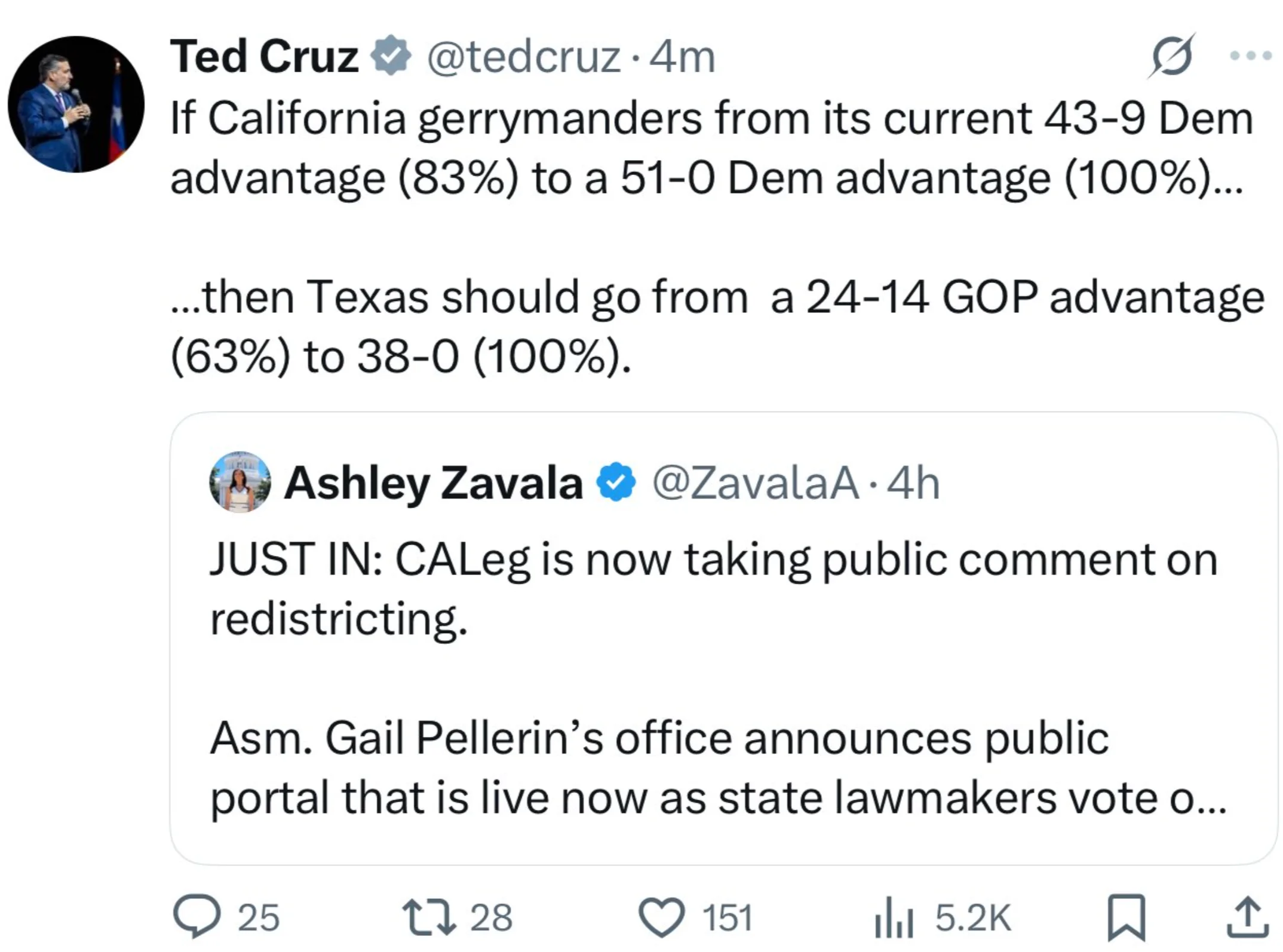
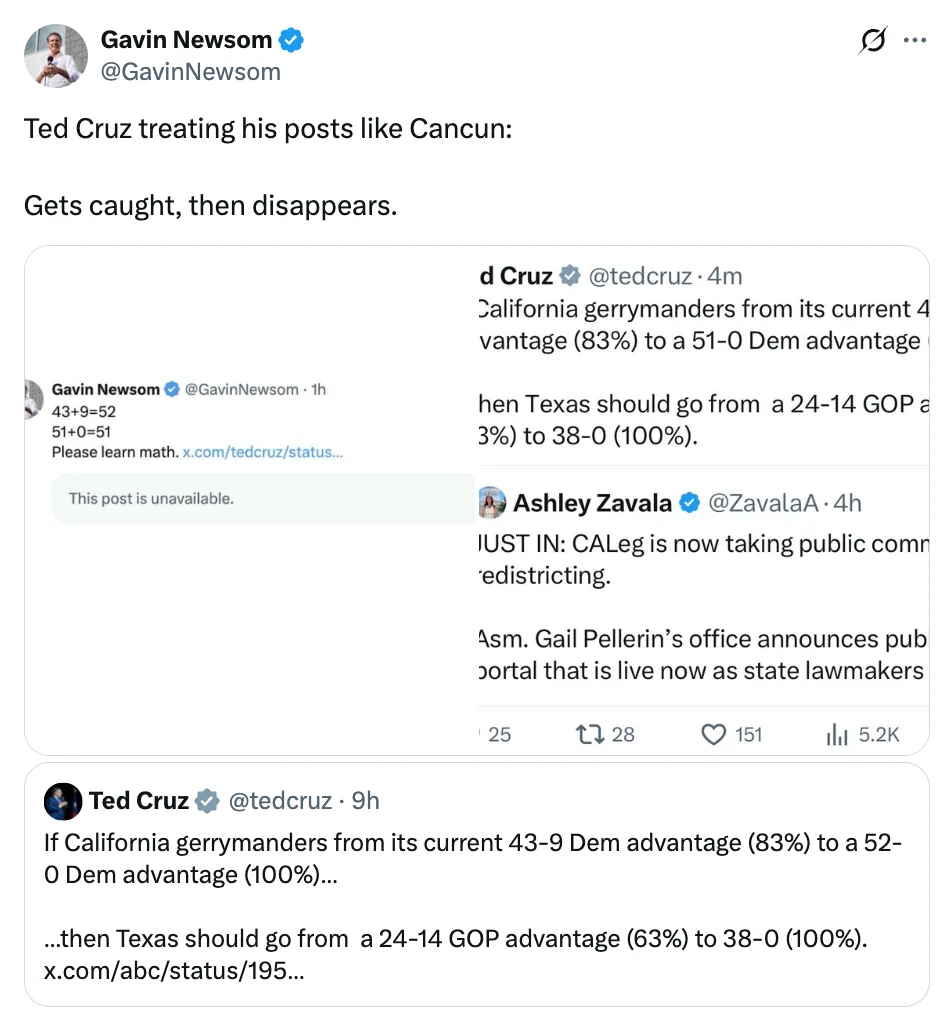
Later in August 2025, Newsom threatened to redraw California's congressional districts after a deadline for Donald Trump and Texas Republicans to intervene passed. Cruz responded to this threat, and the exchange involved accusations of insults and distractions. Newsom also accused Cruz of mathematical errors in his criticism. These interactions highlight the strategic use of redistricting threats as a political tool and the subsequent verbal sparring that can ensue.
Accusations of Hypocrisy and Victimhood:
In February 2026, a disagreement surfaced where Ted Cruz reportedly made a remark perceived as mocking dyslexia. Newsom's perceived response to this jab was characterized by some outlets as a "victimhood self-own," suggesting an attempt to claim victim status rather than engaging with substantive issues. This incident points to the sensitivity surrounding personal characteristics in political attacks and how responses can be framed as attempts to garner sympathy.
Previous reports from September 2022 indicate Cruz criticized Newsom regarding California's electricity issues, using a "let them eat cake" analogy. This criticism was met with backlash, with some framing Cruz's remarks as hypocritical given Newsom's calls for energy conservation. This demonstrates a recurring theme where one politician criticizes another's handling of state issues, only to face accusations of hypocrisy themselves.
Social Media as a Battleground:
Many of these exchanges unfold on platforms like X (formerly Twitter), where politicians can directly address each other and a broad audience. Newsom's recent use of a social media strategy, described as "Trump-esque," has also drawn attention and commentary, suggesting a deliberate tactic to engage and provoke a reaction. The reliance on social media for these disputes underscores its role as a primary arena for modern political communication and conflict.
Conflicting Interpretations of Actions
The public commentary surrounding these exchanges reveals differing perspectives on the motivations and implications of Newsom's and Cruz's actions.
Read More: Shooting at Rhode Island Hockey Game Kills Two, Hurts Three
Newsom's Tactics: Strategic Engagement or Victimhood?
Argument for Strategic Engagement: Some reports suggest Newsom's responses are deliberate and strategic. His engagement with Cruz, particularly his lean-in to jokes and the adoption of a particular social media style, can be interpreted as a calculated effort to control narratives and provoke a reaction from political opponents. For example, after Cruz's alleged jab regarding dyslexia, Newsom's response was framed by some as "leaning into the joke" and posting a caption about "democracy requires flexibility."
Argument for Victimhood Claims: Conversely, other analyses characterize Newsom's reactions as "claiming victimhood" or committing a "victimhood self-own." This perspective suggests that rather than engaging on policy or strength, Newsom resorts to portraying himself as wronged, which is seen as a weak or unproductive tactic by his critics. The "hurt feelings report" metaphor used by one outlet illustrates this viewpoint.
Cruz's Role: Provocateur or Critic?
Argument for Provocation: Cruz's actions are often described as "jabs," "throwing shade," or attempting to "drag" Newsom. This framing implies a deliberate intent to provoke a reaction or to elicit a negative response from the California Governor. His participation in discussions, even when seemingly tangential, suggests an active role in escalating public disputes.
Argument for Legitimate Criticism: From another viewpoint, Cruz's interventions can be seen as legitimate criticism of Newsom's policies or actions. For instance, his comments on California's energy issues or his involvement in the Texas redistricting dispute could be interpreted as Senatorial oversight or concern over governance in another state, rather than mere provocation.
Expert Commentary and Broader Implications
The frequent back-and-forth between Newsom and Cruz has not gone unnoticed by political observers.
Read More: Angus Taylor Becomes Liberal Party Leader, Picks More Conservative Team
"Newsom and Cruz's interventions epitomize how far-reaching the Texas saga is and its broader significance in national politics." - Newsweek
This observation suggests that the disputes between these prominent figures extend beyond their individual interactions and reflect larger, ongoing political struggles between California and Texas, and between Democratic and Republican parties nationally.
"Newsom's obsession with Trump is distracting him from doing his job as governor." - Ron DeSantis, as reported by LA Times, quoting a discussion with Jesse Watters.
This quote, while focusing on Newsom's engagement with Trump, touches upon a broader critique that his public disputes and social media presence might detract from his gubernatorial duties. This raises questions about the balance between national political posturing and state-level governance.
Conclusion and Ongoing Dynamics
The repeated exchanges between Gavin Newsom and Ted Cruz demonstrate a consistent pattern of public political conflict. These disputes, largely conducted through social media, involve sharp criticisms, accusations of hypocrisy, and differing interpretations of actions as either strategic maneuvers or attempts to claim victimhood.
Read More: Iowa State Beats Houston in Close Game
The issues at the heart of their disagreements have spanned legislative maneuvers, energy policy, and even personal characteristics, indicating a wide scope for their public clashes. The commentary from various news outlets suggests that these exchanges are viewed as significant, not just for the individuals involved, but for their reflection of broader political tensions.
Next Steps: The continuation of these patterns suggests that future political disagreements between Newsom and Cruz are likely. The way each politician frames these disputes, and the public's reception of those frames, will continue to be a focal point for political analysis. The extent to which these public battles influence public perception of their leadership and policy effectiveness remains an ongoing area of observation.
Sources:
RedState: Published recently, this article focuses on Newsom's reaction to a perceived jab from Cruz regarding dyslexia, framing Newsom's response as a "victimhood self-own."🔗 https://redstate.com/sister-toldjah/2026/02/16/gavin-newsom-hurt-feelings-report-ted-cruz-n2199237
Newsweek (August 2025): Reports on the war of words between Newsom and Cruz concerning Texas Democrats fleeing their state. Highlights the national significance of the dispute.🔗 https://www.newsweek.com/gavin-newsom-ted-cruz-texas-democrats-2111374
BuzzFeed (December 2025): Discusses an instance where Cruz reportedly tried to criticize Newsom, but the reaction backfired, with Newsom "leaning into the joke."🔗 https://www.buzzfeed.com/bellaarnold/gavin-newsom-response-to-ted-cruz
BuzzFeed (August 2025): Details an exchange where Newsom criticized Cruz's mathematical skills related to redistricting threats, with Newsom accusing Cruz of a "flub."🔗 https://www.buzzfeed.com/mjs538/newsom-vs-cruz
WesternJournal: Published in March 2023, this article criticizes Newsom for traveling while Californians faced power outages, framing it as hypocrisy. While it mentions Newsom being "torched," the direct link to Cruz in the summary is less clear compared to other articles.🔗 https://www.westernjournal.com/newsom-gets-torched-caught-exact-thing-left-blasted-ted-cruz/
Fox News Video: A link to a Fox News video segment titled "Ted Cruz: Gavin Newsom is 'dishonest' and a 'hypocrite'." The summary provided does not contain the content of the video itself.🔗 https://www.foxnews.com/video/6377282938112
Newsweek (September 2022): Details Cruz's criticism of Newsom over California's electricity issues and the subsequent backlash against Cruz.🔗 https://www.newsweek.com/ted-cruz-blasted-after-ripping-newsom-californias-electricity-issues-1740878
Mediaite (August 2025): Reports on Newsom and Cruz trading insults, specifically after Cruz's "jab" at Newsom's redistricting threat contained a mathematical error, prompting Newsom's "Please Learn Math" retort.🔗 https://www.mediaite.com/politics/please-learn-math-newsom-and-ted-cruz-trade-insults-after-texan-flubs-jab-at-california-redistricting-threat/
LA Times: A commentary piece discussing how Newsom's actions, including his social media engagement style, have generated significant reactions, particularly from outlets like Fox News. It includes a quote from Ron DeSantis regarding Newsom's focus.🔗 https://www.latimes.com/entertainment-arts/story/2025-08-22/fox-news-triggered-by-gov-gavin-newsom-trumpy-tweets
Pride.com: This article highlights Newsom's social media strategy, particularly his "roasts" of Donald Trump, and notes his press office's ability to post in a style that angers MAGA supporters.🔗 https://www.pride.com/culture/gavin-newsom-social-media
Read More: AOC and Rubio Discuss Cowboy History