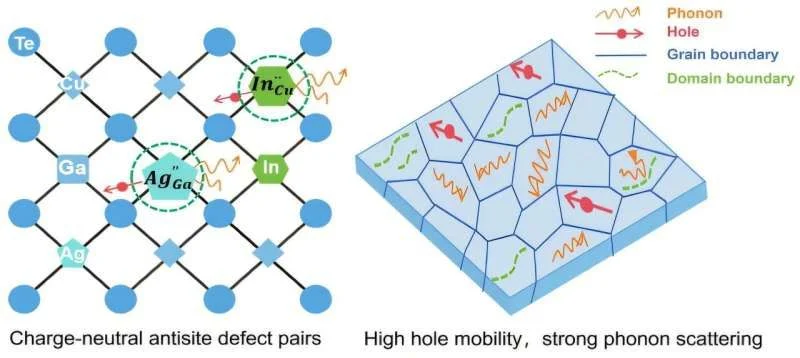
Recent scientific forays into chalcopyrite compounds have yielded substantial gains in thermoelectric performance. Researchers have engineered a novel system, denoted as Cu0.7Ag0.3Ga1-xInxTe2, through a deliberate introduction of dual antisite defects. These defects, which arise from atoms unexpectedly occupying incorrect positions within the material's crystal structure, have proven instrumental in a crucial decoupling of thermal and electrical transport. This strategic manipulation allows for more efficient energy conversion, sidestepping long-standing limitations.

The core breakthrough lies in the ability of these carefully crafted defects to independently influence the material's conductivity of heat and electricity. This 'defect engineering' allows for optimization, where improvements in electrical conductivity do not necessitate a corresponding, detrimental increase in thermal conductivity. The findings, detailed in publications such as the Journal of the American Chemical Society, represent a significant stride in developing materials capable of converting waste heat into usable electricity more effectively.
Read More: New Micro-Lasers Measure Force Inside Cells

Decoupling Mechanism and Its Ramifications
The introduction of dual antisite defects serves as a catalyst for a significant decoupling mechanism. This process, driven by subtle atomic rearrangements, offers a new framework for tackling the inherent challenges in thermoelectric material design. Traditionally, efforts to boost charge carrier density, a factor aiding electrical conductivity, often led to an unwanted rise in lattice thermal conductivity, thereby diminishing overall efficiency. The dual antisite defect strategy effectively circumvents this established coupling.
The intricate ways these defects influence electron-phonon interactions and lattice dynamics open up avenues for further investigation. Researchers are exploring these multiscale coupling effects within thermoelectrics and potentially beyond.

Broader Context in Thermoelectric Development
The pursuit of advanced thermoelectric materials is closely tied to the growing imperative for efficient energy use. Applications range from industrial waste heat recovery in power plants and automotive systems to specialized uses in spacecraft. While materials like lead telluride have shown promise, issues such as mechanical brittleness have historically constrained their widespread deployment in high-performance thermoelectric generators.
Read More: Heated Rocks Capture CO2 1000s of Times Faster
Previous research has explored various defect structures and alloying strategies to enhance thermoelectric properties. Studies on CuGaTe2 and GeTe-based materials, for instance, have highlighted the significant impact of atomic defects and microstructural engineering on both thermal and electrical conductivity. Some investigations have even considered the influence of external factors like pressure on the thermoelectric behavior of defect-containing chalcopyrites, employing computational methods to understand these complex relationships. The current work builds upon this foundation, demonstrating a refined approach to defect manipulation for superior outcomes.