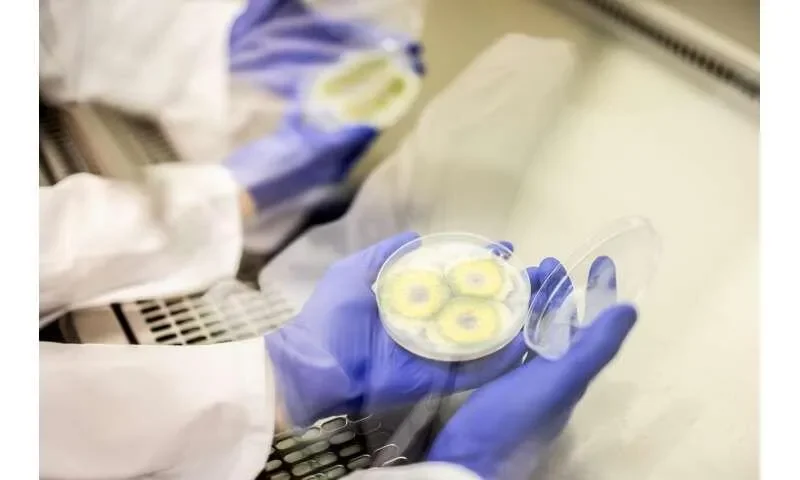
A cell-permeable nanobody demonstrates the ability to repair misfolded cystic fibrosis transmembrane conductance regulator (CFTR) proteins directly within cells, potentially restoring function and opening new therapeutic avenues for cystic fibrosis (CF). This development marks a departure from existing treatments, offering a direct cellular repair mechanism.

Researchers have successfully engineered a nanobody, designated FITC-NB1-R10, capable of penetrating cell membranes. Once inside, it targets the mutated F508del-CFTR protein, the most common genetic defect in CF. Laboratory tests, including live-cell microscopy on CFBE41o-cells, confirmed the nanobody's presence within cells for extended periods—at least 24 hours after initial exposure. This sustained interaction suggests the nanobody can effectively engage with and attempt to correct the misfolded protein.

The nanobody's interaction is described as adhering to the mutated CFTR channel. This physical binding is proposed to facilitate the correction of folding defects. The research presents this as a "preclinical proof of concept for CFTR channel repair" and, importantly, as the "first example of a functional, cell-permeable antibody."
Read More: India IVF Costs And Social Barriers Limit Access In April 2026

Shifting Therapeutic Landscape
This nanobody approach represents a fundamentally new therapeutic strategy, distinct from current CFTR modulator therapies. Existing treatments, such as combinations involving lumacaftor, ivacaftor, tezacaftor, and elexacaftor, aim to improve the stability and function of CFTR proteins or to enhance the channel's opening probability. Some of these drugs act as "correctors" to address folding defects, while others function as "potentiators" to increase channel activity once the protein reaches the cell surface. The nanobody, however, directly intervenes at the molecular level to repair the protein itself.
Underlying Cellular Dysfunction
Cystic fibrosis is fundamentally a protein-folding disorder. The CFTR protein, a chloride channel essential for maintaining the balance of salt and water on many surfaces in the body, malfunctions when it doesn't fold correctly. This misfolding, particularly the prevalent F508del mutation, causes the protein to break down within the cell before it can reach its intended location on the cell surface. Consequently, it cannot perform its function, leading to the accumulation of thick, sticky mucus in various organs, primarily the lungs.
Read More: Penn Scientists Use New Tool to Unlock Fungi Genes for Cancer Drugs
Broader Implications and Future Directions
The success of this cell-permeable nanobody could extend beyond cystic fibrosis. Researchers suggest this work "lays the foundation for broader therapeutic applications," implying that the technology could be adapted to address other protein-folding diseases. The field of CF treatment has been evolving, with increasing focus on 'precision medicine' and combinatorial therapies targeting different aspects of CFTR dysfunction, including gene therapy approaches. However, the direct repair offered by this nanobody presents a potentially simpler, yet more direct, intervention.
The research on the nanobody was detailed in a preprint published on April 26, 2024, on biorxiv.org. This work is seen as a significant step forward, potentially opening new avenues for improving CF treatment and beyond.