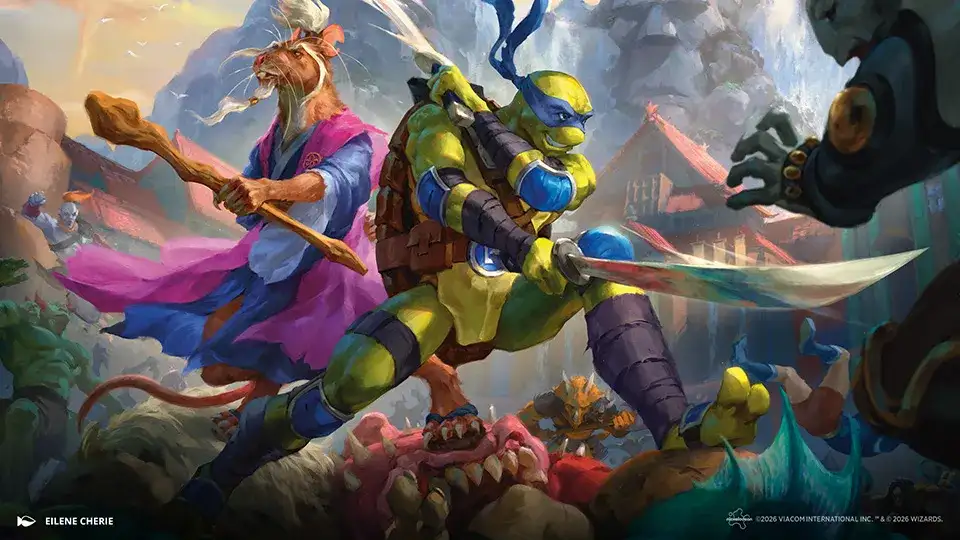
Wizards of the Coast, the architects behind the sprawling 'Magic: The Gathering' universe, are rolling out a new product, the "Turtle Team-Up" set, specifically targeting neophytes. This latest iteration, featuring the iconic 'Teenage Mutant Ninja Turtles', introduces a 'cooperative game mode' designed to ease players into the notoriously complex card game. The box itself bundles four pre-constructed 60-card decks, each dedicated to one of the shelled heroes: Michelangelo, Raphael, Leonardo, and Donatello. Complementing these are a 38-card "boss deck" populated with familiar adversaries like Shredder and Krang, alongside various "traps and events". The inclusion of four 'Play Booster packs' suggests an immediate pathway from cooperative play to more competitive engagements once the basics are absorbed.

A Co-op Approach to a Competitive Battlefield
The fundamental premise of 'Turtle Team-Up' pivots from the game's traditional player-versus-player dynamic to a shared experience against a scripted opponent. In this mode, 'two to four players' assume the roles of the turtles, pooling their "team health" – which scales with player count (20 for two players, 30 for three, 40 for four) – to confront a boss whose "health" also fluctuates (20 for two or three players, 30 for four). This 'cooperative format' marks a significant departure, presenting 'Magic: The Gathering' as a unified front rather than a series of individual battles. This shift aims to demystify the game's mechanics, allowing players to learn by doing, with a common objective against a clearly defined enemy.
Read More: Street Fighter 6 Year 4 Pass adds Tifa and 3 new fighters in 2026
The Business of Beginners and Beyond
Wizards of the Coast has a history of attempting to onboard new players. Previous efforts include "Starter Kits", the entry-level "Magic: The Gathering Foundations", and "Beginner Boxes" with explicit learning modules. The "Turtle Team-Up" aims to build upon these, offering a more integrated and thematic introduction. The product's success hinges on its ability to retain engagement beyond the initial cooperative victory, potentially leading players to explore more traditional competitive formats or delve into collecting specific cards. However, some critics note that hardcore competitive players might find the co-op mode lacking, and those primarily seeking to amass valuable cards may be better served by purchasing individual "singles" or bulk "booster packs" for a more cost-effective acquisition of rare commodities.
Contents and the Canonical Connection
The "Turtle Team-Up" set meticulously lays out its components, revealing a deliberate curation of characters and scenarios from the 'Teenage Mutant Ninja Turtles' lore. The boss deck, in particular, features a rogues' gallery of antagonists including Shredder, Krang, Bebop, Rocksteady, Leatherhead, Slash, and Savanti Romero, each representing a distinct challenge. The game's structure appears to incorporate escalating difficulty through "Mutation counters" that advance the boss through distinct phases, introducing new threats like "double strike" and the summoning of "Foot Soldier tokens." The inclusion of "Play Booster packs" alongside the pre-built decks suggests a blend of curated learning and the potential for player customization, a common strategy in 'Magic: The Gathering' products.
Read More: Jensen Huang's Signed Jacket Auctions for Over $60,000
The Price of a Pint-Sized Shell
Priced at approximately $50, the "Turtle Team-Up" box is positioned as an accessible entry point. While it offers a contained "boxed experience" designed for immediate play, questions arise regarding its long-term value proposition. For those whose primary interest lies in collecting, or those already steeped in the competitive scene, the product might appear less appealing. The inherent replayability of the cooperative mode, once the boss battles are conquered, is a point of consideration for potential buyers. Enthusiasts of the 'Teenage Mutant Ninja Turtles' franchise are likely to find a particular draw in the thematic integration, adding a layer of nostalgia and fan service to the gameplay.
Read More: Steam Machine GPU failure causes Red Line of Death on 7 April 2026



/content/opengraph/MTG-Top-10-Best-Commander-Cards-From-Magic-The-Gathering-Marvel-Super-Heroes-MSC-MSH.png)