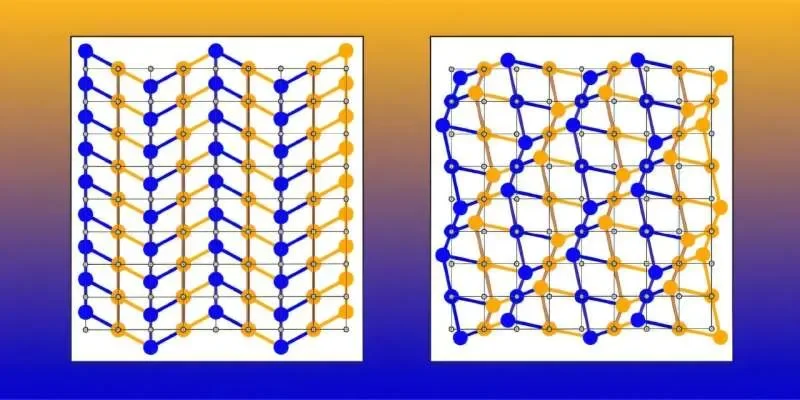
A recent development in materials science points towards a future of faster, more efficient microcircuits. Researchers have identified a readily available, inexpensive compound, lead iodide (PbI₂), that exhibits a remarkable ability to manipulate light within extremely small dimensions. This breakthrough holds significant promise for the creation of photonic microcircuits capable of operating in the elusive terahertz frequency range.
The core innovation lies in lead iodide's capacity to confine light, enabling its use in submicrometer regions. This is crucial for building circuits that leverage light – specifically, a phenomenon known as 'phonon-polaritons' – to transmit information. Unlike conventional electronic circuits that rely on electrons, these light-based systems promise dramatically increased speeds and significantly lower energy losses.
The research, published in Nature Communications, highlights the use of a two-dimensional lamellar crystal made of atomically thin layers of lead iodide. This structure allows for the precise control of light combined with mechanical vibrations.
Read More: Steam Controller Files Released April 27, 2026 As Steam Machine Faces Delays
A key advantage of lead iodide is its accessibility. The material is synthesized from iodine and lead, both of which are described as inexpensive and naturally occurring precursors. This suggests a pathway for more practical and cost-effective implementation of these advanced terahertz technologies. The ability to operate at terahertz frequencies is particularly noteworthy, as this range sits between microwaves and infrared light, offering a vast, largely untapped spectrum for high-speed data transmission.