On a day meant for deliberation and representation, the Jammu and Kashmir Legislative Assembly witnessed a dramatic walkout, orchestrated by Sajad Lone, chief of the Peoples Conference. The cause? The outright rejection of several key amendments he proposed to the Lieutenant Governor's address. Lone, a prominent voice in the region, didn't just leave; he delivered a stinging indictment, calling the proceedings "theatrics" and lamenting that "history will read what was said inside." But what exactly was said, and more importantly, what was deliberately unsaid? This incident raises profound questions about democratic discourse in J&K and the future of its political aspirations.
The Crucial Omissions and the Speaker's Stonewall
The heart of the controversy lies in amendments proposed by Sajad Lone that aimed to address critical issues affecting the people of Jammu and Kashmir. According to reports, Lone's proposed amendments highlighted:
Read More: Taiwan Holds Nantou County Drills to Prepare for State Collapse
The urgent need to address the safety and security of Kashmiris, particularly in light of recent targeted attacks.
The regularization of daily wagers, a significant segment of the workforce often left in precarious employment situations.
Enhanced opportunities for civil service aspirants, suggesting a need for fairer and more accessible pathways into government service.
A specific call to condemn attacks on Kashmiris, such as the reported targeting of Kashmiri shawl sellers in states like Uttarakhand and Himachal Pradesh.
A direct mention of Article 370 in the Governor's address, seeking to reignite discussions on the region's revoked special status.
The revocation of the Public Safety Act (PSA) and concerns regarding police verification processes.
When Lone questioned why these vital amendments were being disallowed, the Speaker, Abdul Rahim Rather, offered a series of explanations. On the matter of Special Status and Article 370, Rather stated that the House had already passed a resolution on the topic in a previous session, deeming further discussion unnecessary. For issues like the PSA and police verification, the Speaker cited their being under the purview of the Union Government, implying the J&K Assembly lacked the authority to legislate on them. He also dismissed the possibility of probing the alleged rigging of the 1987 polls, citing the passage of over 37 years.

"The House has already passed a resolution with regard to Special Status of J&K in the first Assembly session. The proposed amendments noted that the speech failed to address the safety of Kashmiris, the regularisation of daily wagers and enhanced opportunities for civil service aspirants." - Speaker Abdul Rahim Rather, as reported by The Indian Express.
This response, however, has done little to quell the storm. Lone argued that the previous resolution on Article 370 was insufficient and that the current assembly should have the right to discuss and demand its restoration. The rejection of amendments concerning daily wagers and civil service aspirants further fuels the perception that the administration is sidestepping fundamental concerns of the populace.
Read More: Kishtwar Police Arrest Two for Helping Militants
A Pattern of Dissent: Lone's Past Battles for Constitutional Channels
This is not the first time Sajad Lone has voiced strong objections to what he perceives as procedural or constitutional overreach, or a lack of genuine democratic engagement. His walkouts and public statements often center on the belief that substantive constitutional pathways are being bypassed in favor of superficial gestures.
Statehood and the Supreme Court: In August 2025, Lone publicly criticized the Chief Minister's "signature campaign" for the restoration of statehood. He argued that such campaigns lacked legal and constitutional sanctity, asserting that the correct approach was to pass a resolution in the State Assembly before approaching the Supreme Court. His stance was clear: Jammu and Kashmir should present itself to the highest court as a "constitutional entity," not merely as a collection of individuals. He famously quipped, "This is not a video game… but I am asking you, CM sahib—where were you sleeping?" (Asian Mail).
Challenging Unpopular Laws: Lone has consistently challenged the application of laws like the Public Safety Act. His frustration stems from the perceived misuse of such acts and the lack of accountability. He has argued passionately that individuals should not be punished for the actions of their relatives, a sentiment that resonates with many families in the region who have faced collective punitive measures. (Times of India).
The Ghost of 1987: The rejection of his motion to probe the alleged rigging of the 1987 assembly elections is particularly sensitive. This election is widely seen as a turning point in the region's history, sowing seeds of alienation and militancy. For many, an inquiry into these alleged malpractices is not just about historical accuracy but about acknowledging past injustices and building future trust. The Speaker's dismissal, citing the time elapsed, feels like another attempt to bury uncomfortable truths. (ABP Live).
Lone's consistent advocacy for established constitutional procedures and his critique of symbolic political actions underscore his belief that genuine democratic progress in J&K requires more than just rhetoric or bureaucratic hurdles. He appears to champion a vision where the assembly serves as a true forum for debate and the pursuit of constitutional remedies.

The Power of the Speaker: Gatekeeper of Assembly Discourse?
The role of the Speaker in any parliamentary democracy is pivotal. They are expected to be impartial arbiters, ensuring that all voices are heard and that the proceedings adhere to established rules and conventions. However, in J&K, the Speaker's decisions in recent times have come under intense scrutiny, with critics arguing that they are increasingly becoming instruments to stifle dissent rather than facilitate it.
Read More: FBI Analysts Review Georgia 2020 Election Data in Fulton County
| Rejected Amendment Category | Speaker's Rationale | Sajad Lone's Counter-Argument | Implication |
|---|---|---|---|
| Article 370 & Special Status | House already passed a resolution; no further action needed. | Previous resolution was insufficient; current assembly must debate and demand restoration. | Stifling discussion on a core political aspiration for many in J&K. |
| Public Safety Act (PSA) | Under the purview of the Union Government. | Assembly should still debate and condemn its misuse; victims' rights are a local concern. | Prevents local legislative bodies from addressing laws that significantly impact citizens. |
| Police Verification | Beyond the control of the local government; under Union Home Ministry. | Local impact necessitates local discussion and potential intervention. | Similar to PSA, local governance is limited on critical citizen-facing issues. |
| Daily Wagers & Civil Services | Not mentioned in the Governor's address (implying they weren't considered important). | These were key omissions, necessitating amendments to address widespread public concerns. | Suggests a disconnect between the administration and the daily realities of J&K residents. |
| Condemnation of Attacks | Not explicitly stated as a reason for rejection, but part of broader disallowance. | Essential for the safety and morale of Kashmiris, especially given external incidents. | Fails to acknowledge and address growing anxieties among specific communities. |
| Probe into 1987 Poll Rigging | Over 37 years have passed; impractical to probe. | Acknowledging past injustices is crucial for reconciliation and future trust. | Buries historical grievances, hindering a path towards genuine healing. |
"We cannot keep quiet on these issues," Lone is quoted as saying, emphasizing the urgency of the matters he sought to bring before the House. (Times of India).
The repeated rejection of substantive amendments, coupled with Lone's walkout, sends a strong signal. It raises the uncomfortable question: Is the J&K Assembly truly a sovereign space for debate on the region's future, or is it increasingly becoming a platform for symbolic gestures, with key decisions and discussions being preempted by the central government's agenda? The Speaker’s role, in this context, becomes that of a gatekeeper, deciding what constitutes legitimate discourse and what falls outside the permissible boundaries.
The Specter of ‘Theatrics’ and Constitutional Pathways
Sajad Lone's repeated use of the term "theatrics" is a pointed critique of political maneuvering that he believes lacks substance. His frustration appears to stem from a perception that the administration is more interested in projecting an image of normalcy and governance than in engaging with the deeply complex and often painful realities of Jammu and Kashmir.
Read More: Poonch LoC: Army Stops Pakistan Militant Crossing, Search Ongoing
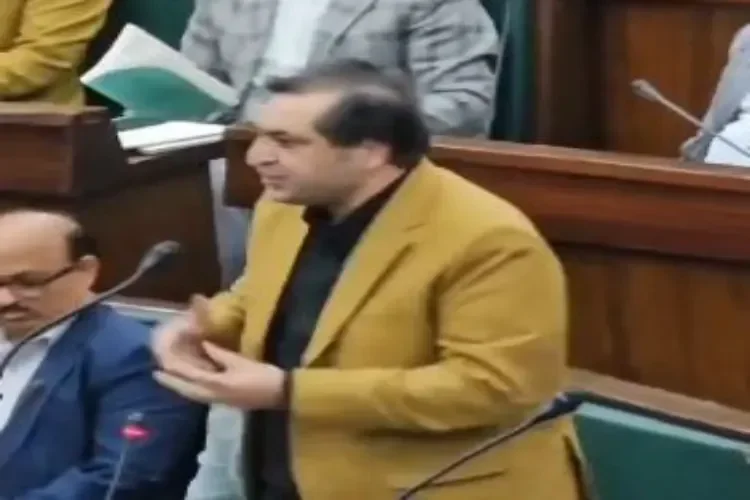
His insistence on constitutional pathways – advocating for assembly resolutions before approaching the Supreme Court, or demanding local debate on laws like the PSA – points to a belief that the region's aspirations should be pursued through established legal and democratic frameworks. When these frameworks appear to be circumvented or shut down, his reaction is one of profound disillusionment.
"History will read what was said inside," Lone declared, implying that the silence imposed by the rejection of amendments is a historical record in itself – a testament to what the assembly failed to discuss or address.
This is a powerful statement. It suggests that the omissions, the disallowed debates, and the walkouts themselves will be the subject of future historical analysis, revealing the limitations of the current political process. The rejection of amendments concerning the safety of Kashmiris, particularly in light of attacks on Kashmiri traders elsewhere, highlights a failure to provide a platform for addressing acute public anxiety. The continued omission of Article 370 from any substantive assembly discourse, despite its centrality to the region's political identity for decades, speaks volumes about the new political reality.
Read More: US 250th Anniversary: Pride Divided by Politics
The implication is that by rejecting these amendments, the assembly is not merely refusing to discuss specific issues; it is actively choosing to ignore the pressing concerns and historical narratives that shape the identity and aspirations of Jammu and Kashmir. This is not just about parliamentary procedure; it’s about the perceived erosion of democratic space and the silencing of legitimate political grievances.
What Happens When the Assembly Rooms Go Quiet?
The walkout by Sajad Lone is more than just a dramatic exit; it's a symptom of a deeper political malaise. When key issues are deemed off-limits, and when proposed amendments aimed at addressing the concerns of daily wage earners, civil service aspirants, and the broader Kashmiri populace are rejected, what remains of the assembly's purpose?
The Speaker’s reliance on the Union government’s purview for matters like the PSA and police verification effectively circumvents the local legislature's ability to act as a check and balance, or even as a forum for public grievances. This raises fundamental questions:
What is the true autonomy of the J&K Assembly in addressing the concerns of its people?
To what extent are legislative decisions dictated by the agenda of the central government?
Does the rejection of amendments related to Article 370 signify a permanent closure on the debate about J&K's constitutional future within the assembly?
How can trust be built and public representation be meaningful if the assembly cannot even formally acknowledge or debate critical issues like the safety of its citizens or historical grievances?
Lone's departure from the assembly, armed with his sharp critique of "theatrics," serves as a stark reminder that democratic legitimacy hinges not just on the performance of procedures, but on the substantive engagement with the people's issues. The silence that follows such walkouts in the assembly hall may be a temporary respite for those in power, but for the people of Jammu and Kashmir, it echoes with unaddressed anxieties and unmet aspirations. The history that Lone invokes will undoubtedly scrutinize not only what was spoken, but more profoundly, what was deliberately left unsaid.
Sources:
Indian Express: ‘History will read what was said inside’: Sajad Lone slams ‘theatrics’ as J&K Speaker rejects key amendments. Published: il y a 58 minutes. https://indianexpress.com/article/india/sajad-lone-slams-theatrics-as-jk-speaker-rejects-key-amendments-10511463/
Asian Mail: “Theatrics won’t restore statehood”: Sajad Lone Slams CM’s signature campaign. Published: 15 août 2025. https://asianmail.in/2025/08/15/theatrics-wont-restore-statehood-sajad-lone-slams-cms-signature-campaign/
The Times of India: Sajad Lone walks out of assembly as Speaker rejects his motions | India News. Published: 4 mars 2025. https://timesofindia.indiatimes.com/india/sajad-lone-walks-out-of-assembly-as-speaker-rejects-his-motions/articleshow/118717406.cms
ABP Live: j&Sajad Lone Walks Out Of J&K Assembly With Salvo At NC: 'Ban On Talking About Art 370'. Published: 4 mars 2025. https://news.abplive.com/news/india/sajad-lone-walks-out-of-jammu-kashmir-assembly-after-motion-on-article-370-rejected-1755299
Kashmir InFocus: Speaker Disallows Amendments, Sajad Lone Stages Walkout in Protest. Published: 5 mars 2025. https://kashmirinfocus.com/2025/03/speaker-disallows-amendments-sajad-lone-stages-walkout-in-protest/
Awaz The Voice: Sajad Lone walks out of J&K Assembly after amendment motion on Article 370 disallowed. Published: 4 mars 2025. https://www.awazthevoice.in/india-news/sajad-lone-walks-out-of-j-k-assembly-after-amendment-motion-on-article-disallowed-35018.html