Recent tests of drogue parachutes are a significant step for India's Gaganyaan human spaceflight mission, aimed at ensuring astronaut safety during the journey back to Earth. These parachutes are vital for slowing down the crew capsule after it re-enters the atmosphere. Successful tests suggest progress towards India's goal of becoming the fourth nation with independent human spaceflight capabilities.

The Gaganyaan mission plans to send a three-person crew into orbit. A crucial part of bringing them back safely involves a series of parachutes designed to slow the crew module. Drogue parachutes are among the first deployed to stabilize the capsule and reduce its high speed, preparing it for the main parachutes.

What: Drogue parachute tests for Gaganyaan.
Who: Indian Space Research Organisation (ISRO) and Defence Research and Development Organisation (DRDO).
Why: To ensure the safe descent and landing of astronauts.
When: Recent tests occurred in August 2023 and were highlighted in February 2025 reporting, with other related tests in September 2025.
Parachute System Explained
The parachute system for the Gaganyaan crew module is complex and involves multiple stages to ensure a safe landing.

Drogue Parachutes: These are deployed first. They are packed inside devices called mortars. When commanded, these mortars eject the drogue parachutes, which are conical ribbon types, to stabilize the capsule and reduce its speed significantly. This is the "first brake" for the spacecraft.
Pilot Parachutes: After the drogue parachutes have done their job, pilot parachutes are deployed.
Main Parachutes: Three pilot chutes work together to extract three larger main parachutes. These further slow the crew module for a safe landing, likely a splashdown in Indian waters.
Testing Progress
India has been steadily testing the various components of the Gaganyaan mission's safety systems.
Read More: Starship V3 Launch Delayed to May 22, 2026 Due to Technical Issues
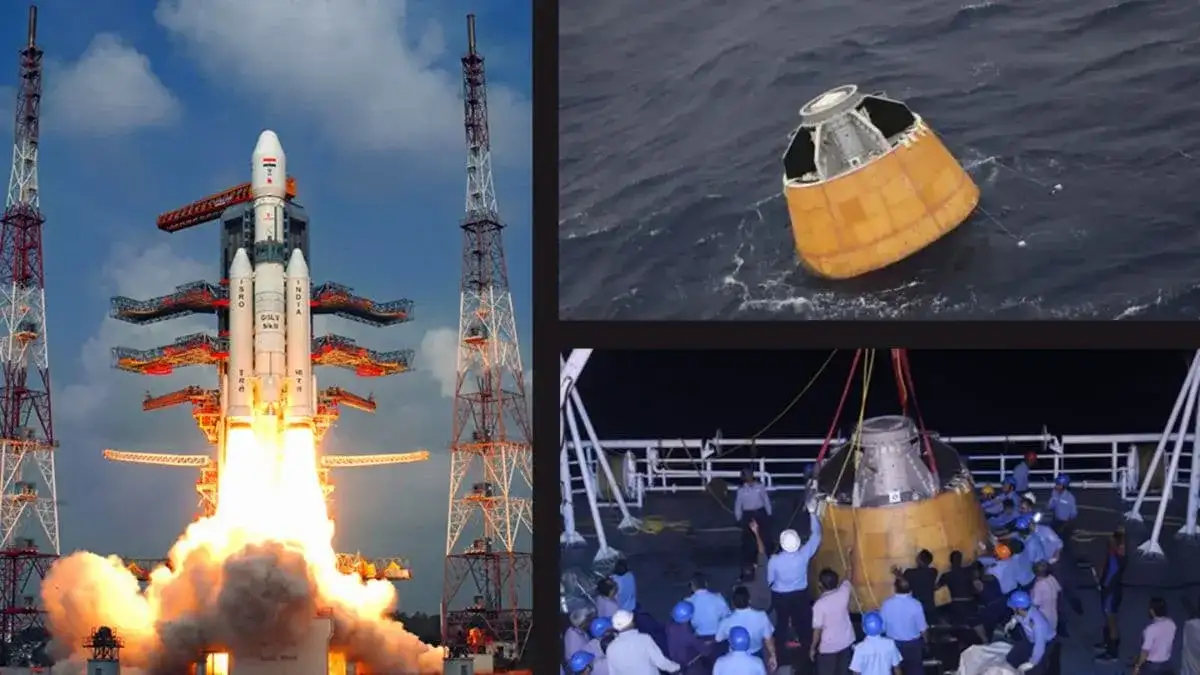
August 2023 Tests: ISRO, in collaboration with DRDO's Aerial Delivery Research and Development Establishment (ADRDE), conducted a series of drogue parachute deployment tests. These took place at the Rail Track Rocket Sled (RTRS) facility at the Terminal Ballistics Research Laboratory in Chandigarh. The tests confirmed the drogue parachutes' readiness for integration into upcoming missions.
Earlier Tests: Before the drogue parachute tests, ISRO had already conducted tests for pilot and apex cover separation parachutes.
Integrated Air Drop Test: In August 2025, ISRO completed its first Integrated Air Drop Test (IADT-01). This test demonstrated the entire parachute-based deceleration system from start to finish, involving ISRO, the Indian Air Force, DRDO, the Indian Navy, and the Indian Coast Guard.
Rocket-Sled Trials: In August 2023, ISRO engineers also used a rocket-powered sled at the Terminal Ballistics Research Laboratory to test how the mortar-packed drogue parachutes would open and slow a capsule launched at high speeds. These trials involved 5.8-meter diameter parachutes.
Role of Key Organizations
Several Indian organizations are working together to make Gaganyaan a success:
ISRO (Indian Space Research Organisation): The lead agency for the Gaganyaan mission, responsible for overall planning and execution.
VSSC (Vikram Sarabhai Space Centre): Part of ISRO, VSSC is the main center for designing and developing launch vehicle technology, including the crew module and its safety systems.
DRDO (Defence Research and Development Organisation): Several DRDO labs are involved.
ADRDE (Aerial Delivery Research and Development Establishment): Mandated to develop systems for dropping heavy loads, brake parachutes, and aircraft arrester barriers. ADRDE was involved in developing the drogue parachutes.
Terminal Ballistics Research Laboratory (TBRL): Provided the Rail Track Rocket Sled (RTRS) facility for crucial testing.
"The drogue parachutes are designed to stabilise the crew module and reduce its velocity to a safe level during re-entry." - Article 2, India Today
"Drogue parachutes are deployed to decrease speed and stabilise rapidly moving objects." - Article 6, The Economic Times
Significance for India's Space Program
The successful testing of the drogue parachutes and the integrated air drop test mark important milestones for India's ambition in human spaceflight.
Astronaut Safety: These tests directly contribute to the safety of future astronauts by validating critical deceleration systems.
Indigenous Capability: The use of indigenously developed drogue parachutes highlights India's growing self-reliance in space technology.
Mission Readiness: These successful tests are critical for qualifying the parachute systems for upcoming demonstration flights, such as the Test Vehicle-D1 mission and the first uncrewed Gaganyaan mission (G1), before a crewed launch.
Global Standing: If successful, Gaganyaan will make India the fourth country, after the United States, Russia, and China, to possess indigenous human launch capabilities.
Conclusion
The recent series of tests, particularly the drogue parachute deployments and the integrated air drop test, represent substantial progress for India's Gaganyaan mission. These exercises are essential for validating the complex parachute system that will ensure the safe return of astronauts from space. The collaborative efforts between ISRO and DRDO, utilizing specialized testing facilities, underscore India's commitment to developing indigenous human spaceflight technology. The successful qualification of these safety systems paves the way for subsequent demonstration flights, bringing India closer to its goal of independent human spaceflight.
Sources Used
moneycontrol.com: Published an article on October 24, 2024, discussing the successful drogue parachute test. https://www.moneycontrol.com/news/india/gaganyaan-s-first-brake-just-passed-drdo-clears-drogue-parachute-in-extreme-load-test-watch-video-13836131.html
indiatoday.in: Published an article on February 11, 2025, detailing the DRDO's tests of drogue parachutes for ISRO's Gaganyaan Mission. https://www.indiatoday.in/science/story/video-drdo-tests-drogue-parachutes-for-isros-gaganyaan-mission-2678359-2025-02-11
tribuneindia.com: Published an article on February 11, 2025, reporting on new parachutes tested for Gaganyaan's crew module to aid safe descent. https://www.tribuneindia.com/news/india/new-parachutes-tested-for-gaganyaans-crew-module-that-will-help-in-safe-decent-to-earth/
gadgets360.com: Published an article on September 4, 2025, about ISRO's Gaganyaan Mission Parachute System passing crucial rocket-sled tests. https://www.gadgets360.com/science/news/isro-tests-gaganyaan-crew-module-parachutes-in-rocket-sled-trials-9215402
isro.gov.in: Published an official release on August 11, 2023, about ISRO conducting Drogue Parachute Deployment Tests for the Gaganyaan Mission. https://www.isro.gov.in/DrogueParachuteTest.html
economictimes.indiatimes.com: Published an article on August 12, 2023, stating ISRO successfully conducted parachute deployment tests for the Gaganyaan mission. https://government.economictimes.indiatimes.com/news/technology/isro-successfully-conducts-parachute-deployment-tests-for-gaganyaan-mission/102671997
newsonair.gov.in: Published an article on August 24, 2025, reporting on ISRO completing the first Integrated Air Drop Test for safe crew recovery in the Gaganyaan mission. https://www.newsonair.gov.in/isro-successfully-conducts-first-integrated-air-drop-test-for-gaganyaan/