

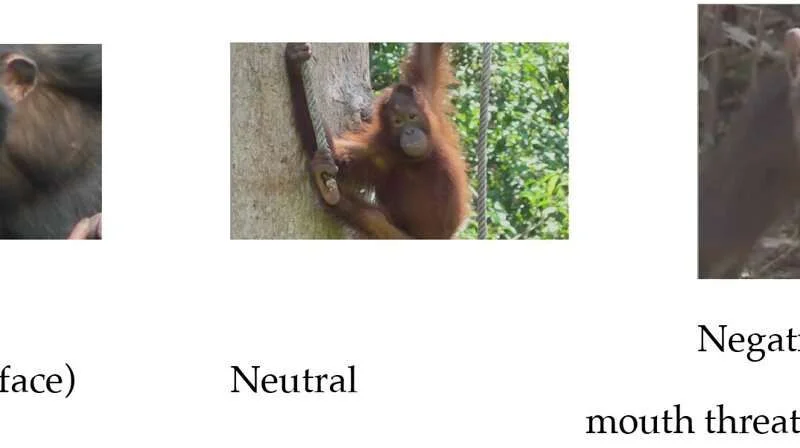
New findings suggest a direct, automatic mirroring of emotional facial expressions between humans and other primates. This phenomenon, previously established among humans, now appears to extend across species, hinting at a deeper, perhaps instinctual, connection.
Researchers have observed that humans, when viewing videos of non-human primates, not only interpret their emotional displays but also spontaneously replicate those facial expressions. This involuntary imitation, often termed 'emotional mimicry,' was evident even when participants had no prior specialized knowledge of primate behavior. The studies involved observing participants' reactions to a range of primate expressions, from neutral to threat displays and playful faces.
The intensity of this mimicry appears to be influenced by the perceived closeness to the primate. Participants exhibited stronger mirroring of positive expressions when they reported feeling a greater connection to the animal. This suggests that empathy, or at least its outward expression, might not be exclusively a human construct but a shared biological mechanism.
Read More: Indigenous Data Rights Now Key in Conservation Genomics
Participants in the studies were also tasked with labeling the emotions they believed the primates were conveying. The findings indicate a notable ability among humans to correctly identify and categorize these expressions, correlating with the observed mimicry. The inclusion of full-body posture alongside facial cues in some of the video materials provided a richer context for emotional interpretation, further substantiating the findings.
Evolutionary Underpinnings and Broader Implications
These observations bring renewed attention to Charles Darwin's early comparisons between human and non-human primate emotional signaling. The automatic resonance of expressions is a recognized element in human social interactions, often considered fundamental to empathy and social bonding. The extension of this mimicry to other primate species suggests that the roots of these social regulators may be ancient and shared.
The implications of this cross-species emotional recognition extend beyond scientific curiosity. Recognizing the emotional lives and expressive capacities of non-human primates could foster greater ethical consideration and a more profound respect for their subjective experiences. It raises questions about the nature of consciousness and sentience across the animal kingdom.
Read More: Orangutan Mothers Plan Playdates for Babies in Borneo
Research Context
The research, involving psychologists from Germany, Italy, and the United Kingdom, sought to empirically establish spontaneous human mirroring of non-human primate facial expressions, a connection that had been theorized but lacked direct evidence. The studies utilized video recordings of various primates and monitored the participants' own facial responses, noting significant instances of mimicry.


:strip_icc()/GettyImages-688951857-586d7be13df78c17b6e3a3cb.jpg)


