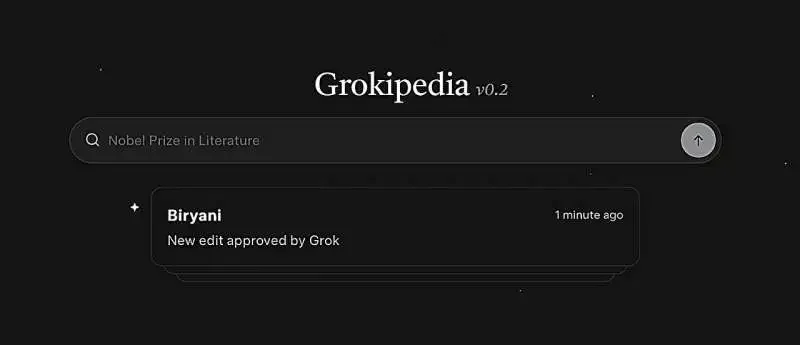
A series of computational analyses conducted between November 2025 and May 2026 indicates that Grokipedia, the artificial intelligence-driven encyclopedia owned by Elon Musk, systematically prioritizes sources that skew toward the political right compared to Wikipedia. While both platforms generally mirror left-leaning source tendencies in their aggregate data, research confirms that Grokipedia exhibits a consistent, measurable shift in ideological positioning and source selection, particularly on contentious political topics and subjects involving elected officials.

The findings highlight several core disparities in how these knowledge platforms curate information:

Sourcing Patterns: Beyond standard news outlets, Grokipedia has been observed pulling from sites characterized by researchers as promoting pseudoscience, conspiracy theories, and specific anti-immigration or state-sponsored agendas.
Structural Positioning: Quantitative studies, including those using machine learning to parse text, note that while both encyclopedias maintain a degree of common content, Grokipedia frequently elevates right-leaning frames to more prominent positions within article structures.
Operational Transparency: Unlike Wikipedia, which relies on a model of community-led verification and established editorial guidelines, Grokipedia functions through automated synthesis. Critics argue this lack of oversight creates an "information vacuum" where algorithmic preference acts as the sole editor.
| Feature | Wikipedia | Grokipedia |
|---|---|---|
| Editing Model | Human community-led | AI-automated |
| Sourcing Priority | Broad, vetted consensus | Algorithmic selection |
| Ideological Drift | Generally left-leaning | Higher right-leaning variance |
| Transparency | Public revision history | Proprietary/Closed-box |
The Mechanics of "Truth"
The divergence appears most acute when analyzing high-profile, volatile political discussions. Researchers suggest that by scraping the open web without the same structural filters used by human editors, Grokipedia adopts the specific biases inherent in the internet's most controversial corners.

When questioned regarding the platform's reliability, the developer's feedback loops—specifically those associated with xAI—have yielded responses dismissive of established journalistic institutions, occasionally labeling them as "Legacy Media." This rhetoric aligns with broader statements from Musk, who has characterized his project as a pursuit of "the whole truth," while simultaneously expressing intentions to rebrand the platform as "Encyclopedia Galactica."
Read More: Chrome mimeHandler API lets extensions handle file types

Contextual Background
The comparison between these two platforms has intensified as Grokipedia continues to evolve from an experimental tool into a broader public resource. Critics of the current model point out that Wikipedia's reliance on human moderation provides a form of friction that prevents extreme, unchecked information from dominating the narrative. By removing this human filter, Grokipedia has sparked a debate over whether the automation of knowledge creation can ever truly remain neutral or if it inevitably reinforces the ideological inclinations of its design.
The current research serves as a signal for the Epistemic Stability of AI-generated content. As Machine Learning becomes the primary gatekeeper for digital archives, the shift in Source Selection suggests that the era of crowd-sourced moderation is increasingly being challenged by top-down, opaque Information Systems.
Read More: David Muir broadcast style secrets revealed as of April 2026