)
The Greek Defence Minister's visit to India is being painted as a monumental step for bilateral ties, focusing on bolstering defense cooperation and solidifying a new EU trade deal. But beneath the polished pronouncements of strengthened alliances and economic blueprints, what deeper currents are at play? Are we witnessing genuine strategic alignment, or a carefully orchestrated dance to secure national interests amidst shifting global landscapes?
A Symphony of Summits and Subsidies
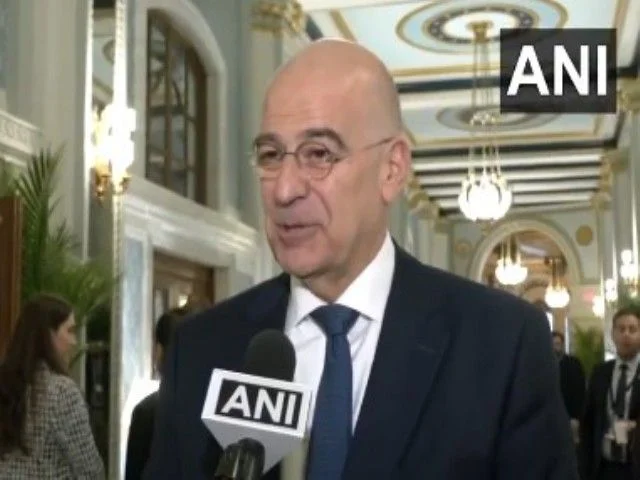
Greek Defence Minister Nikos Dendias has touched down in India, a visit swiftly characterized by headlines heralding a new era of cooperation. The itinerary is packed: high-level discussions with Rajnath Singh and S. Jaishankar on defense and security, a pivotal role in the India-EU Forum, and even a trip to Bengaluru to explore the burgeoning defense industry ecosystems of both nations. This isn't an isolated event; it's happening in the wake of the much-vaunted India-EU Free Trade Agreement (FTA), finalized on January 27th.
Read More: Ukraine gets 100 Patriot missiles with $1 billion EU loan for defense
The timing is highly significant. The FTA, described as the "mother of all deals," promises preferential access for India across 97% of tariff lines, covering a staggering 99.5% of trade value. In return, India will eliminate or reduce duties on 92.1% of its tariff lines for EU exports. This includes immediate duty elimination on nearly 50% of EU goods, with phased reductions over the next decade.

India's Export Boost: A remarkable 70.4% of India's tariff lines, covering 90.7% of its exports, will see immediate duty elimination in sectors like textiles, leather, tea, coffee, and jewelry.
EU's Gain: While India opens up, the EU has offered broader commitments in services, unlocking 144 sub-sectors including IT, professional services, and education. India reciprocates by opening 102 sub-sectors, notably telecommunications, maritime, and financial services.
But does this economic handshake extend seamlessly into the defense arena? And what are the underlying motivations driving this accelerated partnership?
The Shadows of Geopolitics: Turkey, the Mediterranean, and Beyond
The narrative of strengthening defense ties isn't merely about joint naval drills – though those have indeed occurred recently, following exhibitions in Abu Dhabi (GreekReporter.com, Feb 26, 2025). The impetus for this burgeoning alliance can be traced back to earlier strategic discussions. In February 2025, Nikos Dendias himself highlighted India's "emerging role as a major global power" and specifically requested New Delhi's greater involvement in the Mediterranean Sea and the Red Sea (ANI News, Feb 12, 2025; Punjab Kesari, Feb 12, 2025).
Read More: AFP Reviews War Crime Claims Against Australian in Gaza
This isn't just a diplomatic nicety. For Greece, a strategic partnership with India offers a powerful counterweight against perceived regional rivals. Specifically, it's framed as a way to counter the "Turkey-Pakistan alliance in the Aegean and the SE Mediterranean" (GreekReporter.com, Feb 26, 2025).

The Turkey Factor: The mention of countering Turkey is direct. With its complex geopolitical relationships in the Eastern Mediterranean and its alliances, Turkey represents a significant strategic consideration for Greece.
India's Growing Reach: India, under Prime Minister Narendra Modi, is increasingly asserting its global influence. Its growing naval capabilities and its economic clout make it an attractive partner for nations seeking to diversify their strategic alliances.
Is Greece leveraging India's rise to secure its own backyard, or is India seeing an opportunity to project power into regions critical for its own strategic interests, such as the India-Middle East-Europe Economic Corridor (IMEC)?
Trade Dynamics: Beyond the Headlines
While the FTA’s statistics are impressive, the underlying trade relationship between India and Greece has been described as "modest" (economicdiplomacy.in, May 19, 2025). This suggests that the current surge in activity is more about future potential and strategic alignment than a dramatic, existing economic interdependence.
Read More: India to Spend $2 Billion on New Drones for Defense
The EU, as a bloc, stands to gain significantly from preferential access to India's massive market. Greece, as a key EU member with a strategic location, becomes an even more vital node in this burgeoning economic network.
Tariff Concessions Explained:| Agreement Aspect | India's Offer (to EU) | EU's Offer (to India) || :——————————- | :—————————————————————————————- | :—————————————————————————————— || Tariff Lines Eliminated | 92.1% (49.6% immediate, 39.5% phased over 5-10 years) | 97% (covering 99.5% of trade value) || Key Indian Export Sectors | Textiles, leather, tea, coffee, jewelry (immediate duty-free) | N/A (Focus on broad trade value) || Service Sector Access | 102 sub-sectors (telecom, maritime, finance) | 144 sub-sectors (IT, professional services, education) |
The question remains: how much of this economic benefit will directly accrue to Greece versus other EU member states? And how does the defense aspect truly intertwine with these trade flows? Is the defense cooperation intended to underpin these economic ambitions, ensuring stability and security for future trade routes?
The "Mother of All Deals" and its Implications
The timing of Minister Dendias' visit, immediately following the India-EU FTA finalization, cannot be a coincidence. This "mother of all deals" is not just about tariff cuts; it signals a deeper integration of economies and, by extension, a potential for closer geopolitical alignment.
The FTA aims to significantly boost trade across a vast array of goods and services. For Greece, this could mean enhanced opportunities for its businesses within the larger EU framework, facilitated by stronger ties with India. However, what guarantees are in place to ensure equitable benefits for smaller economies within the EU?
Read More: Indus Waters Treaty remains suspended in India and Pakistan April 2026
Strategic Interlocutor: India is being positioned not just as a trade partner, but as a "strategic interlocutor" (economicdiplomacy.in, May 19, 2025). This implies a role in facilitating broader geopolitical and economic discussions, potentially involving regions like the Middle East and Europe.
IMEC's Potential: Greece could play a crucial role in the India-Middle East-Europe Economic Corridor (IMEC) (economicdiplomacy.in, May 19, 2025). This ambitious project aims to create a vast network of shipping and road transport links. A strong defense partnership with India would undoubtedly enhance the security and feasibility of such a corridor.
Is the "mother of all deals" truly about mutual prosperity, or is it a sophisticated strategy to create new economic and strategic spheres of influence, with India and the EU at their core, and nations like Greece acting as vital enablers?
Looking Ahead: From Diplomacy to Action
The diplomatic pronouncements are clear: stronger defense ties, robust trade, and a shared vision for global security. But the real test lies in the implementation.
Institutionalizing Cooperation: The idea of a "joint security observatory" (economicdiplomacy.in, May 19, 2025) is a tangible step towards institutionalizing security collaboration. Will this move beyond paperwork to practical joint operations and intelligence sharing?
Defense Industry Synergy: The visit to Bengaluru, a hub for India's defense manufacturing, signals an intent to foster concrete collaboration between industries. What specific projects or technologies are on the table? Are there plans for joint R&D or co-production?
Beyond Regional Agendas: While countering perceived threats in the Mediterranean is a clear driver for Greece, how will India balance its global ambitions with its specific regional interests? Does this partnership open avenues for India to engage more deeply in European security architecture, and vice versa?
The current Greek-Indian engagement presents a compelling picture of a deepening strategic partnership. However, as a critical observer, one must probe deeper: are these advancements truly reflective of a shared vision for global stability and mutual economic benefit, or are they primarily driven by the national strategic imperatives of both Athens and New Delhi, leveraging each other's strengths in a complex and evolving world order? The true substance of this "strengthened tie" will only be revealed in the actions that follow these high-level dialogues.
Read More: Australia Buys Used US Submarines Instead of Building New Ones
Sources:
Article 1: Greek Defence Minister on India visit; boosts defence ties and EU trade deal - Zeenews India: https://zeenews.india.com/india/greek-defence-minister-on-india-visit-boosts-defence-ties-and-eu-trade-deal-3014366.html (Published: 1 hour ago)
Article 2: Greek defence minister Nikos Dendias arrives in India for official visit - Economic Times: https://economictimes.indiatimes.com/news/defence/greek-defence-minister-nikos-dendias-arrives-in-india-for-official-visit/articleshow/127979918.cms (Published: 4 hours ago)
Article 3: Greek Defence Minister in India to Strengthen Defence, Trade Ties - New Kerala: https://www.newkerala.com/news/a/greek-defence-minister-nikos-dendias-arrives-india-official-188.htm (Published: 4 hours ago)
Article 4: India-Greece Strategic Partnership 2025: Strengthening Defence, Trade, and Cultural Ties - Economic Diplomacy: [https://www.economicdiplomacy.in/post/india-and-greece-rediscovering-a-civilizational-kinship-and-building-a-strategic-partnership-in-202
Article 5: Greek Defence Minister highlights India's Global Role - Punjab Kesari: https://english.punjabkesari.com/world/2025/02/12/greek-defence-minister-highlights-indias-global-role (Seen on: Feb 12, 2025)
Article 6: Greece and India Boost Defense Ties in Joint Naval Drill - GreekReporter.com: https://greekreporter.com/2025/02/26/greece-india-joint-naval-drill/ (Published: Feb 26, 2025)
Article 7: Greek Defence Minister calls for Indian military presence in Mediterranean, Red Sea - ANI News: https://www.aninews.in/news/world/us/greek-defence-minister-calls-for-indian-military-presence-in-mediterranean-red-sea20250212081800/ (Seen on: Feb 12, 2025)