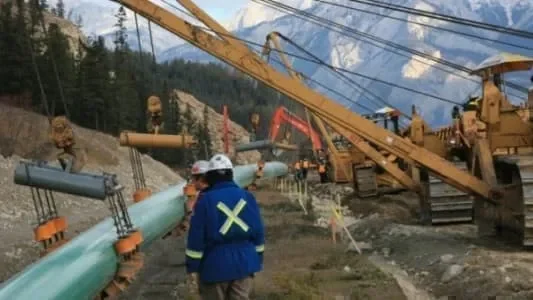
The federal government is signaling a significant shift in its approach to energy infrastructure, with potential federal financing now on the table for an Alberta pipeline through its Indigenous loan guarantee program. This development arrives as both federal and provincial governments navigate complex agreements on energy development and climate initiatives. The strategy hinges on leveraging the 'Canada Indigenous Loan Guarantee Corporation' to backstop Indigenous co-ownership in proposed pipeline ventures, effectively providing a financial backstop for significant investments. This aligns with existing provincial programs, such as the 'Alberta Indigenous Opportunities Corporation,' and aims to foster deeper Indigenous participation in large-scale energy projects.
Reconciliation and Economic Self-Determination Take Center Stage
The push for federal financing of pipeline projects through Indigenous loan guarantees is being framed as a pivotal step in advancing reconciliation and economic self-determination for Indigenous communities. The 'Indigenous Loan Guarantee Program' aims to unlock access to capital, thereby removing barriers to equity investment for Indigenous groups interested in major resource developments. This initiative has seen notable engagement, with companies like TC Energy announcing substantial equity ownership agreements with Indigenous communities, such as the landmark deal involving up to 72 Indigenous communities acquiring a 5.34 per cent stake in TC Energy’s NGTL natural gas network. Similarly, Enbridge has engaged with various First Nations in British Columbia, facilitating equity investments in its Westcoast natural gas pipeline system, supported by loan guarantees.
Read More: Solaris Energy SEI Stock Price Forecast Reaches $91.98 by July 2027

A "Grand Bargain" with Alberta on Energy and Climate
The federal government's embrace of pipeline financing via Indigenous loan guarantees is intricately linked to a broader accord with Alberta, marked by a 'Memorandum of Understanding' (MOU). This MOU, established between Prime Minister Mark Carney and Alberta Premier Danielle Smith, seeks to move beyond a decade of strained relations. Key aspects of this accord include a commitment to move forward with a new bitumen pipeline to the British Columbia coast, alongside Alberta's pledge for a higher industrial carbon levy and participation in a major carbon-capture project. In return, Ottawa has agreed to suspend proposed federal oil and gas emissions caps and relax requirements under the Clean Electricity Regulations. This arrangement, described as a "grand bargain," signals a deliberate pivot toward collaboration on energy development and climate action, though not without its complexities and divisions among Indigenous groups.
Read More: Alberta Pipeline Deal: Federal Emissions Cap Suspended
Emerging Divisions and Uncharted Territory
Despite the overarching agreements, the prospect of new pipelines has ignited a spectrum of reactions among Indigenous communities. While some view these equity partnerships as a crucial avenue for economic self-determination and revenue generation, others express significant concerns about environmental risks and the potential for increased social division. The precedent set by past pipeline cancellations, such as Keystone XL, casts a long shadow, fueling both hope for future economic benefits and apprehension regarding potential opposition and unresolved rights. The extent to which Indigenous groups will find themselves diametrically opposed or in solidarity remains a critical, unresolved factor in the advancement of these projects.
Historical Context: From Conflict to Co-Ownership
The current landscape of federal support for Indigenous investment in energy infrastructure is a significant departure from previous federal approaches. Historically, Indigenous partnerships with energy companies often involved guarantees for construction jobs or other financial benefits, falling short of offering full equity stakes. The federal budget announced the creation of a national Indigenous loan guarantee program precisely to facilitate such equity investments, recognizing the right to economic self-determination. This evolution reflects a broader trend where Indigenous communities are increasingly seeking substantial ownership positions in major projects, driven by a commitment to reconciliation and the desire for long-term revenue streams and greater control over resource development on their traditional territories.
Read More: Summer AC Settings: Save Money by Raising Thermostat