European lawmakers are grappling with a growing tide of digital obsolescence, a concern amplified by the 'Stop Killing Games' initiative. The movement, which recently presented its case in the European Parliament, argues that the inability to access purchased digital content after developers cease support constitutes a significant issue for millions of consumers across the continent.
The core of the 'Stop Killing Games' argument centers on consumer rights and the persistent inaccessibility of digital products. Specifically, the group advocates for responsible decommissioning of online games, rather than outright termination that renders titles unplayable. This approach, they stress, does not necessitate perpetual support from publishers, but rather a considered wind-down process.

The initiative has gained considerable traction, evidenced by its submission to the European Commission. This submission, which successfully surpassed the one million signature threshold in July 2025, triggers a formal review. The European Commission is now obligated to assess the petition within six months and decide whether to propose new legislation aimed at preserving discontinued online games. This potential legislation could extend protections to single-player games reliant on online components, ensuring their continued functionality even after official support ends.
Read More: Sporcle Basketball Quiz Tests 15 Players in 15 Seconds
A Movement Born of Frustration
The 'Stop Killing Games' campaign gained momentum following instances where players lost access to games they had purchased, with no recourse for refunds. The shutdown of titles like The Crew and the subsequent inaccessibility of Concord served as potent examples fueling the movement. Organizers emphasize that their objective is not to force publishers to indefinitely support their products, but to implement a more responsible exit strategy.
This broader concern extends beyond the gaming sphere, touching upon the fundamental nature of digital ownership. The question of whether consumers truly "own" digital content that can be rendered inaccessible at a company's discretion remains a central tenet of the movement's advocacy.
The Path Forward: Legislation or Status Quo?
The European Commission's upcoming evaluation will determine the next steps. Should they deem new laws necessary, the proposals will be presented to the European Parliament. This process underscores a growing tension between the transient nature of digital services and established consumer protection frameworks.
Read More: AI Chatbots Give Bad Health Advice, Study Finds
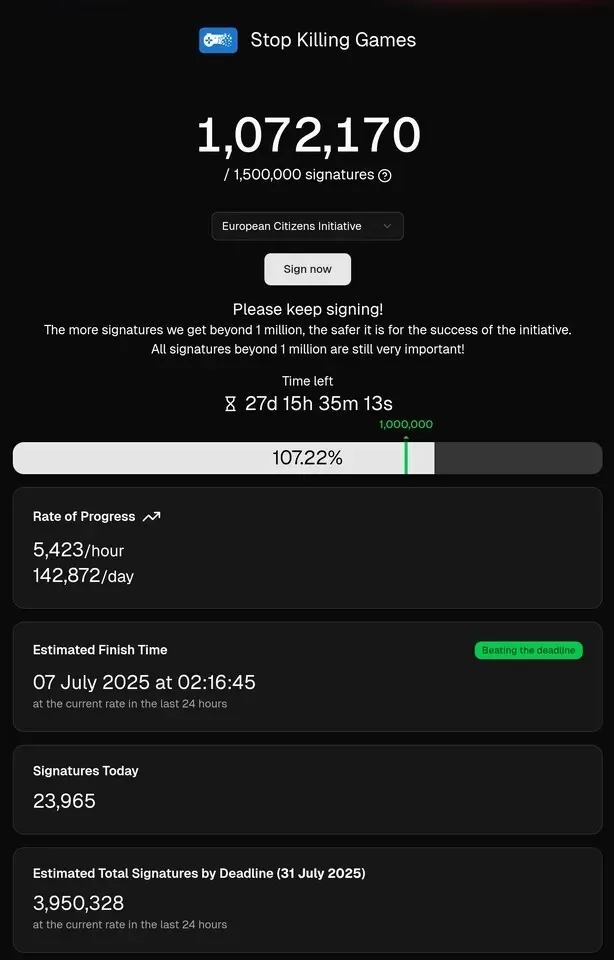
The initiative has also garnered significant public support, with a petition reaching 1.4 million signatures by mid-August 2025, a figure that could prompt an EU review. A parallel UK petition has also garnered enough signatures to warrant parliamentary debate.
However, the success of the 'Stop Killing Games' initiative hinges not only on public endorsement but also on meeting stringent verification standards and ultimately securing legislative action. The movement acknowledges that private server solutions, while sometimes proposed, are not ideal, citing concerns over data protection and content moderation.
Background: Digital Permanence and Consumer Rights
The debate around 'killing' games highlights a fundamental challenge in the digital age: the impermanence of digital assets. Unlike physical media, which can often remain accessible independently of the original manufacturer, digital games are frequently tied to online servers and ongoing support. When this support is withdrawn, the game effectively ceases to exist for the consumer, irrespective of prior purchase.
Read More: Expedition 33 Gets 12 BAFTA Games Award Noms; BAFTA Protects Brand
This situation raises questions about the definition of "licensing" versus "ownership" in the context of digital goods. Many games are technically licensed, meaning the user acquires the right to play under specific terms, which can include the possibility of the license being revoked or the service underpinning it being discontinued. 'Stop Killing Games' aims to redefine these terms, pushing for a more robust form of digital ownership that accounts for the longevity of the purchased product. The initiative seeks to prevent such digital "deaths," advocating for practices that ensure longevity and accessibility for consumers.