
Seattle Mariners reporter Angie Mentink recently addressed social media backlash after a video surfaced showing her using Google Gemini to assist with postgame interview questions. The footage, recorded without her knowledge by a fan in the stadium, prompted accusations that she was incapable of performing her duties without automated assistance.
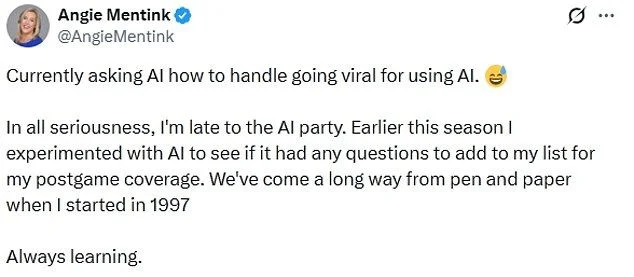
Mentink, a veteran broadcaster, responded by publicizing her process with humor, stating she is "currently asking AI how to handle going viral for using AI." She maintains that the tool serves as a learning aid—an evolution of the research process she has utilized since starting her career with pen and paper in the late 1990s.

The Dynamics of the Controversy
The digital reaction followed a predictable pattern of escalation:
Voyeuristic Capture: The incident originated from a short, unauthorized video clip lacking context, which was circulated to imply professional incompetence.
Targeted Shaming: Various online accounts and commentators seized upon the footage to cast doubt on her capability, with some linking the event to broader, often reductive, narratives regarding women in sports media.
Ignoring Personal Context: Critics largely overlooked that Mentink has only recently returned to the broadcast booth following a February stroke that resulted in paralysis on the left side of her body.
Professional Resilience: Despite these personal health hurdles, Mentink has remained active in the Mariners' coverage, with peers and supporters noting that her reliance on a digital assistant is a common, modern approach to workflow management rather than a failure of skill.
| Feature | The Accusation | The Reality |
|---|---|---|
| Objective | Claiming incompetence | Augmenting interview preparation |
| Method | Viral, unauthorized video | Standard research workflow |
| Context | Assuming lack of expertise | Utilizing tools while managing recovery |
A Shifting Professional Landscape
The critique directed at Mentink highlights a broader friction between traditional journalistic methods and the integration of machine learning tools. While some reporters use artificial intelligence as an AI-powered brainstorming aid or an editing assistant, others face intense scrutiny when such methods become visible to the public.
Read More: FIFA World Cup 2026 Revenue Reaches $15 Billion With New Ticket Prices
This tension is distinct from cases involving professional malpractice, such as the Wyoming reporter previously caught fabricating quotes via automation. Mentink’s use of the technology was to prompt potential discussion points, not to deceive viewers or replace the human element of her interaction with players. As broadcast workflows continue to incorporate automated assistance, the reaction to Mentink underscores the current vulnerability of media personnel when personal process is subjected to uncontextualized public monitoring.