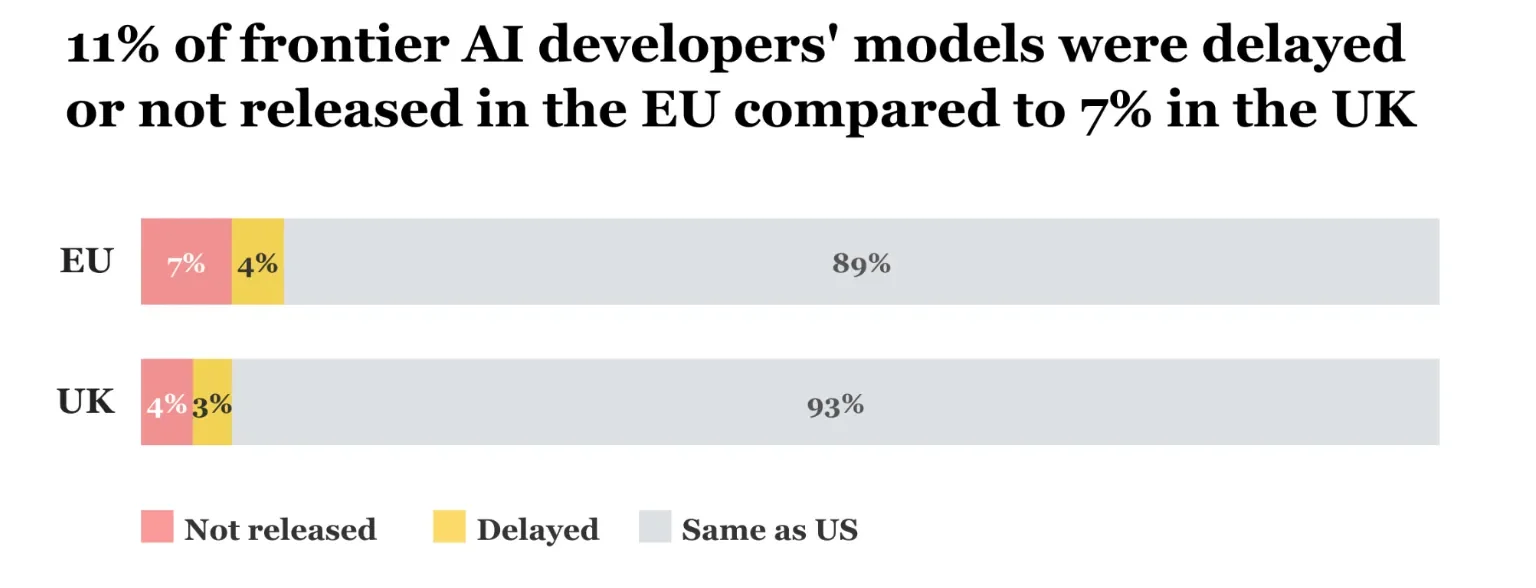
A new report from Governance AI highlights significant delays in the release of advanced artificial intelligence models within the European Union, attributing the slowdown primarily to the bloc's stringent data protection rules, specifically the General Data Protection Regulation (GDPR). The study indicates that these regulations are responsible for delaying approximately 11% of large language model (LLM) releases and, in some instances, preventing them entirely within the EU and the UK. The research, published recently, identifies the GDPR as the principal barrier, cited in 56 out of 68 documented delay cases.
Researchers observed that while other regulations such as the AI Act and the Digital Markets Act are mentioned as contributing factors, the GDPR consistently emerges as the most significant impediment to timely LLM deployment in Europe. This contrasts with the United States, where comparable AI models often reach consumers much sooner. The authors suggest that the EU's "aggressive enforcement" of data protection laws and the lack of clear guidance on how these rules apply to the training and deployment of LLMs exacerbate these delays.
Read More: Chrome mimeHandler API lets extensions handle file types
"Our report finds that European regulation, primarily the GDPR, led frontier AI companies to sometimes delay model releases or in some cases not release models at all to the EU and UK."
Navigating the Regulatory Maze
The study contrasts the situation in the EU with that in the UK, noting that despite shared data protection frameworks like the GDPR, barriers appear more pronounced within the EU. This disparity is attributed to the nuances in regulatory enforcement and interpretation. While the AI Act was also examined, the study found limited evidence directly linking its provisions to deployment slowdowns during the period assessed.
The findings hold particular relevance for the privacy-focused technology sector, including areas bridging AI and cryptocurrency. Innovations like zero-knowledge proofs, federated learning, and homomorphic encryption are presented as potential solutions to the challenges posed by GDPR for AI model training. Companies that can demonstrate GDPR-compliant AI training methods without compromising model performance could gain a substantial competitive advantage in the European market.
Legislative Undercurrents and Future Adjustments
The European Union appears cognizant of the impact its data protection rules have on AI development. Discussions are underway regarding the 'Digital Omnibus' initiative, which aims to amend data regulations to better accommodate AI development. Furthermore, the EU is currently reviewing the EU Copyright Directive and the AI Act's copyright provisions, indicating a broader effort to balance innovation with intellectual property rights.
Read More: BEREC Asks for Mobile Network API Ideas from Developers
The Governance AI study underscores a critical juncture for Europe's AI ambitions. The delay in accessing cutting-edge AI technologies not only affects consumers but also poses challenges for businesses seeking to leverage these tools for growth and competitiveness. The report emphasizes the need for policymakers in the EU and the UK to consider the risk of regulatory hurdles hindering their citizens and businesses from accessing the latest AI advancements.