

:max_bytes(150000):strip_icc()/This-Morning-Habit-Could-Help-Slow-Aging-New-Study-Suggests-0dc859ca90e74f9c8f295d0a26c45a62.jpg)
Consuming a mass-market multivitamin every morning for two years appears to delay certain chemical markers of senescence by approximately four months. This marginal deceleration, recorded in a cohort of nearly 1,000 adults averaging 70 years of age, suggests that while the chronological clock remains indifferent, the cellular narrative can be slightly edited through consistent micronutrient intake.

Data derived from the COcoa Supplement and Multivitamin Outcomes Study (COSMOS) suggests the effect is most visible in bodies already exhibiting 'accelerated' decay—where biological markers outpace the calendar.
The ritual of the daily pill yielded a decrease of 0.113 years on the PCGrimAge clock and 0.214 years on the PCPhenoAge clock annually.
Researchers noted no statistical synergy or independent benefit from cocoa extract, which was tested alongside the vitamins but failed to alter the epigenetic trajectories.
"Epigenetic clocks estimate biological aging based on tiny changes in DNA… This study opens the door to learning more about accessible, safe interventions that contribute to healthier, higher-quality aging." — Mass General Brigham Report
The Mechanics of the Metric
The study utilized five distinct epigenetic clocks, which are essentially algorithms built to interpret DNA methylation—the "noise" or "grit" that accumulates on the genetic code as cells replicate and weather environmental friction. The biological age of a person is not a fixed state but a statistical estimation of physiological wear.
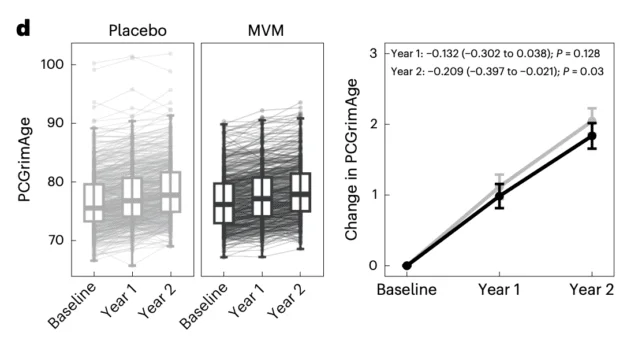
Comparative Efficacy in the COSMOS Trial
| Intervention | Biological Impact | Duration | Clock Sensitivity |
|---|---|---|---|
| Multivitamin | ~4 Months Slowdown | 24 Months | High (GrimAge/PhenoAge) |
| Cocoa Extract | Negligible / Zero | 24 Months | None |
| Placebo | Standard Decay | 24 Months | Baseline |
The results are skewed toward those who began the trial in a state of metabolic deficit. For those whose "biological age" was already higher than their birth certificate indicated, the vitamins acted as a stabilizing force. For the relatively "young-old," the impact was less discernible.
Read More: Ben Shephard 50 Years Old Back Pain From Son Jumping Causes Mobility Issues
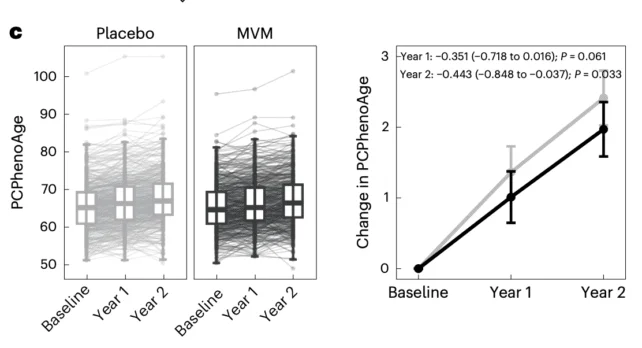
Skeptical Reframing of the 'Clock'
While the data suggests a slowing of the machine, the tools used to measure this—the clocks themselves—are asymmetrical and imperfect. They rely on associations rather than direct causation of vitality.
The PCGrimAge clock is often linked to mortality risk.
The PCPhenoAge clock tracks physiological function and clinical chemistry.
These are predictive constructs, not absolute mirrors of health.
The modest gain—four months saved over a twenty-four-month span—represents a 16.6% reduction in the rate of biological advancement. It is an incremental shift in the body’s internal accounting, rather than a reversal of the underlying entropy.
Background: The Quest for Quantifiable Longevity
The COSMOS trial remains one of the few large-scale, randomized controlled environments attempting to strip the marketing veneer from the supplement industry. Previous inquiries into longevity often focused on single-molecule interventions (like Vitamin D or Omega-3s), which frequently failed to move the needle in isolation.
The move toward studying "broad-based" multivitamins reflects a shift in investigative philosophy: viewing the body as a complex system requiring a spectrum of raw materials rather than a single "silver bullet." However, the Harvard and Mass General Brigham researchers caution that while the epigenetic needles moved, further study is required to see if this mathematical slowing translates into fewer hospital visits or a legitimate extension of the "healthspan."
Read More: US Politicians Focus on Office Worker Issues in 2024 to Help White-Collar Jobs