A novel technique for generating a contained "blob" of turbulence within a water tank has been pioneered by University of Chicago physicists. This development, described across several reports from June and September 2023, offers a promising new avenue for studying the notoriously elusive nature of fluid turbulence. The core breakthrough involves creating an isolated, self-contained ball of turbulence, free from the confounding influences of tank walls or fluctuating intensity. This isolated phenomenon allows for a more focused investigation into fundamental questions surrounding turbulent behavior.
The method reportedly hinges on carefully orchestrated interactions of vortex rings. Previously, attempts to combine these rings to induce turbulence often resulted in energy being repelled before dissipation. The UChicago team found success by firing multiple sets of vortex rings at repeating intervals, enabling incoming and outgoing rings to collide and interact in a controlled manner. This interaction, rather than creating chaotic splashing, coalesced into a stationary ball of turbulence at the tank's center.
Read More: Obama Presidential Center Opens in Chicago on June 3, 2026
This breakthrough holds significant implications. Turbulence, a ubiquitous force shaping everything from weather patterns to the efficiency of aircraft, has long resisted simple explanation or accurate simulation, even for powerful supercomputers. The difficulty in understanding and predicting turbulent flows stems from the complex, cascading interactions of fluctuations within the fluid. The creation of a contained, stable turbulence model could therefore unlock secrets crucial for designing everything from airplanes and turbines to fusion reactors.
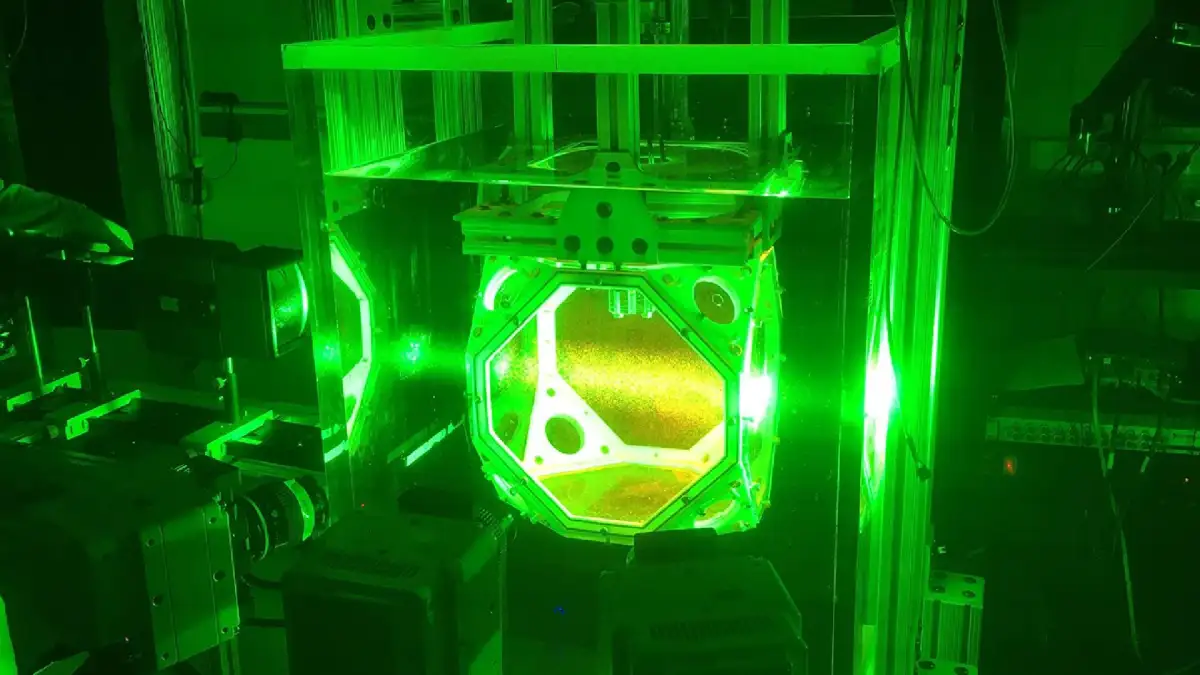
Further research by the team has also shed light on how turbulence decays. While the specific findings on decay mechanisms are still being detailed, the ability to observe and manipulate a stable turbulent state is seen as key to advancing this understanding.
The challenge of studying turbulence has historically been its inherent unpredictability and the difficulty in isolating its fundamental properties. Analytical descriptions of fluid motion are notoriously complex, as any minor disturbance can ripple through the system, altering its overall behavior. The UChicago physicists' method provides a rare opportunity to observe turbulence in a controlled environment, effectively turning a chaotic phenomenon into a more manageable subject of scientific inquiry. The team plans to leverage this new capability to probe deeper into the most fundamental aspects of turbulent behavior and fluid flow interactions.
Read More: Obama Center Bronzeville Park vs Tower Debate Starts
Background
The nature of turbulence has been a persistent puzzle in physics for decades. Its widespread presence in natural phenomena and technological applications, coupled with its resistance to straightforward mathematical description, has made it a long-standing challenge. Traditional experimental approaches often grapple with the influence of boundaries, external forces, and the sheer unpredictability of turbulent eddies. Numerical simulations, while powerful, frequently struggle to capture the fine-grained details of turbulent flows without immense computational cost. The quest to understand turbulence extends back to foundational work by figures like Osborne Reynolds and has remained a vibrant area of research. Earlier work, such as research published in 2020 involving helicity in fluids, has also explored specific, less chaotic aspects of fluid dynamics, but the creation of a truly contained, observable ball of turbulence represents a novel experimental leap.
Read More: Chicago Sky injury updates for May 2026 impact team roster and games