Researchers at Lawrence Berkeley National Laboratory have introduced MatterChat, a multimodal architecture designed to grant Large Language Models (LLMs) the capacity to interpret atomic-scale physical structures. The system addresses a fundamental limitation in current generative AI: while models are proficient at synthesizing linguistic data, they lack the intrinsic ability to perceive or process the three-dimensional geometric and atomic coordinates inherent in material science.
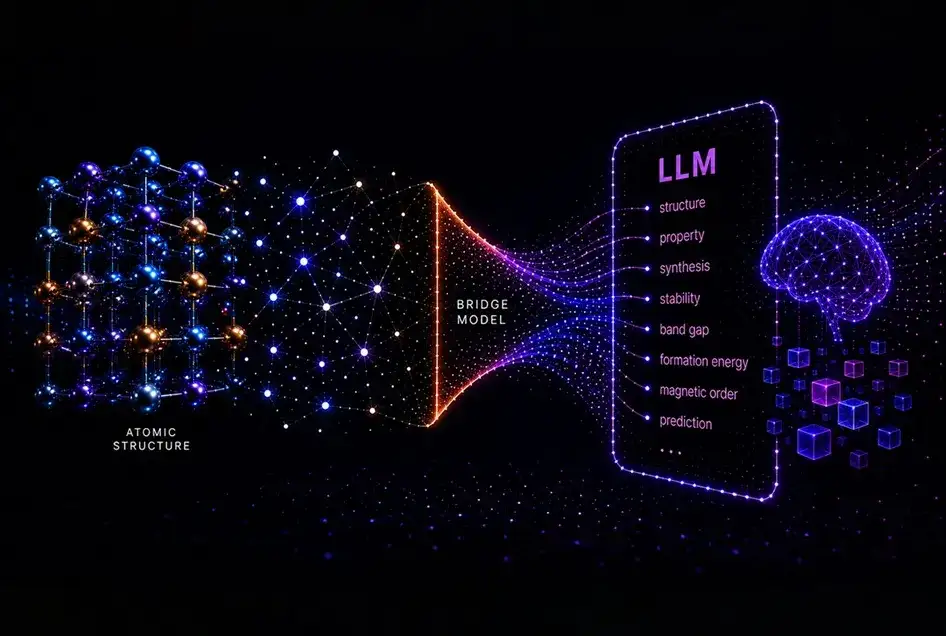
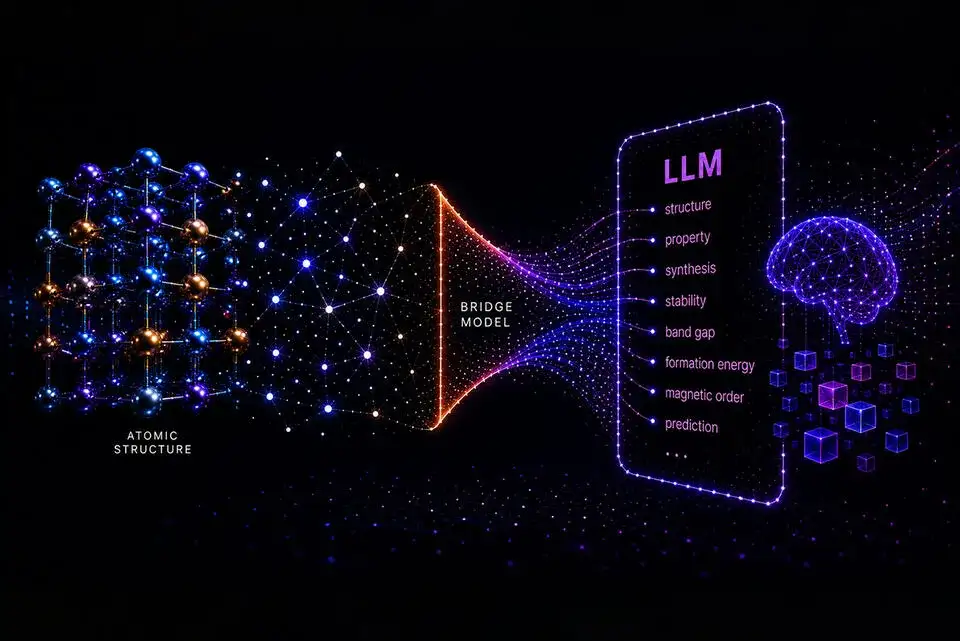
MatterChat functions as a specialized interface that translates complex atomic-scale forces into a format digestible by language models, enabling them to apply scientific reasoning to material discovery.
Technical Methodology
The team, led by Yingheng Tang, Wenbin Xu, and Benjamin Erichson, constructed the model by drawing conceptual frameworks from Vision Question Answering (VQA) and Text-to-Image (T2I) generation.

The approach emphasizes "forward-compatible" architecture, ensuring the model remains functional as scientific datasets scale.
Rather than competing with industry-standard LLMs, the laboratory is positioning the tool as "connective tissue" that optimizes existing general-purpose models for high-stakes, domain-specific physical analysis.
The project utilized the National Energy Research Scientific Computing Center (NERSC) to facilitate the computational heavy lifting required for atomic modeling.
| Feature | Limitation of Current LLMs | Capability of MatterChat |
|---|---|---|
| Data Input | Textual knowledge synthesis | Atomic coordinates & structural data |
| Analysis | Semantic/linguistic logic | 3D physical force interpretation |
| Primary Goal | General pattern matching | Domain-specific material discovery |
Context and Implications
The development arrives amidst a broader push within Materials Science to integrate machine learning into physical research. While traditional models frequently experience "hallucinations"—generating inaccurate scientific claims—the use of structural bridging tools seeks to ground model output in actual coordinate-based reality.
Read More: Two Point Museum Arty-Facts DLC Adds Art Studios on May 19 2026
By developing modular, "forward-compatible" methods, the Berkeley Lab researchers are moving away from the paradigm of building massive, opaque models from the ground up. Instead, they are prioritizing the creation of specialized "connective" layers that allow for the translation of abstract, non-textual scientific data into the linguistic logic used by commercial AI. This approach highlights an institutional strategy focused on leveraging high-performance Computational Science infrastructure to bridge the gap between silicon-based reasoning and physical world experimentation.