


Bengaluru, a city increasingly defined by its gleaming tech parks, is now hosting a new spectacle: "The Sixth Sense," billed as India's first and largest multidisciplinary immersive festival. Promising a fusion of art, music, and cutting-edge technology within a historic industrial space, it aims to "reawaken human connection with the natural world" and "decode nature's intelligence." But as attendees wander through light installations and soundscapes, a crucial question lingers: Is this festival genuinely fostering deeper connections, or is it merely a sophisticated distraction, a digital mirage obscuring real-world concerns? With over 35,000 visitors anticipated, the scale of this event demands a critical examination of its substance beneath the dazzling surface.
A Festival of Firsts, Or Just First-Rate Hype?
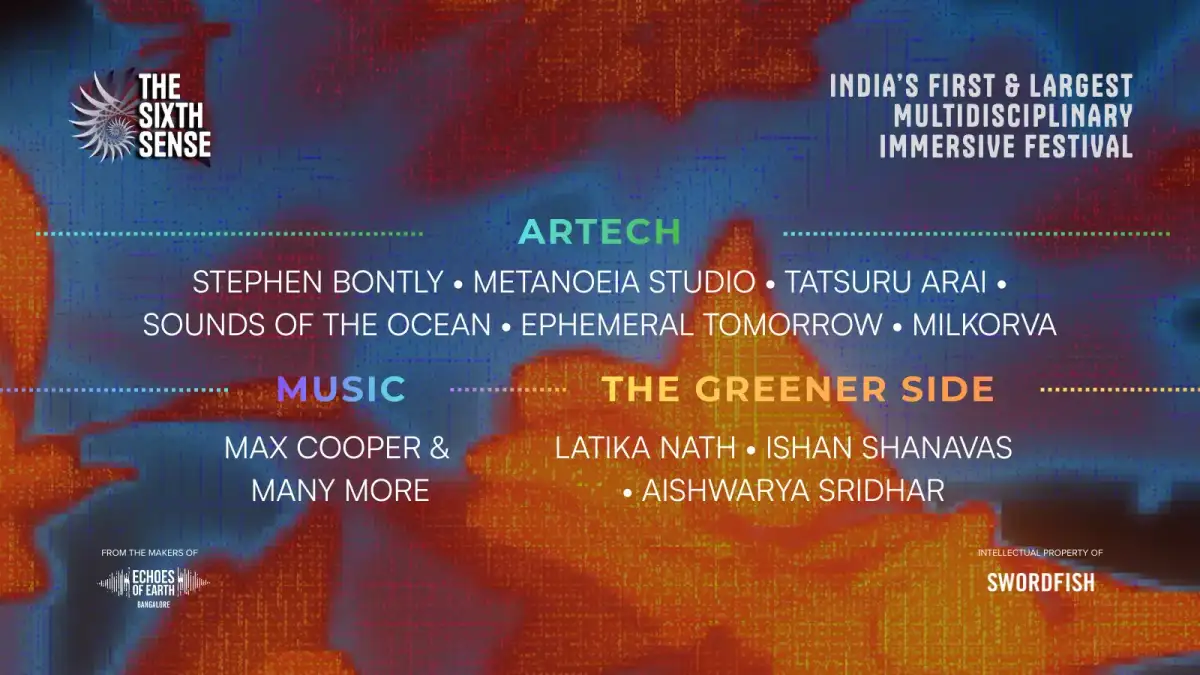
"The Sixth Sense" festival, spearheaded by the team behind the sustainability-focused "Echoes of Earth" music festival, has landed in Bengaluru with significant fanfare. Launched from February 5th to 22nd, 2026, at the Alembic City, a repurposed historic glass factory in Whitefield, it boldly claims the title of "India's first and largest multidisciplinary immersive festival." This ambitious venture spans 18 days, aiming to blend "art, music, technology, and nature" into a cohesive, multi-sensory experience.
Read More: Wuthering Heights Director Regrets Cutting Margot Robbie's Unshaven Armpit Scene
The festival's core tenets appear to revolve around the intersection of art and technology, transforming what are often seen as disparate fields into a harmonious whole. According to Lalindra Amarasekara, the Technical Director, "Art too, has gravitated towards technology, and a lot of forward thinking with regard to technology happens through art." This synergy is expected to manifest through:
Immersive Art-Tech Installations: Over 15 such installations are planned, featuring large-scale projections, interactive works, and experimental environments designed to engage the senses.
360° Immersive Dome: A central feature offering full-dome audiovisual experiences for complete spatial immersion.
Multi-sensory Performances: Live music and electronic compositions are set to be synchronized with real-time visual environments, promising a deeply immersive auditory and visual journey.
Collaborative Learning: Workshops focusing on sustainability, led by initiatives like "Echoes of Earth’s The Greener-side," are included for both children and adults.
Furthermore, the festival boasts international collaborations, notably with The NODE Institute (Germany), bringing India's first-ever TouchDesigner sessions. This highlights a global ambition, aiming to position Bengaluru as a hub for such avant-garde cultural movements. Global artists like sitar virtuoso Niladri Kumar and Malian desert blues icon Vieux Farka Touré are slated for a cross-cultural collaboration, as is acclaimed electronic composer Max Cooper, known for bridging science, sound, and visual storytelling.
Read More: Chrome mimeHandler API lets extensions handle file types

However, given the festival's emphasis on the "first and largest" claims and its high-tech veneer, it's essential to probe:
Does the "immersive" nature truly translate to deeper human connection, or is it a sophisticated form of entertainment?
How effectively does this festival "decode nature's intelligence" beyond symbolic representation?
What tangible impact do the sustainability workshops have, and how are they integrated into the broader festival experience?
From "Echoes of Earth" to "The Sixth Sense": A Familiar Footprint?
"The Sixth Sense" emerges from the same team that brought "Echoes of Earth" to prominence. "Echoes of Earth" itself was positioned as a "sustainability-led music festival," a concept that inherently carries a strong social and ecological message. This new venture, conceived over two years, seems to amplify this underlying ethos by integrating it into a larger, more technologically advanced format.
"Echoes of Earth" (Past Event): Focused on sustainability, music, and art.
"The Sixth Sense" (Current Event): Expands on these themes with a strong emphasis on technology, immersive experiences, and a multidisciplinary approach.
The connection is evident: "The Sixth Sense" "takes the ecological concerns that shaped Echoes of Earth, and reworks them into a larger, multidisciplinary immersive format," as reported by Homegrown. This suggests a narrative evolution, where the core message of environmental awareness is now being communicated through a more advanced technological lens.
Read More: Bengaluru Photo Contest Adds Rural Nature Category
However, this raises critical questions:
Is the focus on technology and immersion overshadowing the original sustainability message?
When Max Cooper frames the festival as an attempt to translate "nature’s intelligence" in a moment when "artificial intelligence is reshaping how people understand creativity," is he drawing a parallel or a contrast? What is the nuanced message here?
Has the previous festival faced scrutiny regarding its environmental impact or the effectiveness of its sustainability initiatives, and if so, how is "The Sixth Sense" addressing these potential concerns?
The reported aim to highlight "concerns around ecology and where we're headed within a shared public space" is commendable. But the delivery method – a festival of this scale, utilizing extensive technology – inevitably has its own environmental footprint. The adaptive reuse of the former glass factory at Alembic City is a positive step, demonstrating a commitment to sustainability in venue selection. Yet, the energy consumption, waste generation, and materials used in creating such large-scale immersive installations are significant considerations that demand transparency.
Art, Tech, and the "Visceral Experience": Deconstructing Immersion
The festival explicitly champions the fusion of art and technology, moving beyond traditional artistic expression. Lalindra Amarasekara states, "Art and technology may seem like opposites, but when they come together, they create a space where magic happens." This "magic" is manifested in exhibits where, for example, the "connect we feel with a tree is amplified," and the experience is "visibly experienced." The intention is for visitors to focus on a "visceral experience" at a leisurely pace, absorbing the "underlying story that unravels as one walks through the exhibits."
Read More: BEREC Asks for Mobile Network API Ideas from Developers
The concept of immersion here seems to involve:
| Element | Description |
|---|---|
| Spatial Sound | Utilizes ambisonic listening experiences to create three-dimensional soundscapes. |
| Visual Storytelling | Integrates real-time visual environments with music, creating a cohesive audio-visual narrative. |
| Interactive Installations | Artworks that respond to visitor presence or actions, fostering a dynamic engagement. |
| Sensory Amplification | Experiences designed to heighten perception, making abstract concepts (like connection to nature) more tangible. |
Max Cooper's work, described as bridging "science, sound, and visual storytelling," is a prime example of this interdisciplinary approach. His performances are intended to reshape "how electronic music can be felt, seen, and understood," moving beyond mere listening to a comprehensive sensory engagement.
The underlying philosophy seems to be that technology can act as a mediator, translating complex ideas and emotions into directly perceivable experiences. However, this raises several critical questions:
Is this amplified sensory experience truly a deeper connection, or a technologically induced emotional response?
What happens when the "magic" fades and visitors return to their everyday lives? Does the "visceral experience" leave a lasting impact on their perception of art, technology, or nature?
Could an over-reliance on curated technological experiences inadvertently alienate individuals who find deeper connection through simpler, less mediated forms of engagement with nature?
In a world increasingly saturated with digital stimuli, is another layer of sophisticated digital immersion the most effective way to foster genuine human-nature connection?
The Specter of AI: A Dialogue or a Distraction?
A recurring theme in the festival's promotion is its positioning in relation to Artificial Intelligence (AI). "The Sixth Sense" is presented as a counterpoint, a way of "decoding nature’s intelligence into stories and immersive experiences" at a time when "AI is reshaping our conversations." This framing is particularly intriguing.
Festival's Stated Goal: To understand and translate nature's intelligence.
Contextual Environment: A world increasingly shaped by artificial intelligence.
The festival's creators seem to be drawing a deliberate parallel between natural intelligence and artificial intelligence, suggesting that their immersive format offers a way to grasp the former amidst the rise of the latter. This can be interpreted in several ways:
Read More: Hotel Towel Twisting Art Revealed by Staff
A Contrast: Highlighting the organic, complex, and perhaps more profound intelligence found in nature as distinct from, and potentially superior to, manufactured AI.
A Comparison: Suggesting that understanding nature's intricate systems can inform our approach to developing AI, fostering a more harmonious integration of technology.
A Bridge: Using the tools and aesthetics of AI-influenced digital art to make the principles of natural intelligence more accessible.
The crucial question is: How is this dialogue between nature's intelligence and AI actually playing out within the festival's programming?
Are there specific exhibits that directly address the comparison or contrast between natural and artificial intelligence?
Are the artists themselves engaging with these themes in their work, or is this primarily a narrative spun by the festival organizers?
Given that AI is now capable of generating art, music, and complex simulations, how does "The Sixth Sense" distinguish its human-led, nature-inspired technological art from AI-generated content? Does it need to, and if so, how?
When Lalindra Amarasekara mentions that "a lot of forward thinking with regard to technology happens through art," does this include the development of AI itself, or is art's role here more about critiquing or guiding technological advancement, including AI?
Without clear programmatic examples or statements from the artists themselves, the festival's engagement with AI feels somewhat abstract, a backdrop against which its technological art is presented rather than a core theme explored in depth. The claim that this festival helps "decode nature’s intelligence" in the age of AI is a powerful one, but it demands substantiation beyond promotional slogans.
Transparency and Impact: Beyond the Lights and Sounds
While "The Sixth Sense" festival aims to be a groundbreaking cultural event, its success and integrity hinge on more than just its immersive qualities. As a critical investigative journalist, I am compelled to ask about the tangible impacts and operational transparency.

Key Areas for Scrutiny:
Environmental Footprint:
What are the specific energy consumption targets and actual usage for the festival?
How is waste management being handled, particularly concerning electronic waste from installations and single-use materials?
Are there independent audits of the festival's environmental impact?
Economic Impact and Local Engagement:
What is the economic benefit to Bengaluru beyond ticket sales? Are local artists and businesses being significantly involved and compensated?
What are the ticket prices, and how accessible is this "immersive experience" to diverse socioeconomic groups within the city?
Educational Value:
Beyond the "Greener-side" workshops, how are other elements of the festival designed to educate visitors on ecological issues or technological innovation?
Are there post-festival initiatives to sustain the dialogue or educational impact initiated by the event?
Artist Welfare and Compensation:
What are the contractual agreements and payment structures for the participating artists, particularly international versus local talent?
Are there mechanisms in place to ensure fair recognition and compensation for creators in this technologically complex environment?
Safety and Accessibility:
Given the immersive and potentially disorienting nature of some installations, what safety protocols are in place?
How accessible is the festival venue and its exhibits to individuals with disabilities?
The festival's positioning as a "landmark collaboration" and the "beginning of a vibrant cultural movement" suggests aspirations beyond mere entertainment. However, such movements require a foundation of responsible practice. The scale of anticipated visitors (over 35,000) magnifies the importance of these questions. A truly impactful festival would not only dazzle its audience but also operate with a high degree of accountability, demonstrating that its grand vision is matched by concrete actions and transparent practices.
Read More: Confidential Computing Security Flaw Found on 4 April 2026
Conclusion: A Call for Substance Over Spectacle
"The Sixth Sense" festival arrives in Bengaluru draped in the allure of innovation, promising a novel fusion of art, technology, and nature that seeks to deepen our human connections. Its ambition is undeniable, seeking to redefine cultural experiences in India. The team behind "Echoes of Earth" has clearly leveraged their experience to create something grander, more technologically sophisticated.
However, the festival's self-proclaimed status as India's first and largest immersive spectacle invites rigorous scrutiny. We are presented with a sensory smorgasbord, a dazzling display of light, sound, and spatial design. But the deeper value lies not just in the aesthetic experience, but in the resonance it leaves behind.
The Promise: To reawaken human connection with the natural world and decode nature's intelligence.
The Method: Immersive art-tech installations, multisensory performances, and collaborative learning.
The Underlying Concern: Whether the technological spectacle will truly foster deeper understanding and connection, or serve as an elaborate, albeit beautiful, distraction.
The narrative around AI, while intriguing, needs tangible exploration within the festival's programming to move beyond mere rhetorical framing. The success of "The Sixth Sense" will ultimately be measured not by the number of visitors or the novelty of its technology, but by its capacity to effect genuine, lasting change in how attendees perceive themselves, their environment, and the complex interplay between nature and innovation. Until a deeper level of transparency regarding its operational impact and educational efficacy is provided, "The Sixth Sense" risks being perceived as a glittering, yet ultimately ephemeral, phenomenon—a testament to our technological prowess, but perhaps less so to our profound, unmediated connection with the world around us.
Read More: Louvre Abu Dhabi Shows Picasso Art Changes
Sources:
The Sixth Sense 2026: https://www.district.in/events/the-sixth-sense-2026-buy-tickets#::text=The%20Sixth%20Sense%20is%20India%E2%80%99s%20first%20and%20largest,industrial%20space%20through%20light%2C%20sound%2C%20and%20spatial%20design.
The Sixth Sense brings a sensory smorgasbord to Bengaluru: https://www.thehindu.com/entertainment/the-sixth-sense-brings-a-sensory-smorgasbord-to-bengaluru/article70583313.ece
Home | The Sixth Sense: https://www.thesixthsensefestival.com/
The Sixth Sense Debuts in Bengaluru as India’s First Multidisciplinary Immersive Festival | EVENTFAQS India: https://in.eventfaqs.com/2026/01/15/the-sixth-sense-debuts-in-bengaluru-as-indias-first-multidisciplinary-immersive-festival/
From The Team Behind Echoes Of Earth Comes An Immersive Art, Music, & Tech Festival: https://homegrown.co.in/homegrown-explore/from-the-team-behind-echoes-of-earth-comes-an-immersive-art-music-tech-festival
The Sixth Sense Festival Brings Art, Music And Technology To Bengaluru From February 5-22: https://www.bwtravel.com/industry-insights/the-sixth-sense-festival-brings-art-music-and-technology-to-bengaluru-from-february-5-22-11066421
The Sixth Sense – India’s First Multidisciplinary Immersive Festival to Debut in Bengaluru: https://www.deccanchronicle.com/lifestyle/the-sixth-sense-indias-first-multidisciplinary-immersive-festival-to-debut-in-bengaluru-1921812






