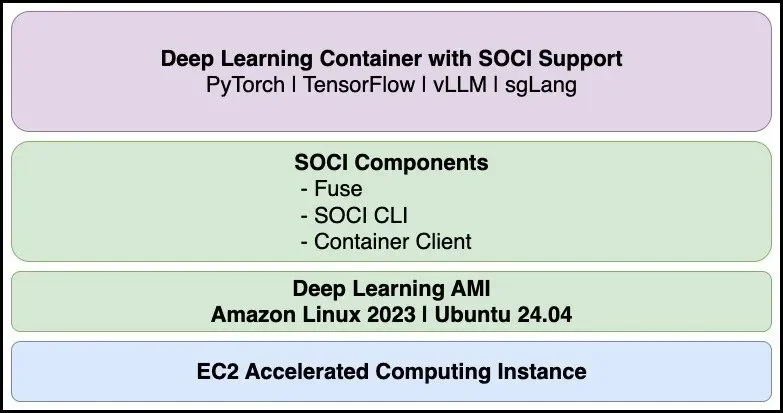
The integration of Seekable OCI (SOCI) index support into AWS Deep Learning AMIs (DLAMI) and Deep Learning Containers (DLC) marks a shift in how inference environments negotiate container initialization. By enabling lazy loading, the system circumvents the traditional requirement to download entire image blobs before execution.
| Metric | Traditional (Eager) Loading | SOCI (Lazy) Loading |
|---|---|---|
| Download Requirement | Full Image Payload | On-demand (file-by-file) |
| Container Start | Blocked by Network I/O | Immediate (partial) |
| Data Strategy | Sequential / Monolithic | Selective / Indexed |
Operational Mechanics and Constraints
The transition to this model requires specific structural shifts in registry management. The SOCI Snapshotter, a plugin for containerd, facilitates this functionality.

Registry Dependencies: Container images must contain a SOCI index stored within the registry. Without this pre-computed index, lazy loading is impossible.
CLI Requirements: Users must configure their container runtimes—such as
nerdctlorfinch—to utilize the--snapshotter sociflag to initiate the process.Infrastructure Parity: The tools are currently available for Deep Learning Containers and DLAMI, aligning the standard execution environments with the Seekable OCI specification.
Context: The Cost of Cold Starts
The conventional container lifecycle relies on an eager loading pattern where the image registry pushes the entire container filesystem to the local node before the entrypoint executes. For machine learning workloads, which often utilize heavy dependencies and large libraries, this creates a persistent bottleneck known as a "cold start."

"Lazy loading (also known as asynchronous loading) is a design pattern commonly used in computer programming… to defer the initialization of an object until the point at which it is needed." — Background on Seekable OCI implementation
By treating the container image as a searchable database of files rather than a static block of data, AWS attempts to reduce the idle time inherent in scaling elastic infrastructure. The effectiveness of this approach depends entirely on the accuracy of the index generated at build time. Users managing large-scale inference clusters must now integrate the index creation into their CI/CD pipelines to realize these gains.
Read More: Chrome mimeHandler API lets extensions handle file types