A revolutionary analytical tool is casting a shadow of doubt over the authenticity of some of the most revered masterpieces, specifically those attributed to the Flemish master Jan van Eyck. Recent reports suggest that advanced artificial intelligence, designed to scrutinize the very fabric of art, is flagging anomalies that could question the provenance of paintings held in prestigious Italian and American museums. This isn't just about spotting a forgery; it's about re-evaluating our understanding of artistic genius and the unassailable narratives we build around it. Can a machine, with its cold, calculated logic, truly unmask the subtle hand of a 15th-century genius, or is it merely creating new mysteries?
The Unsettling Echoes of Artificial Scrutiny
The idea that a machine might doubt the attribution of a Jan van Eyck painting is, frankly, unsettling. For centuries, van Eyck has been lauded not only for his breathtaking realism and meticulous detail but also for an almost magical ability to capture light and texture. His works, particularly the Arnolfini Portrait, are cornerstones of art history, studied and admired for their profound complexity. But now, the very tools we've developed to understand and preserve art are suggesting that some of these celebrated pieces might not be what they seem. This technological intrusion raises a torrent of questions: What criteria is this AI using? How extensive is this doubt? And, most importantly, who is truly in control – the art historians who have shaped our understanding, or the algorithms that are now re-writing it?
Read More: Banana Art Stolen From French Museum, Replaced Quickly
The core of the issue lies in the ability of AI vision language models to analyze datasets of both real and AI-generated paintings [Article 3]. These models are trained to detect patterns, brushstrokes, and compositional elements that might betray a non-human origin, or simply, an unfamiliar hand. When applied to the works of masters like van Eyck, whose technique is considered almost inimitable, these findings become incredibly significant. Could the AI be identifying elements that don't align with our established understanding of van Eyck's documented practices? Or is it detecting something entirely new, a characteristic that suggests a different artist, a later period, or even a deliberate imitation?
Read More: Chrome mimeHandler API lets extensions handle file types

The potential for AI to challenge established art historical attributions is a profound development, forcing a re-examination of long-held beliefs and the methods used to verify artistic provenance.
Van Eyck: A Pioneer, a Magician, an Enigma
Jan van Eyck (c. 1390-1441) was not just a painter; he was a revolutionary figure in the Northern Renaissance. Famed for his exquisite detail and mastery of oil paint, he brought an unprecedented level of naturalism to his work. He was sought after by royalty and nobility, a testament to his international recognition [Article 4]. Yet, much about his life and methods remains shrouded in mystery and legend. Art historians have long debated his techniques, particularly his understanding and application of perspective.
Historically, it was widely accepted that van Eyck was unaware of the geometric laws of perspective that were being developed concurrently in Italy [Article 2]. However, recent computer vision analyses have challenged this long-held assumption. Researchers have used computational tools to study the vanishing points in his paintings, suggesting that van Eyck might have employed a sophisticated, possibly even revolutionary, form of "polyscopic perspective" – a system that predates established Western perspective by decades and, intriguingly, has been linked to concepts like augmented reality and holography [Article 2, Article 10].
Read More: Indian artists use Instagram for anti-caste art

This dual narrative – van Eyck as a misunderstood genius of perspective, and now, potentially, the subject of AI-driven authentication doubts – creates a complex picture.
Traditional View: Van Eyck achieved realism through empirical observation and unparalleled skill with oil paints, possibly without formal knowledge of linear perspective.
Emerging Research: Advanced computer analysis suggests he understood and employed a unique, multi-point perspective system, akin to modern AR precursors.
New AI Findings: AI analysis is now questioning the very hand behind these celebrated works, irrespective of their perspectival complexities.
The very elements that make van Eyck's work so fascinating – its intricate detail, its complex spatial representations, and the persistent enigmas surrounding its creation – are now the very points being scrutinized by AI. What if the anomalies detected by AI are not errors, but rather clues to the very techniques that made him so revolutionary?
The AI Mirror: Reflecting Reality or Distorting It?
The debate about AI's capability in art analysis hinges on its ability to differentiate between human artistry and machine-generated output, and more crucially, to accurately attribute existing works. As demonstrated in recent research, vision language models (VLMs) are being evaluated for their capacity to judge "the hand or the machine behind the canvas" [Article 3]. These models are trained on vast datasets, and their analyses are based on identifying subtle statistical patterns in elements like brushstrokes, pigment usage, and compositional structure.
Read More: BEREC Asks for Mobile Network API Ideas from Developers

Consider the comparative analysis of traditional painting versus AI-generated art, using the Arnolfini Portrait as a case study [Article 1]. This research explores whether AI can replicate the "depth and complexity" of traditional works. While the specific findings of this study regarding AI's ability to replicate are not detailed here, the implication is that AI is now a tool capable of evaluating that depth and complexity.
Furthermore, the field of machine learning and forgery detection is rapidly advancing [Article 6]. Algorithms can now analyze chemical compositions of pigments through techniques like X-ray fluorescence (XRF), with AI models providing "superior results" compared to traditional methods, detecting chemical elements and their quantities with greater accuracy and speed, and requiring less expert involvement [Article 6]. If AI can detect the precise chemical makeup of paints and compare it to known databases, what does this imply for historical attributions? Could the AI be flagging paintings that use pigments or techniques inconsistent with van Eyck's known materials and methods?
Read More: Kerala Artist Abhilash Thotathil Shows Work at Cannes Biennale
| AI Capabilities in Art Analysis ||—————————————————-|—————————————————————————————————————|| Pattern Recognition: Detects subtle anomalies in brushwork, composition, and detail. || Material Analysis: Identifies chemical composition of pigments and binders. || Stylistic Comparison: Evaluates stylistic consistency against known works of an artist. || Provenance Tracking: Potentially aids in verifying or questioning ownership history. |

The question becomes: Is the AI an infallible arbiter, or is it susceptible to misinterpretations, especially when dealing with centuries-old techniques and materials that might not be perfectly cataloged?
Echoes of Past Doubts: The Specter of Forgery and Misattribution
This contemporary AI scrutiny is not entirely unprecedented. Art history is replete with examples of masterful forgeries and misattributions that have challenged experts for decades. The notorious case of Han van Meegeren, who forged works by Vermeer and Johannes Vermeer’s contemporaries, only to be discovered through scientific analysis of his materials, serves as a stark reminder of how easily even the most convincing fakes can infiltrate the art world [Article 6, Reference 1].
Read More: Confidential Computing Security Flaw Found on 4 April 2026
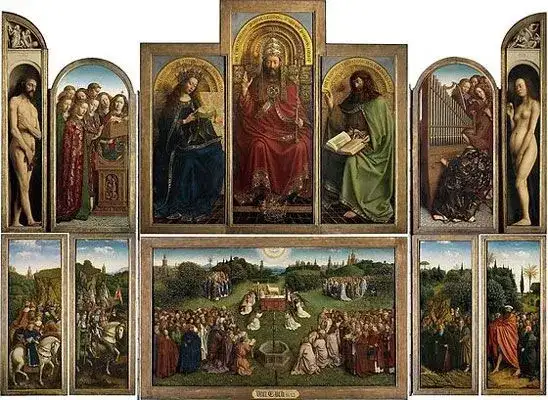
More broadly, the very identity and artistic output of Jan van Eyck have been subjects of scholarly debate. The existence and role of his brother, Hubert van Eyck, in the creation of the Ghent Altarpiece, for instance, have been debated, with some scholars suggesting that attributing sole genius to Jan might diminish the potential for artistic collaboration and overshadow Hubert's contributions [Article 8]. This historical uncertainty about artistic authorship within the van Eyck circle perhaps makes the ground fertile for new questions, whether posed by humans or machines.
Furthermore, the specific object of much of this debate, the Arnolfini Portrait, has itself been subject to various interpretations regarding its sitter and purpose. While widely accepted as a depiction of Giovanni (?) Arnolfini and his Wife, its exact subject and historical context have been points of discussion, even touching on its potential travel with historical figures like Margaret of Austria [Article 9, Article 7]. The painting’s rich symbolism and enigmatic details invite layers of interpretation, making it a prime candidate for re-examination through new analytical lenses.
Read More: Farmer Creates Heart Shape With Sheep in Guyra as Tribute
The history of art is not a static, unquestionable record; it is a dynamic field constantly re-evaluated by new evidence, new interpretations, and now, new technologies.
Probing Questions for the Future of Art Authentication
As AI delves deeper into the intricacies of artistic creation, several critical questions emerge that demand thorough investigation:
What specific criteria are the AI models using to flag potential discrepancies in van Eyck's work? Are they based on brushstroke analysis, pigment composition, perspective rendering, or a combination of factors?
How robust is the training data for these AI models, particularly concerning 15th-century Netherlandish painting techniques? Are there gaps or biases that could lead to erroneous conclusions?
What is the error rate of these AI systems when applied to known authentic and known forged artworks? Transparency on performance metrics is crucial.
Are the AI analyses being corroborated by traditional art historical research and scientific methods (e.g., XRF, dendrochronology, infrared reflectography)? Over-reliance on a single analytical tool, however advanced, carries risks.
Who commissioned or conducted these AI analyses, and what are their motivations? Understanding the impetus behind these investigations is key to assessing their impartiality.
If significant doubts are raised, what is the process for re-evaluating the attribution of these museum pieces? What evidence would be required to overturn centuries of scholarly consensus?
How will museums and art institutions integrate AI into their authentication and conservation processes? Will it be a tool for experts, or will it eventually dictate conclusions?
Could these AI analyses inadvertently create new 'mysteries' or controversies around artworks, potentially impacting their market value or public perception?
The pursuit of objective truth in art authentication is laudable, but we must proceed with caution. The current situation, where AI is casting doubt on revered masters, necessitates a rigorous, multi-disciplinary approach. It's a moment that calls for the best of human expertise – art historians, conservators, scientists, and ethicists – to work in tandem with these powerful new tools, ensuring that progress in art analysis serves to illuminate, not obfuscate, our understanding of human creativity.