
Large Language Models (LLMs) operate fundamentally as sophisticated prediction engines, tasked with identifying the statistically most probable next "token" – be it a word or a fragment of one – based on the preceding sequence. This iterative process, where each predicted token becomes part of the new context for the subsequent prediction, forms the bedrock of their text generation capabilities. The entire architecture is geared towards calculating probabilities and selecting the next piece of text based on those calculations.

The Mechanics of Predictive Text
At its core, an LLM's function mirrors the predictive text feature on a smartphone, albeit on an immeasurably grander scale and with vastly deeper contextual awareness.
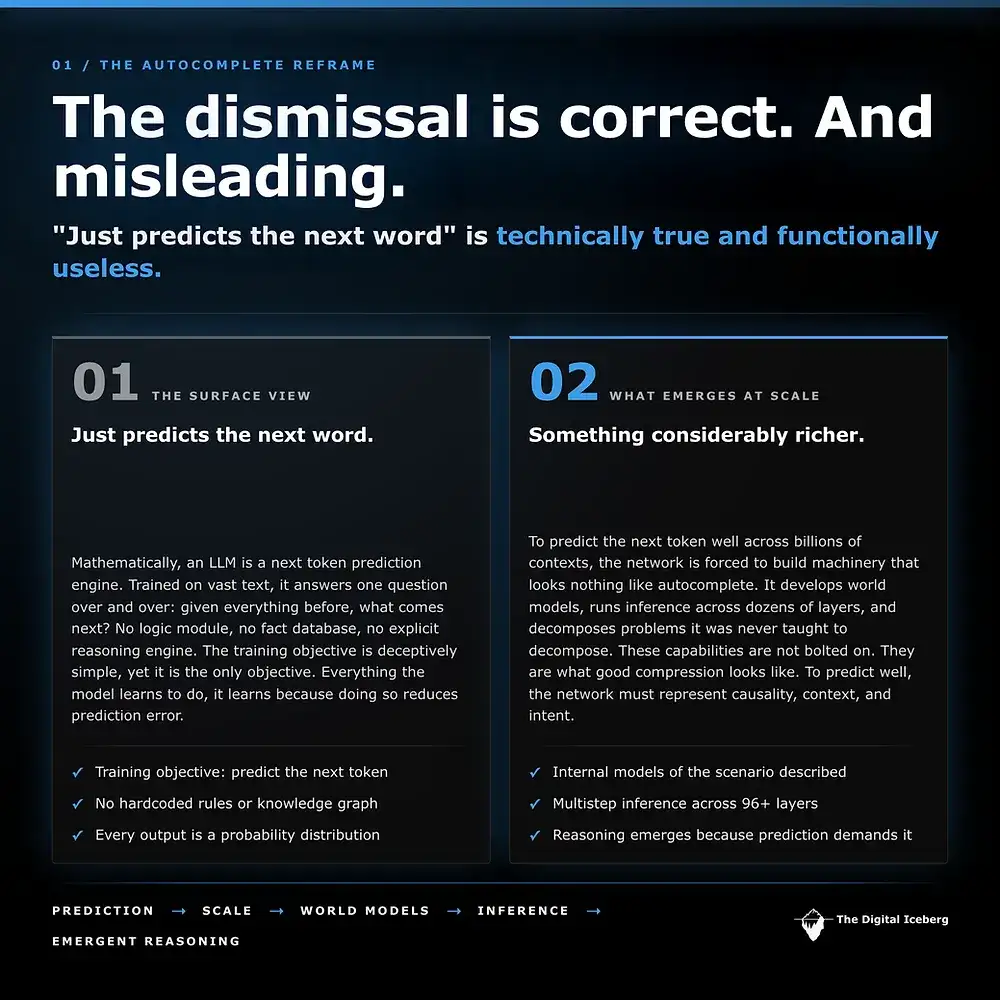
The training phase imbues these models with an understanding of statistical relationships between tokens.
This allows them to anticipate what is likely to follow given a particular input string.
Techniques like 'temperature sampling', 'top-k', and 'top-p' are employed as decoding strategies, guiding how the model selects from its probability estimates to produce coherent text.
Beyond Memorization: Towards Recursive Understanding
Recent developments, such as Recursive Language Models (RLMs), illustrate an evolution beyond simple memorization. These models exhibit enhanced performance on tasks requiring long-context understanding, with one RLM framework outperforming a larger, non-recursive model. The innovation here involves keeping the primary prompt separate from the model's internal context window, circumventing the degradation issues that plague standard LLMs with extended inputs.
Read More: Chrome mimeHandler API lets extensions handle file types
When faced with lengthy documents and questions about early details, traditional LLMs often falter, even with expansive context windows.
RLMs address this by processing information recursively, allowing them to better manage and recall information from vast swathes of text.
The Illusion of Thought
The output of an LLM, often presented as coherent paragraphs, represents the "reasoning" itself, not merely a description of a separate, internal thought process. The models develop structures that effectively function as world models, allowing them to generate text that reflects an understanding of relationships and concepts. The act of generating text is, in this framework, the model's method of problem-solving or information synthesis.
The "thinking" is embedded in the generated text.
The models learn to predict not just the next word, but by extension, the patterns and structures that constitute knowledge and narrative.
Context and the LLM Ecosystem
The practical application of LLMs is also evolving. Projects like 'llm-wiki' showcase a dynamic where users query a knowledge base, and the LLM both generates and maintains its content. This symbiotic relationship highlights a future where LLMs are not just tools for output, but active participants in information curation and management, periodically self-auditing their output for accuracy and coherence.
This approach blurs the lines between user and AI as creators.
The LLM is tasked with maintaining the integrity of the information it generates.