


MICROSCOPIC LANTERNS FORCE DOZENS OF LASERS INTO SINGLE FIBER
Israeli researchers have developed a microscopic optical device, a 'photonic lantern', using advanced 3D printing. This device can combine the light from up to 37 individual semiconductor lasers, each producing multiple spatial patterns, into a single optical fiber. The breakthrough promises to improve high-power laser systems and facilitate the transmission of larger quantities of light through existing fiber infrastructure.
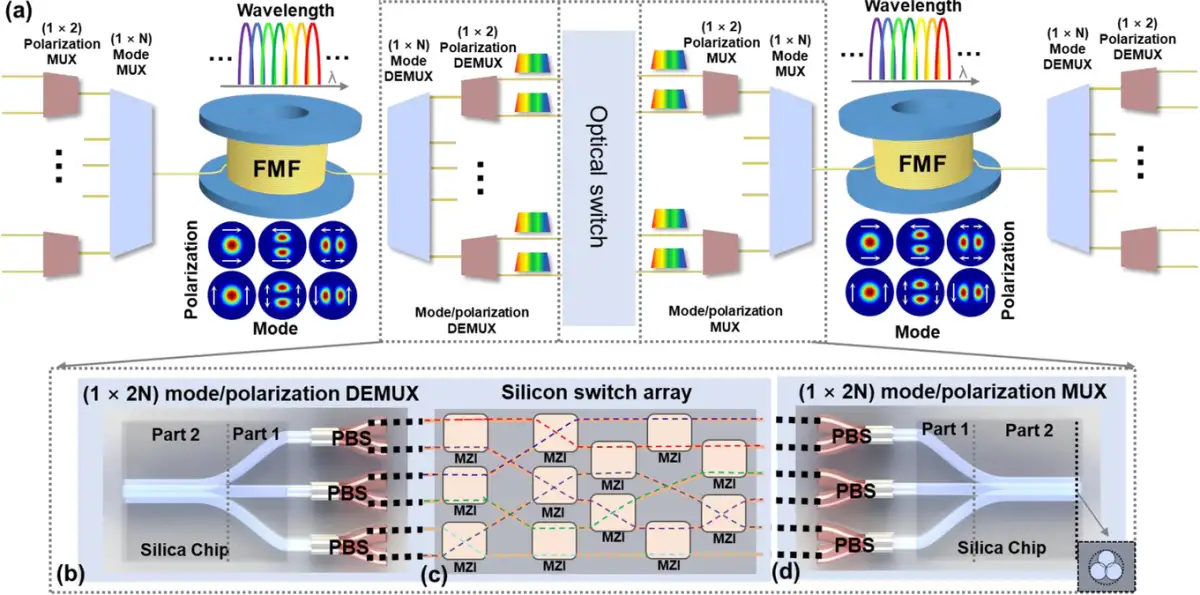
The newly developed "N-MM PL" architecture successfully multiplexes sources emitting across six spatial modes. In experiments, the system combined light from arrays of Vertical-Cavity Surface-Emitting Lasers (VCSELs). The device achieved this while maintaining the brightness of the light, a critical aspect for advanced optical applications. This represents a significant step beyond earlier designs which struggled to integrate the complex spatial modes emitted by these lasers.

EFFICIENCY AND SCALE
The 3D-printed photonic lanterns, measuring less than half a millimeter in length, demonstrated substantial scalability. Researchers successfully multiplexed devices handling 7, 19, and crucially, 37 multimode VCSEL sources. This system supports a total of up to 222 spatial modes within a single fiber.
Read More: Starship Refueling Delays Could Push Back Artemis Moon Missions by 2 Years

The device achieved low coupling losses when directing the combined light into standard 50 micrometer multimode optical fiber. Losses were recorded as low as -0.6 decibels for the 19-input lanterns and -0.8 decibels for the 37-input versions. This efficiency is notable given the diminutive size of the photonic lanterns compared to conventional optical multiplexing systems.

REINVENTING THE LANTERN
Traditional photonic lanterns are designed to interface between multiple single-mode laser inputs and a single multimode waveguide. The innovation lies in the realization of a "Multimode Photonic Lantern" (MM PL) architecture capable of handling numerous multimode VCSEL sources simultaneously.
This contrasts with established relay lens systems, which often degrade beam quality. The "N-MM PL" design appears to match the modal capacity of the inputs to the output fiber, thereby preserving the inherent brightness of the laser array.
Read More: NASA Van Allen Probe A Satellite Burning Up on Earth Re-entry March 10
BROADER CONTEXT AND EVOLUTION
The concept of photonic lanterns has been an area of research for years, focusing on manipulating light modes within optical fibers. Earlier work explored integrating these devices with various fiber types, including few-mode and multicore fibers, for applications in space-division multiplexing. Efforts have also been directed towards fabricating these components using techniques like laser inscription and 3D nanoprinting, aiming for microscale devices. The development of mode-selective photonic lanterns has been key to enabling the efficient coupling and manipulation of different light patterns within a single fiber. The pursuit of integrated photonics and advancements in laser writing have continuously pushed the boundaries of what is possible in optical communications and high-power laser systems.