In a massive desertion from the forest camps of Chhattisgarh, 108 Maoist cadres belonging to the Dandakaranya Special Zonal Committee (DKSZC) turned themselves in at Jagdalpur on Wednesday. The group, which included 44 women, surrendered a stash of 101 weapons and led police to a hidden cache containing ₹3.61 crore in cash and one kilogram of gold valued at roughly ₹1.64 crore. Officials describe the hardware recovery—which included AK-47s, Light Machine Guns, and grenade launchers—as the largest single seizure in the history of regional anti-insurgency efforts.
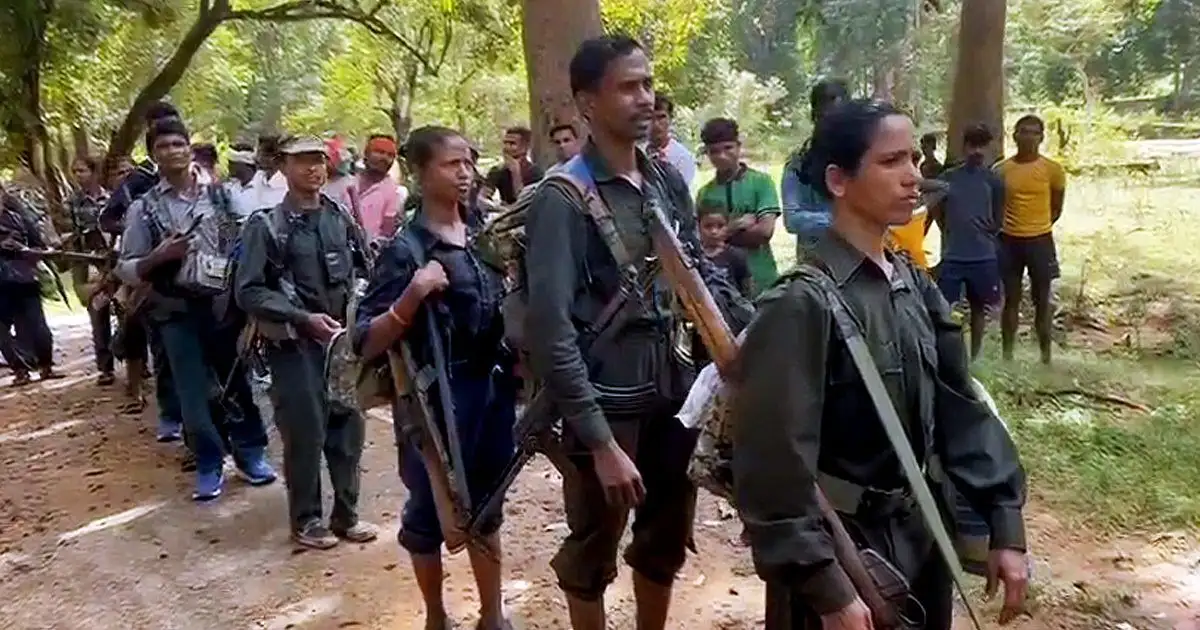
"The recovered arsenal includes 101 weapons, comprising seven AK-47 rifles, 10 INSAS rifles, four Light Machine Guns (LMG), 11 Barrel Grenade Launchers (BGL), twenty .303 rifles and various other firearms." — Sundarraj Pattilingam, IG Bastar Range.
Breakdown of the Ranks and Bounties
The defecting group was not merely low-level foot soldiers; it included a dense layer of the insurgency’s middle management. The collective bounty on their heads totaled between ₹3.29 crore and ₹3.95 crore.

| Rank / Position | Number | Reward (Estimated) |
|---|---|---|
| Divisional Committee Members (DVCM) | 5 to 6 | ₹8 lakh each |
| Platoon Party/Company Commanders | 15 to 18 | Varied |
| Area Committee Members | 21 to 23 | Varied |
| General Party Members | 56 to 63 | Varied |
The surrender effectively hollows out the West, East, and North Bastar divisions, with key names like Rahul Telam, Pandru Kovasi, and Jhitru Oyam among those walking away from the conflict.
Read More: Secret Service Promotions After Butler Attack Criticized by Congress

Geographic Spread of the Desertion
The 108 individuals represent a wide fracture across the southern districts of the state:
Bijapur: 37 members
Dantewada: 30 members
Sukma: 18 members
Bastar: 16 members
Narayanpur: 4 members
Kanker: 3 members
Logistics of the "Poona Margem"
The mass exit was organized under a state-run program titled 'Poona Margem' (translated as Rehabilitation through Rebirth). Under this framework, the former fighters are promised a mix of:
Immediate financial aid and housing.
Vocational training and schooling.
Legal processing of their prior insurgent activity.
Deputy Chief Minister Vijay Sharma noted that out of 30 Naxalite area committees active in the region, 26 have now been effectively disbanded or neutralized.
Background: The 2026 Deadline
This surge in surrenders occurs as the central government nears its self-imposed March 31, 2026 deadline for the "complete removal" of Maoist influence in India. Security forces have ramped up pressure in the Indravati area, pushing the DKSZC—a group notorious for past lethal ambushes—into a corner where staying in the brush is becoming more expensive than quitting. Currently, police state only two high-level Central Committee members of the outlawed CPI (Maoist) remain at large in this sector.
Read More: India IVF Costs And Social Barriers Limit Access In April 2026