

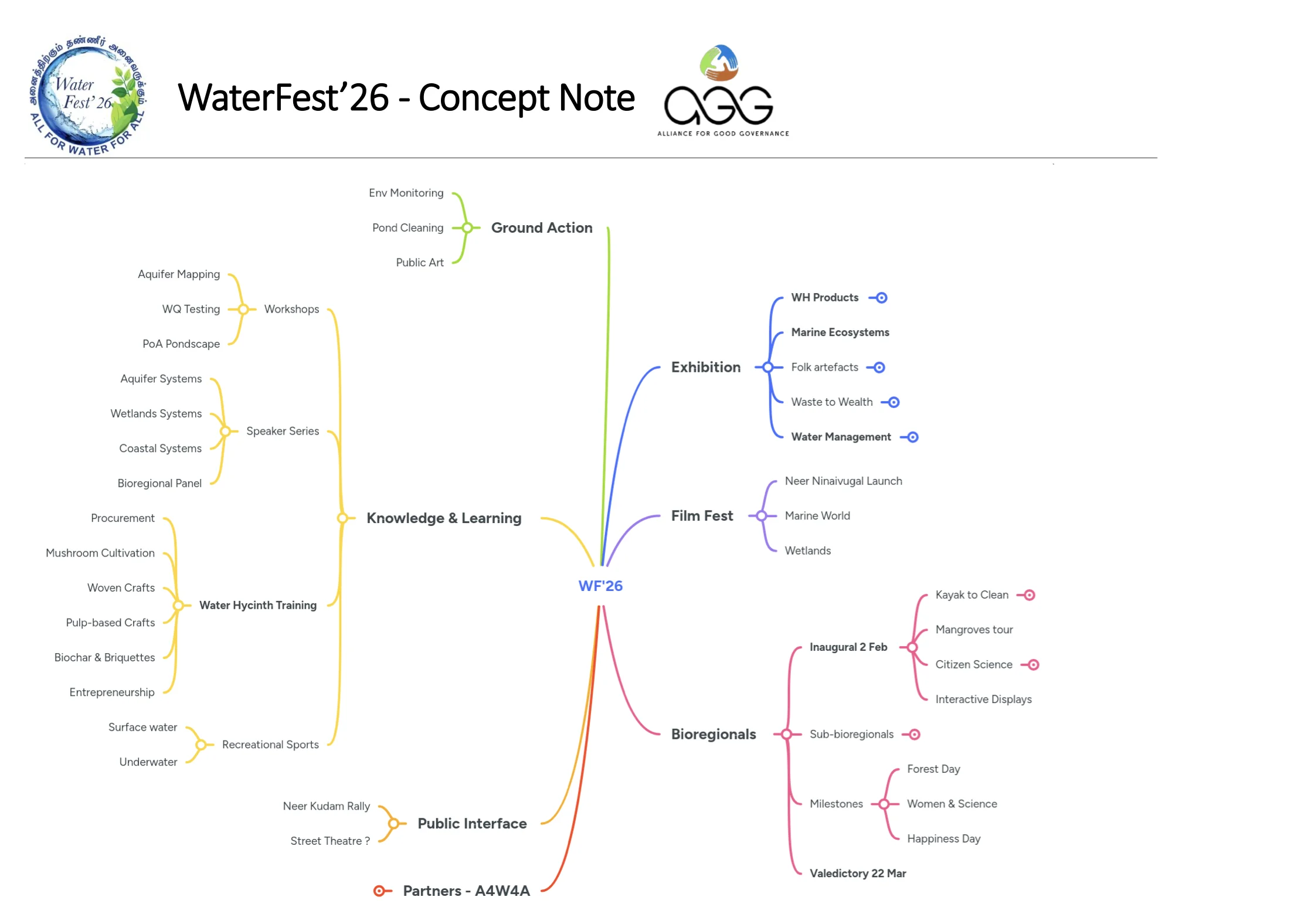
WaterFest, a series of events focused on water conservation and stewardship, has commenced across Puducherry. The initiative aims to bring together various groups, including government bodies, non-governmental organizations, and citizens, to address water-related issues. Activities include educational programs, scientific research, and community action.
Context and Evolution of WaterFest
WaterFest appears to be a recurring event with a history of diverse participation and thematic focus.

Recent Events: The "WaterFest '25" concluded on March 24, 2025, marking its fifth edition. This event was inaugurated on February 2, 2025. Information regarding the commencement of a new WaterFest, possibly "WaterFest 2026" or a subsequent iteration, is also available, with one source mentioning it being set in Bahour and spanning 45 days.
Multi-Stakeholder Engagement: The festival is described as a large, multi-stakeholder program involving government departments such as the Department of Science, Technology and Environment, Local Administration, Education, and Forests and Wildlife. Civil society organizations, individuals, institutions, and people’s organizations are also key participants.
Bioregional Scope: WaterFest extends its focus beyond Puducherry Union Territory to the broader PVAC bioregion, which includes Puducherry, Villupuram, Auroville, and Cuddalore. This wider scope is presented as a unique call for action at a bioregional level.
Thematic Focus: Core themes include water security, citizen science, wetlands assessment, water and livelihoods, education, health, and the interconnectedness of these areas. The event promotes field-level action and research. Specific activities have included biodiversity mapping using apps like iNaturalist and eBird, and exhibitions on wetlands and marine life.
Key Activities and Program Components
WaterFest encompasses a range of activities designed to raise awareness and encourage practical solutions for water challenges.
Citizen Science and Education:
A citizen science activity corner is available to introduce children to biodiversity mapping using mobile applications.
Initiatives like water budgeting and water audits in schools are planned.
Educational programs are integrated into the festival.
Conservation and Livelihoods:
Discussions and workshops explore innovative research and practical solutions for water challenges.
A significant component of "WaterFest '26" involves a 45-day integrated training on water hyacinth-based livelihoods and circular economy practices.
The festival supports pond-scape regeneration through biomass removal and improved water quality.
Exhibitions have showcased handicraft products made from water hyacinth.
Ecosystem Exploration:
Field trips are organized to sites such as the Ousteri Wetlands Sanctuary, Aurovanam Nature Education Centre, and Thengaithittu Estuary.
These excursions focus on freshwater, marine, and brackish water ecosystems.
Community and Governance:
The event is characterized as a citizen-centric festival that calls for action.
It aims to foster partnerships and long-term engagement with water systems and governance.
Community-based conservation strategies are a focus of workshops.
Recognition: An award is presented annually to individuals or institutions for outstanding contributions to protecting water bodies within the PVAC bioregion.
Concerns Regarding Water Quality
Data presented during WaterFest '25 highlights specific concerns about water quality in Puducherry.

High TDS Levels: Mr. Jawahar indicated that Total Dissolved Solids (TDS) in Puducherry's water have reached values of 2,000 mg/l.
Groundwater Dependence: This elevated TDS level is attributed to the region's sole dependence on groundwater.
Organizational Involvement
WaterFest involves collaboration between various entities.
Government Departments: Department of Science, Technology and Environment; Department of Local Administration; Department of Education; Department of Forests and Wildlife.
Civil Society and NGOs: Alliance for Good Governance (a collective of non-governmental organizations); Svarnim Puducherry (a unit of Sri Aurobindo Society); individuals; institutions; and people’s organizations.
Academic and Research: Collaboration with entities such as Sri Aurobindo Society and participation from speakers like Dr. Vidyadhar Atkore from SACON and Dr. Samuel Corgne from CNRS.
Insights from Participants and Organizers
Information from summaries suggests the organizers view WaterFest as a significant undertaking.
"WaterFest '26" Significance: This iteration is described as marking an important milestone, entering its 10th anniversary phase. It is evolving from an annual awareness event into a more sustained, bioregional platform for water stewardship.
"WaterFest '25" Impact: The fifth edition of WaterFest '25 was described as a call for action, emphasizing that "water matters for everybody." It successfully concluded, highlighting water conservation and encouraging sustainable practices. The event is also referred to as India's only conference of its kind in safeguarding the country's wetlands.
Conclusion
WaterFest initiatives are actively engaging Puducherry and its surrounding bioregion through a broad spectrum of events and collaborations. The program emphasizes citizen participation, scientific inquiry, and practical action to address water scarcity and quality issues. The evolution of the festival from an annual event to a more sustained bioregional platform suggests a growing commitment to long-term water stewardship. Specific data points, such as the high TDS levels in local water, underscore the urgency of these conservation efforts.
Sources Used
The Hindu: WaterFest with diverse events gets under way across Puducherry - Published 4 minutes ago. Link: https://www.thehindu.com/news/cities/puducherry/waterfest-with-diverse-events-gets-under-way-across-puducherry/article70652643.ece
The Hindu: 5th edition of WaterFest ‘25 gets underway - Published February 2, 2025. Link: https://www.thehindu.com/news/cities/puducherry/5th-edition-of-waterfest-25-gets-underway/article69172936.ece
The Hindu: WaterFest ‘25 draws to a close - Published March 24, 2025. Link: https://www.thehindu.com/news/cities/puducherry/waterfest-25-draws-to-a-close/article69368425.ece
Svarnim Puducherry: WaterFest’25 Conference. Link: https://svarnim.aurosociety.org/waterfest25/
Auro Society: WaterFest’25: A Celebration of Wetlands, Conservation, and Community. Link: https://aurosociety.org/society/viewpastevents/1953/Past-Events
All for Water All: Water Festival 2026 | All for Water For All. Link: https://www.allforwaterforall.org/water-festival-2026
Auro Society: WaterFest ‘25 draws to a close | Sri Aurobindo Society. Link: https://aurosociety.org/society/newsandmediadetail/47/NewsAndMedia