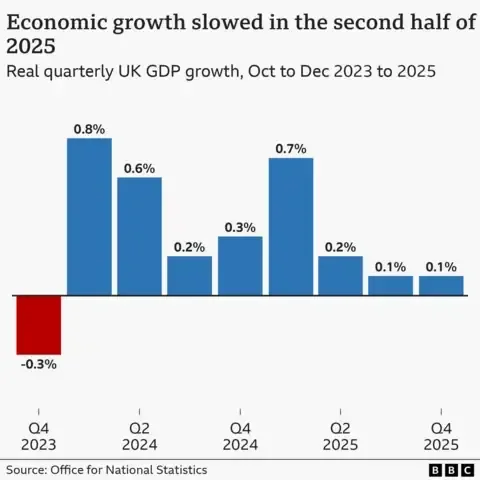
The United Kingdom's economy displayed minimal growth in the final months of 2025, a development that falls short of expert expectations. Figures indicate a 0.1% increase in economic activity, a rate that has persisted across the last three months. This sluggish performance, particularly the notable decline in construction and stagnation in the services sector, presents a significant backdrop as the government prepares its upcoming budget. Business investment appears subdued, and the overall economic picture suggests a considerable lack of momentum.
Economic Landscape: A Closer Look at the Numbers
Office for National Statistics (ONS) data reveals that the UK economy grew by 0.1% in the final quarter of 2025. This figure matched the growth rate observed in the preceding three months, and was less than the 0.2% predicted by many economists.
The dominant services sector reported no growth during this period, a situation not seen for two years.
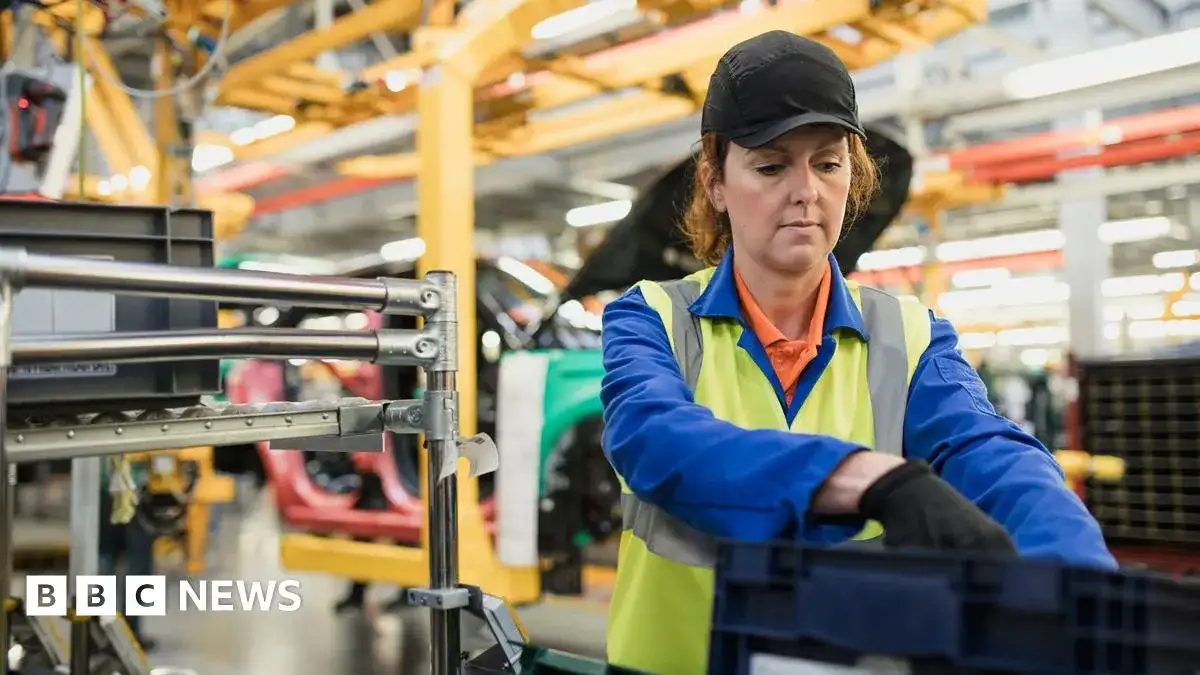
Conversely, the manufacturing sector emerged as a primary driver of the limited expansion.
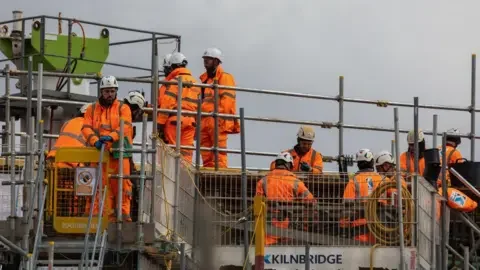
The construction sector recorded its worst performance in over four years.
In September 2025, a monthly shrinkage of the economy was observed, partly attributed to a cyber attack that severely impacted UK car production.
In October 2025, the economy shrank unexpectedly as consumer spending decreased ahead of the government's budget.
Factors Influencing Economic Performance
Several key elements appear to be shaping the UK's economic trajectory.

Business Investment and Consumer Confidence
Is there a discernible link between falling business investment and the broader economic stagnation?
The ONS noted that consumers were hesitant to spend in the lead-up to Chancellor Rachel Reeves's budget, contributing to economic contraction in October. This suggests a cautious approach from households, potentially influenced by upcoming fiscal policies.
Sector-Specific Challenges
The construction sector's significant downturn raises questions about its underlying causes. Was this a temporary setback or indicative of deeper structural issues?
The impact of a cyber attack on car manufacturing, specifically mentioned in relation to September's figures, highlights the vulnerability of key industries to external shocks. The slow recovery of this sector, as seen with Jaguar Land Rover, further exacerbates production challenges.
Government Response and Economic Outlook
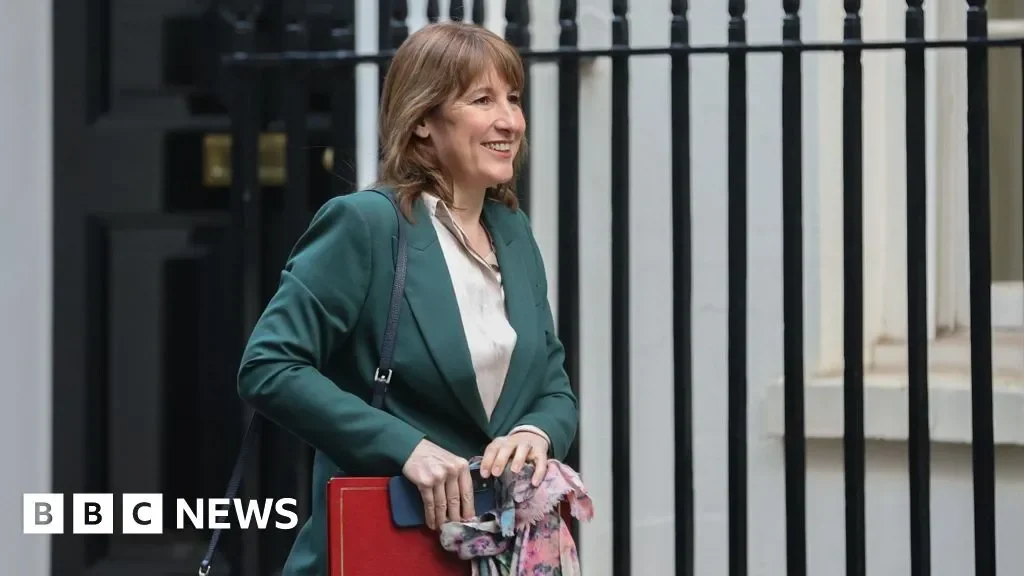
Chancellor Rachel Reeves acknowledged that "there is more to do to build an economy that works for working people," responding to the weak GDP figures. She also stated that government choices had created conditions for the Bank of England to potentially cut interest rates and positioned Britain as the fastest-growing European economy within the G7.
Conversely, Ruth Gregory, deputy UK chief economist at Capital Economics, described the "private sector activity [as] still appears to be extremely subdued."
Sanjay Raja, chief UK economist at Deutsche Bank, indicated that the monthly fall in GDP in October increased the likelihood of a drop in fourth-quarter output.
Andrew Wishart, a senior UK economist at Berenberg, commented, "The UK economy has faltered more dramatically than we expected."
Expert Perspectives on Subdued Growth
Economic analysts offer varying interpretations of the recent economic data.
Read More: Labour Now Says Brexit Hurts UK Economy

The Services Sector's Inertia
The services sector, often a pillar of economic strength, showing "no growth" is a significant signal. While travel agencies and administrative support services performed well, their gains were not enough to offset a broader lack of expansion. This raises questions about the resilience and drivers of growth within the services industry itself.
Manufacturing as a Limited Lifeline
The reliance on manufacturing for the limited growth presents a potential vulnerability. Is this sector's performance sustainable, or is it a temporary surge masking underlying weaknesses elsewhere?
Interest Rate Considerations
The subdued economic outlook and fading inflationary pressures have led economists to suggest that the Bank of England may consider an interest rate cut. This would align with observations of rising unemployment and a faltering economy, as noted by economists like Sanjay Raja.
Conclusion: An Economy in Stasis
The latest economic figures paint a picture of an economy grappling with a lack of momentum. The 0.1% growth rate, coupled with declines in critical sectors like construction and the stagnation of the services industry, suggests a period of significant unease. The impact of external factors, such as the car manufacturing cyber attack, alongside pre-budget consumer caution, have demonstrably affected economic output. While government representatives highlight efforts to foster future growth and potential interest rate adjustments, the overarching sentiment from economic analysts points to a faltering economy. The implications for upcoming policy decisions and the broader public sentiment remain significant as the nation approaches a crucial budget.
Sources:
The Guardian: https://www.theguardian.com/business/2026/feb/12/uk-economy-grows-rachel-reeves-budget-ons-gdp-growth - Article details the ONS figures, sector performance, and expert commentary on subdued private sector activity.
BBC News: https://www.bbc.com/news/articles/c4gjmm7dlggo - Reports on the 0.1% growth, sector performance, and government statements regarding economic policy and international comparisons.
BBC News (Live): https://www.bbc.co.uk/news/live/c87427qpzrpt - Focuses on the slower-than-expected growth, its impact on pre-Budget pressure, and links it to specific events like the car production cyber attack.
The Guardian: https://www.theguardian.com/business/2025/dec/12/uk-economy-shrank-unexpectedly-before-budget-data-shows - Details the unexpected shrinkage in October, consumer spending hesitation, and the potential for a Bank of England interest rate cut.
The Times (AOL): https://www.thetimes.com/business-money/economics/article/uk-economy-news-gdp-latest-khjk2fqmm - Covers the 0.1% growth in November, the expert reaction from the City, and warnings from Rachel Reeves about the time needed for economic improvements.