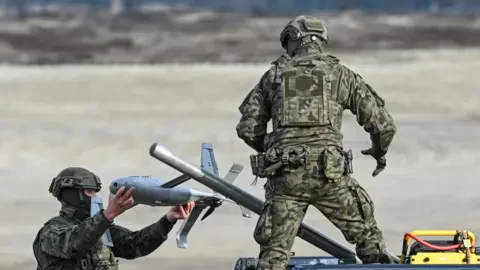
A significant step has been taken in European defence cooperation, with the United Kingdom announcing a joint initiative with France, Germany, Italy, and Poland to develop new air defence weapons. This program, named LEAP (Low-Cost Effectors & Autonomous Platforms), aims to counter the growing threat posed by low-cost drones and autonomous systems, a challenge highlighted by recent conflicts. The initiative seeks to bolster the defensive capabilities of NATO by creating more cost-effective solutions to address increasingly complex aerial threats.

Growing Threat of Low-Cost Drones
The modern battlefield has seen a notable shift with the widespread use of inexpensive drones. These unmanned aerial vehicles, often deployed in large numbers, present a significant challenge to traditional, costly missile defence systems.

Recent conflicts have shown how hundreds of attack drones can be used, overwhelming existing defenses.
The cost disparity between these drones and the systems used to counter them is a major concern, as noted by Poland's defense minister, Władysław Kosiniak-Kamysz, who stated, "We need to make sure that we’re matching the cost of the threats with the cost of defense."
This practical issue was underscored when Russian drones entered Polish airspace in September 2025, requiring the use of multimillion-dollar jets to intercept drones that cost significantly less.
The LEAP Initiative: A Collaborative Response
The LEAP program is designed to address these challenges through shared development and production.

Actors: The United Kingdom has partnered with France, Germany, Italy, and Poland, collectively referred to as the E5 partners.
Objective: To develop and produce low-cost missiles and autonomous drones, as well as drone defence systems.
Inspiration: The initiative draws inspiration from Ukraine's rapid development of a robust domestic drone manufacturing sector since the full-scale invasion by Russia. The United Kingdom is specifically reported to be collaborating with Ukraine on drone development, including a program codenamed Project Octopus.
Timeline: The LEAP initiative was officially launched on Friday, February 20, 2026, during a meeting in Krakow.
"European security is at a pivotal moment. The UK and our E5 partners are stepping up – investing together in the next generation of air defence and autonomous systems to strengthen NATO’s shield and keep our people safe." – Luke Pollard MP, Minister for Defence Readiness and Industry.
Industrial and Strategic Implications
The LEAP initiative signifies a broader trend towards enhanced European defence cooperation and a re-evaluation of defence procurement strategies.
Read More: India's Defence Ministry approves ₹52,000 crore on Friday for new Army and Navy tech

Industrial Cooperation: Manufacturers from the participating nations will be invited to submit plans for building the new systems. This aims to accelerate production and reduce fragmentation across national programs.
Reducing Reliance: The program seeks to reduce reliance on non-European suppliers, fostering a more self-sufficient European defence industry.
EU Support: Ministers welcomed recent European Union measures offering member states greater fiscal flexibility for defence spending, although defence capabilities remain a national responsibility.
NATO Strength: The initiative is framed as a way to make Europe stronger within NATO, reinforcing the alliance's eastern flank.
"Their battlefield effectiveness has prompted European governments to accelerate efforts to expand domestic production and reduce reliance on non-European suppliers." – Article 3 summary.
Autonomous Systems and AI
A key component of the LEAP initiative involves the advancement of autonomous systems, incorporating artificial intelligence.
Autonomous Drones: The program emphasizes boosting the use of autonomous drones that can independently identify targets without direct human control. This was a significant part of a UK military capabilities review unveiled in the summer of last year.
AI Integration: The initiative includes the joint development of drone-based strike capabilities and payloads that use artificial intelligence.
Ukraine's Role and Lessons Learned
Ukraine's experience in the ongoing conflict has been a significant catalyst for this new defence strategy.
Battlefield Proven: The effectiveness of drones, including those used by Ukraine, has prompted European governments to act.
Ukrainian Expertise: The program aims to leverage Ukrainian expertise hard-won over years of war against Russia.
Rapid Development: Ukraine has rapidly developed a substantial domestic drone manufacturing sector since the full-scale invasion four years ago, demonstrating a capacity for swift adaptation and innovation.
"The UK has launched a drone-building programme with Ukraine, codenamed Project Octopus, which will see interceptor drones built in British factories within weeks and deployed to deter Russian aggression. They have already proven effective against Iranian-made Shahed suicide drones… but have a production cost of less than a tenth of their rivals." – Article 7 summary.
Broader European Defence Landscape
The LEAP initiative aligns with broader European efforts to strengthen defence capabilities and adapt to new threats.
EU Action Plan: This initiative complements the European Commission’s action plan on drone and counter-drone security, which focuses on detection, resilience, and industrial capacity within member states. While the Commission's plan primarily addresses civilian internal security, it also supports defence efforts.
Leaked EU Plan: A leaked EU plan outlined a European Drone Defence Initiative aimed at detecting, tracking, and disabling hostile drones, reflecting a wider concern across Europe regarding airspace incursions.
UK Investment: The United Kingdom has also announced significant internal investment, pledging £2 billion to enhance its drone capabilities, aiming to make its army "10 times more lethal." This includes prioritizing cheap, one-way attack craft and reusable systems, as well as establishing a drone knowledge-sharing center.
Expert Analysis
The move signals a pragmatic shift in European defence, recognizing the evolving nature of warfare and the economic realities of modern threats.
"The problem is to be effective at shooting down relatively low-cost missiles, drones, and other threats facing us." – Władysław Kosiniak-Kamysz, Poland’s defense minister. This statement encapsulates the core rationale behind the LEAP initiative: aligning defensive spending with the actual cost of emerging threats. The emphasis on "low-cost effectors" suggests a move away from expensive, high-end systems in favor of scalable, deployable solutions capable of overwhelming or neutralizing swarms of cheaper adversaries. The collaboration with Ukraine is particularly noteworthy, as it signifies a willingness to learn from and integrate the innovative, albeit costly, experiences of a nation actively engaged in conflict.
Conclusion
The establishment of the LEAP initiative marks a significant multilateral commitment to modernizing European air defence. By pooling resources and expertise with France, Germany, Italy, and Poland, the United Kingdom aims to develop cost-effective drone and autonomous system capabilities. This program is a direct response to the escalating threat posed by low-cost drones and is inspired by lessons learned from the conflict in Ukraine. The initiative not only strengthens NATO's eastern flank but also fosters greater industrial cooperation within Europe, seeking to reduce reliance on external suppliers and build a more resilient defence sector. The integration of AI and autonomous technologies signals a forward-looking approach to contemporary security challenges.
Read More: Europe June 2026 heatwave caused 39 percent rise in Belgium deaths
Sources Used
BBC News: UK agrees drone defence plan with four EU allies. https://www.bbc.com/news/articles/c875jj3y475o
UK Government (gov.uk): UK and European allies to develop low-cost air defence weapons to protect NATO skies. https://www.gov.uk/government/news/uk-and-european-allies-to-develop-low-cost-air-defence-weapons-to-protect-nato-skies
The European: European Drone Defence Programme Launched by Five Major Powers. https://the-european.eu/story-57344/europes-leading-defence-powers-launch-joint-drone-and-autonomous-systems-programme.html
Associated Press (via AP News): 5 European nations pledge millions to use Ukrainian know-how to make cheap drone defenses. https://apnews.com/article/e5-poland-drone-defense-military-nato-b00f5c80c312a6b97dcad40a8692db86
European Commission: New plan to counter drone threats. https://commission.europa.eu/news-and-media/news/new-plan-counter-drone-threats-2026-02-11en
LBC: Leaked EU plan outlines new defence strategy to counter Russia - with implications for the UK. https://www.lbc.co.uk/article/leaked-eu-defence-plan-russia-uk-security-implications-5HjdFXw2/
The Telegraph: Britain to build drone wall to protect Europe from Russia. https://www.telegraph.co.uk/news/2025/09/28/britain-build-drone-wall-protect-europe-from-russia/
The Guardian: UK to invest £2bn in drones to make army ‘10 times more lethal’. https://www.theguardian.com/politics/2025/jun/02/uk-to-invest-2bn-in-drones-to-make-army-10-times-more-lethal